Chen Nan, Higashiyama Nicole, Hoyos Valentina
Baylor College of Medicine, Houston, TX 77030, USA.
Lester and Sue Smith Breast Center, Baylor College of Medicine, Houston, TX 77030, USA.
Biomedicines. 2021 Dec 8;9(12):1863. doi: 10.3390/biomedicines9121863.
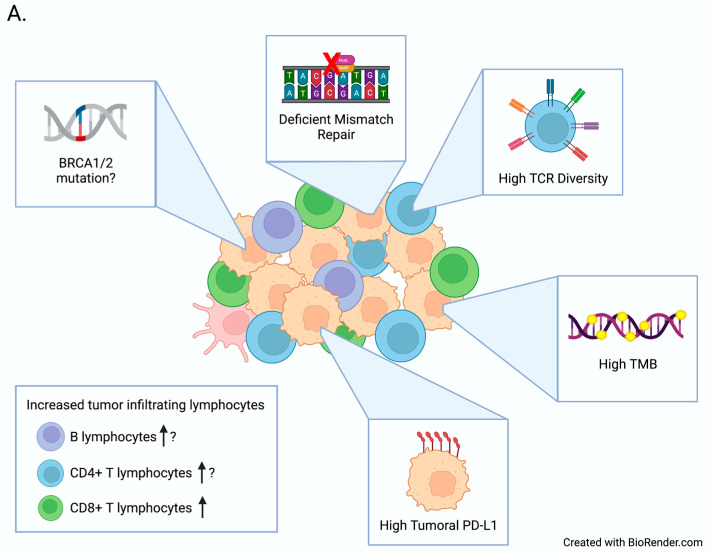
Immune checkpoint inhibitors utilize the immune system to kill cancer cells and are now widely applied across numerous malignancies. Pembrolizumab has two breast-specific indications in triple-negative disease. Currently, programmed death ligand-1 (PD-L1) expression on tumor and surrounding immune cells is the only validated predictive biomarker for immune checkpoint inhibitors (ICIs) in breast cancer; however, it can be imprecise. Additional biomarkers are needed to identify the patient population who will derive the most benefit from these therapies. The tumor immune microenvironment contains many biomarker candidates. In tumor cells, tumor mutational burden has emerged as a robust biomarker across malignancies in general, with higher burden cancers demonstrating improved response, but will need further refinement for less mutated cancers. Preliminary studies suggest that mutations in breast cancer gene 2 () are associated with increased immune infiltration and response to ICI therapy. Other genomic alterations are also being investigated as potential predictive biomarkers. In immune cells, increased quantity of tumor-infiltrating lymphocytes and CD8+ cytotoxic T cells have correlated with response to immunotherapy treatment. The role of other immune cell phenotypes is being investigated. Peripherally, many liquid-based biomarker strategies such as PD-L1 expression on circulating tumor cells and peripheral immune cell quantification are being studied; however, these strategies require further standardization and refinement prior to large-scale testing. Ultimately, multiple biomarkers utilized together may be needed to best identify the appropriate patients for these treatments.
免疫检查点抑制剂利用免疫系统来杀死癌细胞,目前已广泛应用于多种恶性肿瘤。帕博利珠单抗在三阴性疾病中有两种乳腺癌特异性适应症。目前,肿瘤及周围免疫细胞上程序性死亡配体1(PD-L1)的表达是乳腺癌中免疫检查点抑制剂(ICI)唯一经过验证的预测生物标志物;然而,它可能并不精确。需要额外的生物标志物来识别能从这些疗法中获益最大的患者群体。肿瘤免疫微环境包含许多潜在的生物标志物。在肿瘤细胞中,肿瘤突变负荷总体上已成为多种恶性肿瘤中一种可靠的生物标志物,肿瘤突变负荷较高的癌症显示出更好的反应,但对于低突变癌症还需要进一步优化。初步研究表明,乳腺癌基因2()的突变与免疫浸润增加及对ICI治疗的反应相关。其他基因组改变也正在作为潜在的预测生物标志物进行研究。在免疫细胞中,肿瘤浸润淋巴细胞和CD8+细胞毒性T细胞数量的增加与免疫治疗反应相关。其他免疫细胞表型的作用正在研究中。在周围血方面,许多基于液体的生物标志物策略,如循环肿瘤细胞上PD-L1的表达和外周免疫细胞定量分析正在研究中;然而,这些策略在大规模测试之前需要进一步标准化和优化。最终,可能需要一起使用多种生物标志物来最好地识别适合这些治疗的患者。