School of Life and Health Sciences, University of Roehampton, London SW15 4JD, UK.
Department of Biomedical Sciences, University of Cagliari, Monserrato, 09042 Cagliari, Italy.
Molecules. 2021 Dec 10;26(24):7480. doi: 10.3390/molecules26247480.
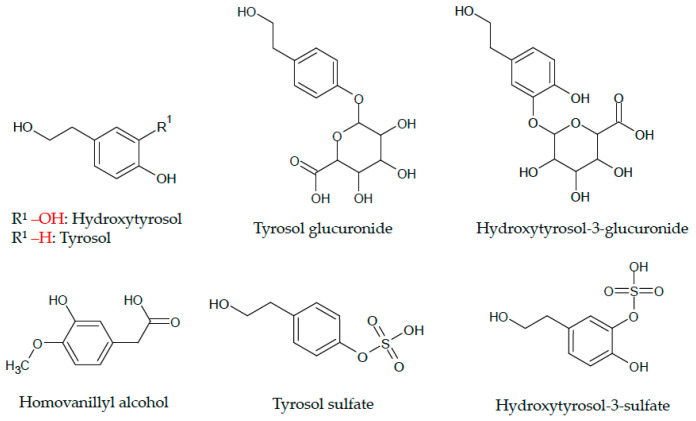
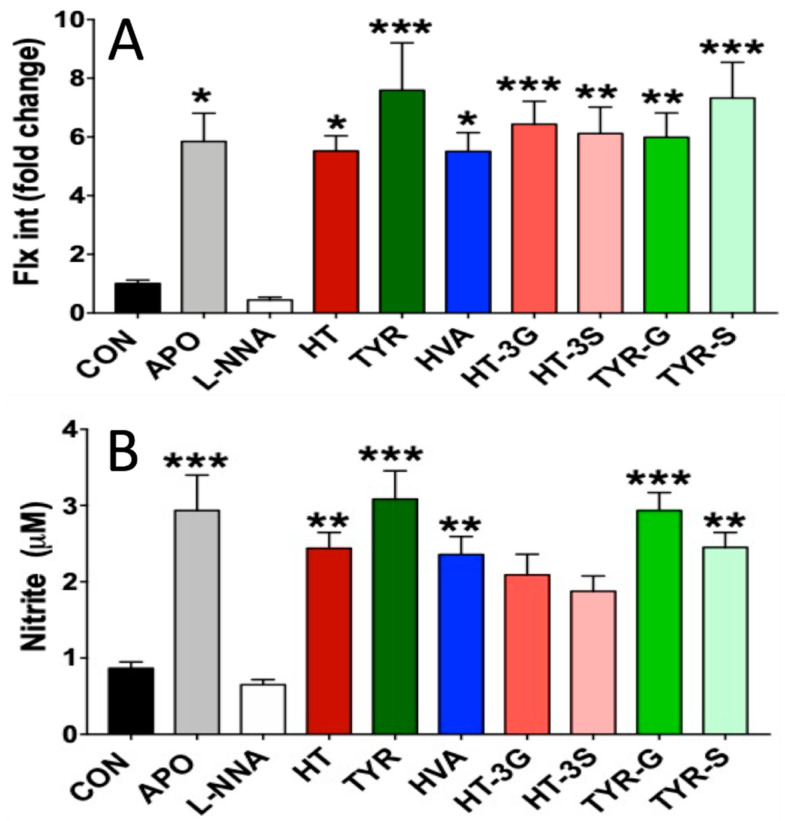
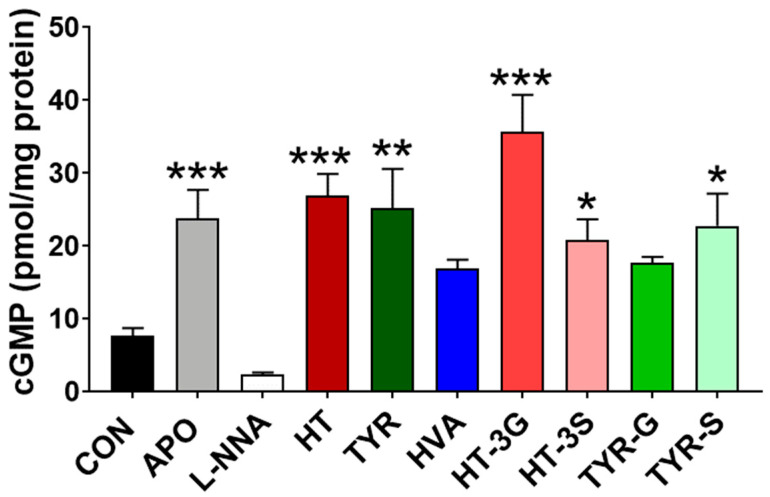
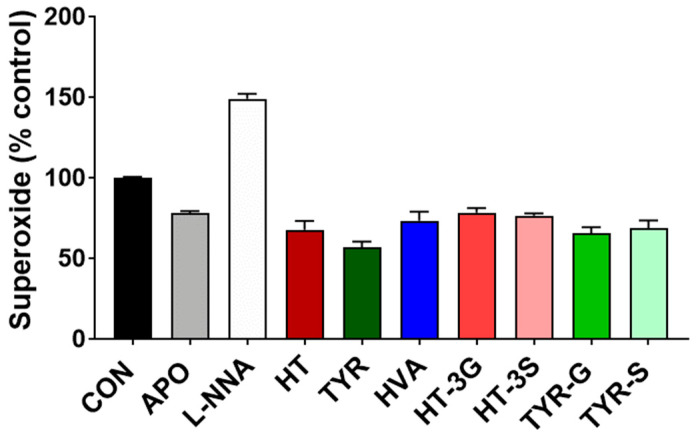
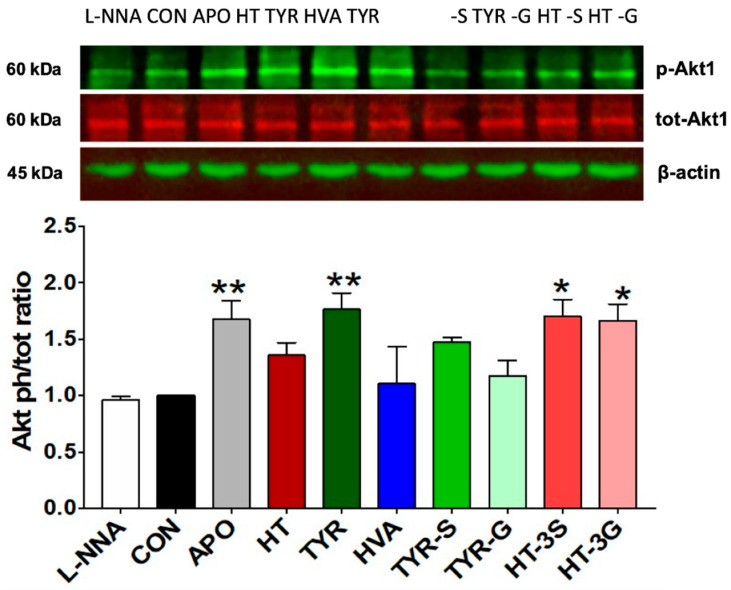
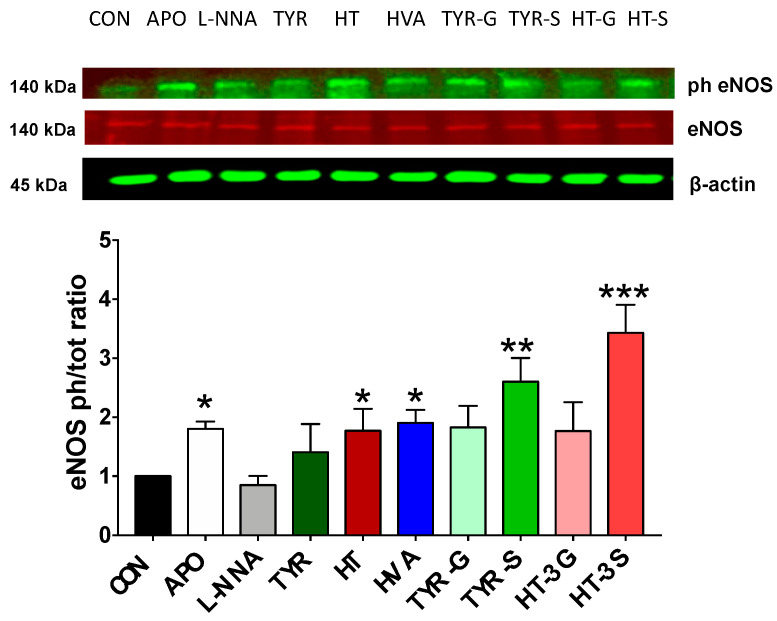
Nitric oxide (NO) is an important signaling molecule involved in many pathophysiological processes. NO mediates vasodilation and blood flow in the arteries, and its action contributes to maintaining vascular homeostasis by inhibiting vascular smooth muscle contraction and growth, platelet aggregation, and leukocyte adhesion to the endothelium. Dietary antioxidants and their metabolites have been found to be directly and/or indirectly involved in the modulation of the intracellular signals that lead to the production of NO. The purpose of this study was to investigate the contribution of conjugated metabolites of hydroxytyrosol (HT) and tyrosol (TYR) to the release of NO at the vascular level, and the related mechanism of action, in comparison to their parental forms. Experiments were performed in human aortic endothelial cells (HAEC) to evaluate the superoxide production, the release of NO and production of cyclic guanosine monophosphate (cGMP), the activation of serine/threonine-protein kinase 1 (Akt1), and the activation state of endothelial nitric oxide synthase (eNOS). It was observed that the tested phenolic compounds enhanced NO and cGMP concentration, inhibiting its depletion caused by superoxide overproduction. Moreover, some of them enhanced the activation of Akt (TYR, HT metabolites) and eNOS (HT, HVA, TYR-S, HT-3S). Overall, the obtained data showed that these compounds promote NO production and availability, suggesting that HT and TYR conjugated metabolites may contribute to the effects of parental extra virgin olive oil (EVOO) phenolics in the prevention of cardiovascular diseases.
一氧化氮(NO)是一种重要的信号分子,参与许多病理生理过程。NO 介导动脉中的血管舒张和血流,其作用通过抑制血管平滑肌收缩和生长、血小板聚集和白细胞黏附在内皮细胞来促进血管稳态。已发现膳食抗氧化剂及其代谢物直接和/或间接地参与调节导致 NO 产生的细胞内信号。本研究旨在探讨羟基酪醇(HT)和酪醇(TYR)的共轭代谢物在血管水平上释放 NO 的贡献及其相关作用机制,与它们的母体形式进行比较。在人主动脉内皮细胞(HAEC)中进行实验,以评估超氧化物的产生、NO 的释放和环鸟苷酸单磷酸(cGMP)的产生、丝氨酸/苏氨酸蛋白激酶 1(Akt1)的激活以及内皮型一氧化氮合酶(eNOS)的激活状态。结果表明,测试的酚类化合物增强了 NO 和 cGMP 的浓度,抑制了超氧化物过度产生导致的其耗竭。此外,其中一些化合物增强了 Akt(TYR、HT 代谢物)和 eNOS(HT、HVA、TYR-S、HT-3S)的激活。总的来说,获得的数据表明这些化合物促进了 NO 的产生和可用性,这表明 HT 和 TYR 共轭代谢物可能有助于母体特级初榨橄榄油(EVOO)酚类化合物预防心血管疾病的作用。