Department of Health Sciences, University Medical Center Groningen, 9713 GZ Groningen, The Netherlands.
Department of Nephrology, University Medical Center Groningen, 9713 GZ Groningen, The Netherlands.
Int J Environ Res Public Health. 2021 Dec 18;18(24):13354. doi: 10.3390/ijerph182413354.
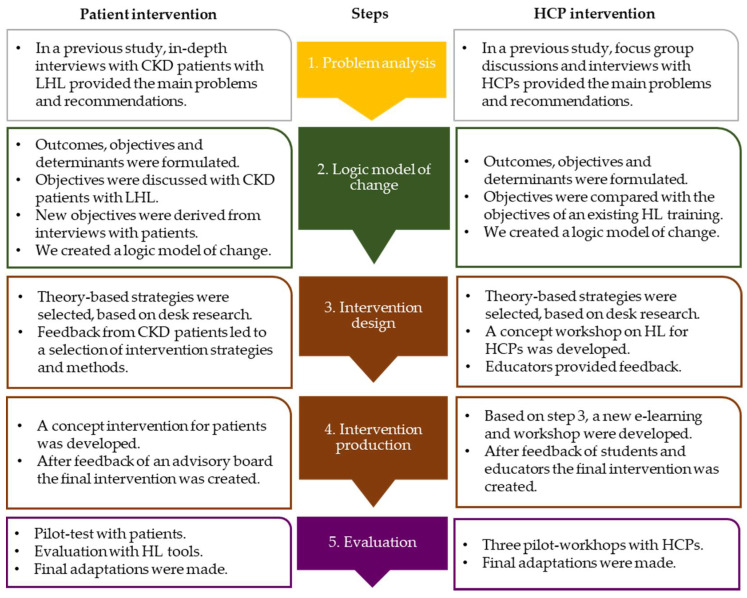
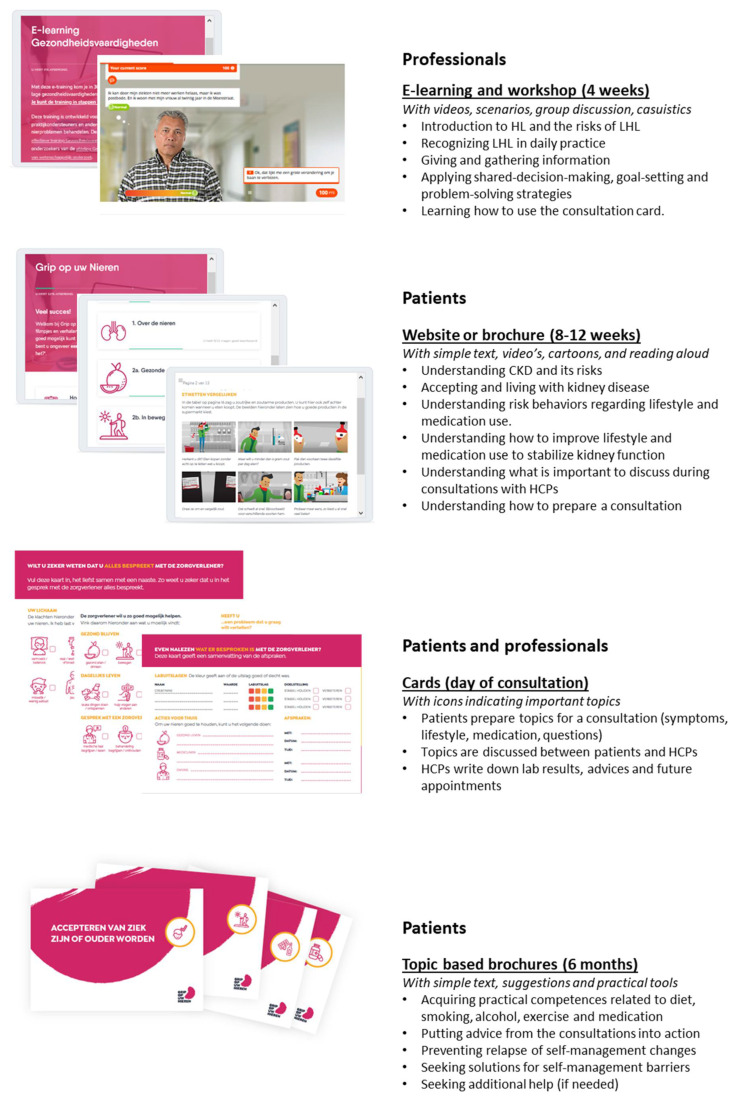
Limited health literacy (LHL) is common in chronic kidney disease (CKD) patients and frequently associated with worse self-management. Multi-component interventions targeted at patients and healthcare professionals (HCPs) are recommended, but evidence is limited. Therefore, this study aims to determine the objectives and strategies of such an intervention, and to develop, produce and evaluate it. For this purpose, we included CKD patients with LHL ( = 19), HCPs ( = 15), educators ( = 3) and students ( = 4) from general practices, nephrology clinics and universities in an Intervention Mapping (IM) process. The determined intervention objectives especially address the patients' competences in maintaining self-management in the long term, and communication competences of patients and HCPs. Patients preferred visual strategies and strategies supporting discussion of needs and barriers during consultations to written and digital strategies. Moreover, they preferred an individual approach to group meetings. We produced a four-component intervention, consisting of a visually attractive website and topic-based brochures, consultation cards for patients, and training on LHL for HCPs. Evaluation revealed that the intervention was useful, comprehensible and fitting for patients' needs. Healthcare organizations need to use visual strategies more in patient education, be careful with digitalization and group meetings, and train HCPs to improve care for patients with LHL. Large-scale research on the effectiveness of similar HL interventions is needed.
健康素养有限(LHL)在慢性肾脏病(CKD)患者中很常见,并且常常与自我管理不善有关。建议针对患者和医疗保健专业人员(HCP)的多组分干预措施,但证据有限。因此,本研究旨在确定此类干预措施的目标和策略,并开发,生产和评估它。为此,我们将来自普通实践,肾脏病诊所和大学的患有 LHL 的 CKD 患者(= 19),HCP(= 15),教育者(= 3)和学生(= 4)纳入干预映射(IM)过程。确定的干预目标特别针对患者在长期内维持自我管理的能力以及患者和 HCP 的沟通能力。患者更喜欢视觉策略和在咨询中支持讨论需求和障碍的策略,而不是书面和数字策略。此外,他们更喜欢针对个人的小组会议。我们制作了一个由四部分组成的干预措施,包括一个具有吸引力的网站和基于主题的小册子,患者咨询卡以及针对 HCP 的 LHL 培训。评估结果表明,该干预措施非常有用,易于理解,并且符合患者的需求。医疗保健组织在患者教育中需要更多地使用视觉策略,小心数字化和小组会议,并培训 HCP 以改善对 LHL 患者的护理。需要对类似 HL 干预措施的有效性进行大规模研究。