Jeong Joonho, Shin Jung Woo, Jung Seok Won, Park Eun Ji, Park Neung Hwa
Department of Internal Medicine, Ulsan University Hospital, University of Ulsan College of Medicine, Ulsan, Korea.
Big-data Center, Ulsan University Hospital, University of Ulsan College of Medicine, Ulsan, Korea.
Clin Mol Hepatol. 2022 Apr;28(2):254-264. doi: 10.3350/cmh.2021.0314. Epub 2021 Dec 28.
BACKGROUND/AIMS: Tenofovir alafenamide (TAF) has shown less favorable effect on lipids compared to tenofovir disoproxil fumarate (TDF) in clinical trials. However, data regarding these outcomes in patients with chronic hepatitis B (CHB) are scarce. Therefore, this study aimed to evaluate the effect of TAF on the lipid in patients with CHB.
A total of 237 TAF-treated CHB patients compared with TDF, inactive CHB, and non-hepatitis B virus (HBV)-infected control groups using propensity score matching (PSM).
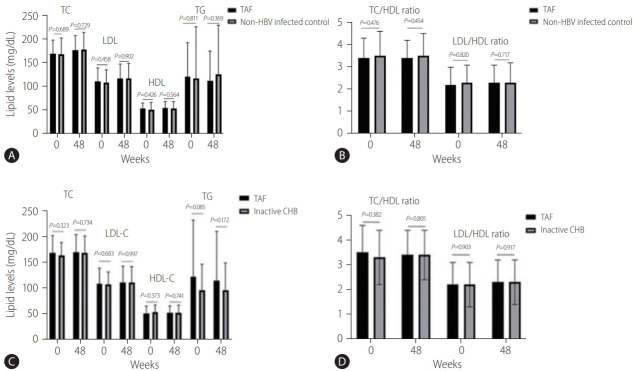
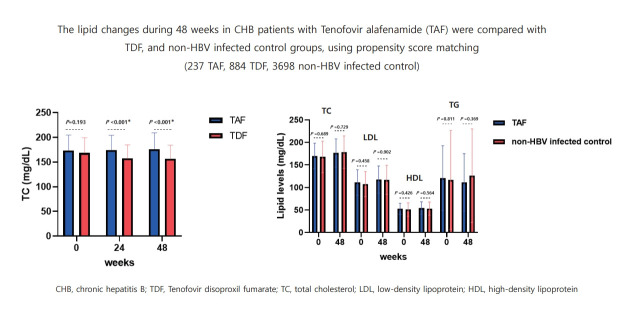
Following PSM, each analysis was conducted on cohorts via the matching of 70:140 (TAF:TDF), 89:89 (TAF:inactive CHB), 140:560 (TAF:non-HBV infected control), and 368:1,472 (TDF:non-HBV-infected control). A significant decrease in the total cholesterol (TC) level was noted at 48 weeks in the TDF group compared to the TAF group (176.3±32.9 vs. 156.7±27.7, P<0.001) and the non-HBV-infected control group (175.0±29.5 vs. 156.2±28.3, P<0.001). However, no significant change in TC was observed in the TAF group and inactive CHB or non-HBV-infected control groups at 48 weeks. For the subgroup analyses of TAF vs. non-HBV-infected control subjects and inactive CHB patients whose detailed lipid profile information were available, no between-group differences in TC, low-density lipoprotein (LDL)-cholesterol, highdensity lipoprotein (HDL)-cholesterol, TC/HDL ratio, and LDL/HDL ratio were observed at 48 weeks.
TDF seems to have a lipid-lowering effect compared to the non-HBV-infected control and TAF-treated groups. However, in real practice, TAF might not worsen the lipid profiles of subjects compared to non-HBV-infected controls and patients with inactive CHB.
背景/目的:在临床试验中,与替诺福韦酯(TDF)相比,丙酚替诺福韦(TAF)对脂质的影响较差。然而,关于慢性乙型肝炎(CHB)患者这些结果的数据很少。因此,本研究旨在评估TAF对CHB患者脂质的影响。
采用倾向评分匹配(PSM)方法,将237例接受TAF治疗的CHB患者与TDF、非活动性CHB和未感染乙型肝炎病毒(HBV)的对照组进行比较。
PSM后,对队列进行了各项分析,匹配比例为70:140(TAF:TDF)、89:89(TAF:非活动性CHB)、140:560(TAF:未感染HBV的对照组)和368:1472(TDF:未感染HBV的对照组)。与TAF组(176.3±32.9 vs. 156.7±27.7,P<0.001)和未感染HBV的对照组(175.0±29.5 vs. 156.2±28.3,P<0.001)相比,TDF组在48周时总胆固醇(TC)水平显著降低。然而,TAF组以及非活动性CHB或未感染HBV的对照组在48周时TC未观察到显著变化。对于可获得详细脂质谱信息的TAF与未感染HBV的对照受试者和非活动性CHB患者的亚组分析,在48周时未观察到组间TC、低密度脂蛋白(LDL)胆固醇、高密度脂蛋白(HDL)胆固醇、TC/HDL比值和LDL/HDL比值的差异。
与未感染HBV的对照组和TAF治疗组相比,TDF似乎具有降脂作用。然而,在实际应用中,与未感染HBV的对照组和非活动性CHB患者相比,TAF可能不会恶化受试者的脂质谱。