Friedrich-Loeffler-Institut, Federal Research Institute for Animal Health, Institute of Infectology, 17493 Greifswald-Insel Riems, Germany.
Leibniz-Centre for Agricultural Landscape Research, 15374 Muencheberg, Germany.
Viruses. 2021 Dec 9;13(12):2463. doi: 10.3390/v13122463.
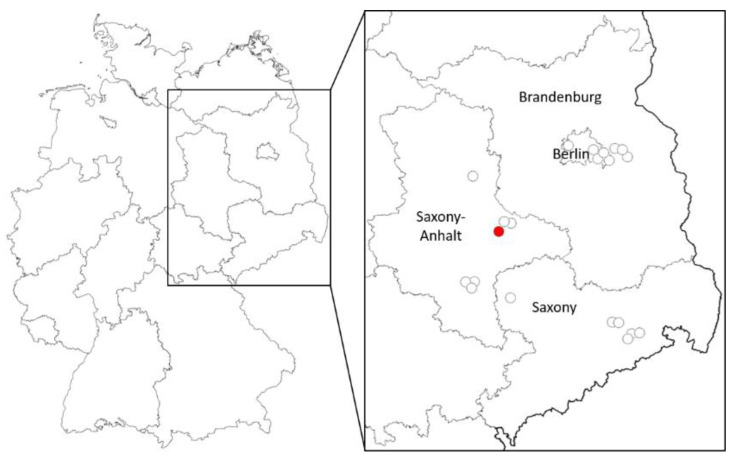
Mosquitoes collected from mid-December 2020 to early March 2021 from hibernacula in northeastern Germany, a region of West Nile virus (WNV) activity since 2018, were examined for WNV-RNA. Among the 6101 mosquitoes tested in 722 pools of up to 12 specimens, one pool of 10 complex mosquitoes collected in early March 2021 in the cellar of a medieval castle in Rosslau, federal state of Saxony-Anhalt, tested positive. Subsequent mosquito DNA analysis produced biotype . The pool homogenate remaining after nucleic acid extraction failed to grow the virus on Vero and C6/36 cells. Sequencing of the viral coding region, however, demonstrated high homology with virus strains previously collected in Germany, e.g., from humans, birds, and mosquitoes, which have been designated the East German WNV clade. The finding confirms the expectation that WNV can overwinter in mosquitoes in Germany, facilitating an early start to the natural transmission season in the subsequent year. On the other hand, the calculated low infection prevalence of 0.016-0.20%, depending on whether one or twelve of the mosquitoes in the positive pool was/were infected, indicates a slow epidemic progress and mirrors the still-hypoendemic situation in Germany. In any case, local overwintering of the virus in mosquitoes suggests its long-term persistence and an enduring public health issue.
2020 年 12 月中旬至 2021 年 3 月初,从德国东北部的冬眠地采集了蚊子,该地区自 2018 年以来一直存在西尼罗河病毒(WNV)活动。对这些蚊子进行了 WNV-RNA 检测。在对 722 个最多包含 12 个样本的蚊池中进行的 6101 次测试中,有一个 10 只混合蚊的蚊池于 2021 年 3 月初在萨克森-安哈尔特州罗斯拉尔的一座中世纪城堡的地窖中检测呈阳性。随后的蚊子 DNA 分析产生了 生物型 。在从核酸提取中剩余的蚊池匀浆未能在 Vero 和 C6/36 细胞中培养病毒。然而,对病毒 编码区 的测序表明,与德国以前收集的病毒株,例如从人类、鸟类和蚊子中分离出的病毒株具有高度同源性,这些病毒株被指定为东德 WNV 分支。这一发现证实了人们的预期,即 WNV 可以在德国的蚊子中越冬,从而促进次年自然传播季节的提前开始。另一方面,根据阳性池中感染的蚊子数量(为 1 只或 12 只)计算出的低感染率(0.016-0.20%)表明流行速度缓慢,反映了德国仍然处于低流行状态。无论如何,病毒在蚊子中的本地越冬表明其长期存在,并构成持久的公共卫生问题。