Florey Institute of Neuroscience and Mental Health, Parkville, Australia.
Florey Department of Neuroscience and Mental Health, University of Melbourne, Parkville, Australia.
Pharmacol Res Perspect. 2022 Feb;10(1):e00907. doi: 10.1002/prp2.907.
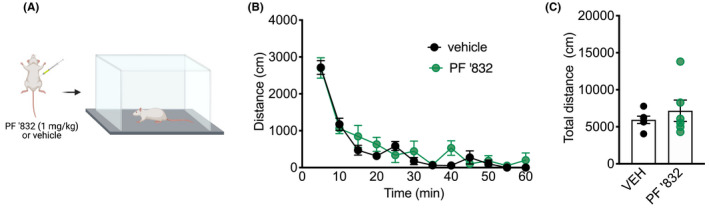
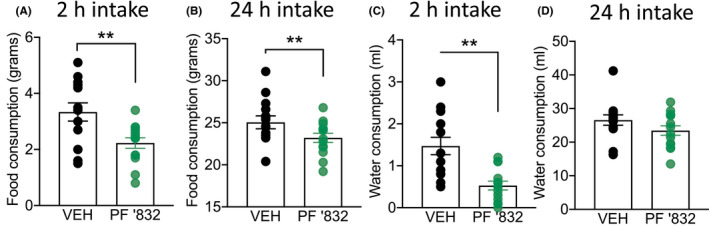
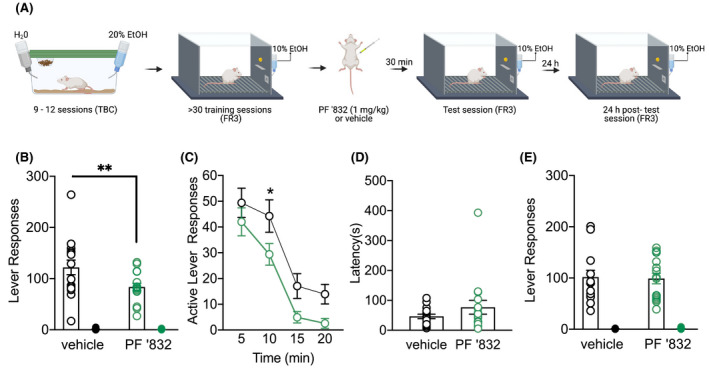
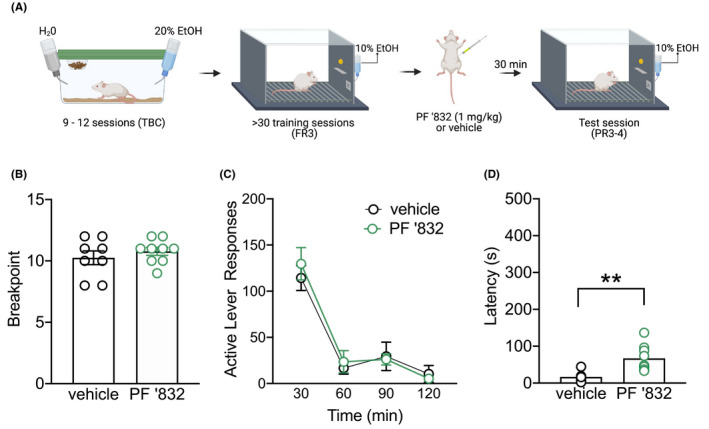
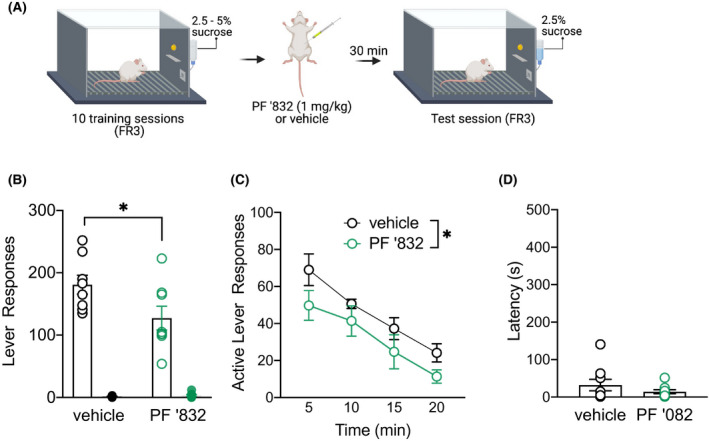
Muscarinic acetylcholine receptors (mAChRs) have been shown to mediate alcohol consumption and seeking. Both M and M mAChRs have been highlighted as potential novel treatment targets for alcohol use disorders (AUD). Similarly, M mAChRs are expressed throughout reward circuitry, and their signaling has been implicated in cocaine consumption. However, whether the same effects are seen for alcohol consumption, or whether natural reward intake is inadvertently impacted is still unknown. To determine the role of M mAChRs in alcohol consumption, we tested operant self-administration of alcohol under both fixed ratio (FR3) and progressive ratio (PR3-4) schedules. Enhancing M mAChR signaling (via the M PAM-Agonist PF-06767832, 1 mg/kg, i.p.) reduced operant alcohol consumption on a fixed schedule but had no effect on motivation to acquire alcohol. To determine whether these actions were specific to alcohol, we examined the effects of M enhancement on natural reward (sucrose) self-administration. Systemic administration of PF-06767832 (1 mg/kg, i.p.) also reduced operant sucrose self-administration, suggesting the actions of the M receptor may be non-selective across drug and natural rewards. Finally, to understand whether this reduction extended to natural consummatory behaviors, we assessed home cage standard chow and water consumption. M enhancement via systemic PF-06767832 administration reduced food and water consumption. Together our results suggest the M PAM-agonist, PF-06767832, non-specifically reduces consummatory behaviors that are not associated with motivational strength for the reward. These data highlight the need to further characterize M agonists, PAMs, and PAM-agonists, which may have varying degrees of utility in the treatment of neuropsychiatric disorders including AUD.
毒蕈碱型乙酰胆碱受体(mAChRs)已被证明可介导酒精摄入和寻求。M 和 M mAChRs 都被突出为酒精使用障碍(AUD)的潜在新型治疗靶点。同样,M mAChRs 在整个奖励回路中表达,并且它们的信号转导已被牵连到可卡因的消耗中。然而,是否会看到相同的效果,或者是否无意中影响了自然奖励摄入,仍然未知。为了确定 M mAChRs 在酒精摄入中的作用,我们在固定比率(FR3)和逐步比率(PR3-4)方案下测试了操作性自我给药的酒精。增强 M mAChR 信号(通过 M PAM-Agonist PF-06767832,1mg/kg,ip)减少了固定方案下的操作性酒精消耗,但对获取酒精的动机没有影响。为了确定这些作用是否特定于酒精,我们研究了 M 增强对自然奖励(蔗糖)自我给药的影响。PF-06767832 的全身给药(1mg/kg,ip)也减少了操作性蔗糖自我给药,这表明 M 受体的作用可能在药物和自然奖励之间没有选择性。最后,为了了解这种减少是否扩展到自然消费行为,我们评估了家庭笼标准饲料和水的消耗。通过全身 PF-06767832 给药增强 M 减少了食物和水的消耗。总的来说,我们的结果表明,M PAM-agonist PF-06767832 非特异性地减少了与奖励的动机强度无关的消费行为。这些数据强调了需要进一步表征 M 激动剂、PAMs 和 PAM-agonists,它们在治疗包括 AUD 在内的神经精神疾病方面可能具有不同程度的效用。