School of Pharmaceutical Sciences, Guangzhou University of Chinese Medicine, Guangzhou, China.
Institute: Guangxi Scientific Experimental Center of Traditional Chinese Medicine, Guangxi University of Chinese Medicine, Nanning, China.
Pharm Biol. 2022 Dec;60(1):108-118. doi: 10.1080/13880209.2021.2017981.
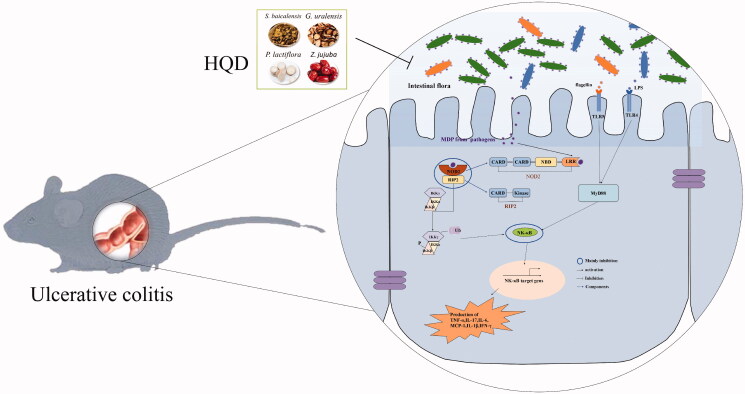
Chinese herb Huangqin decoction (HQD) can regulate intestinal flora in ulcerative colitis (UC) mice.
Our study clarifies the mechanism of HQD in regulating the intestinal flora of UC mice.
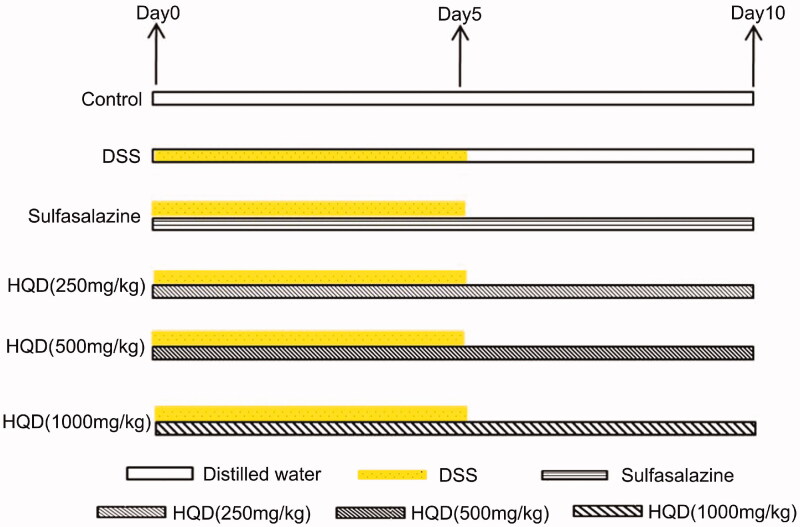
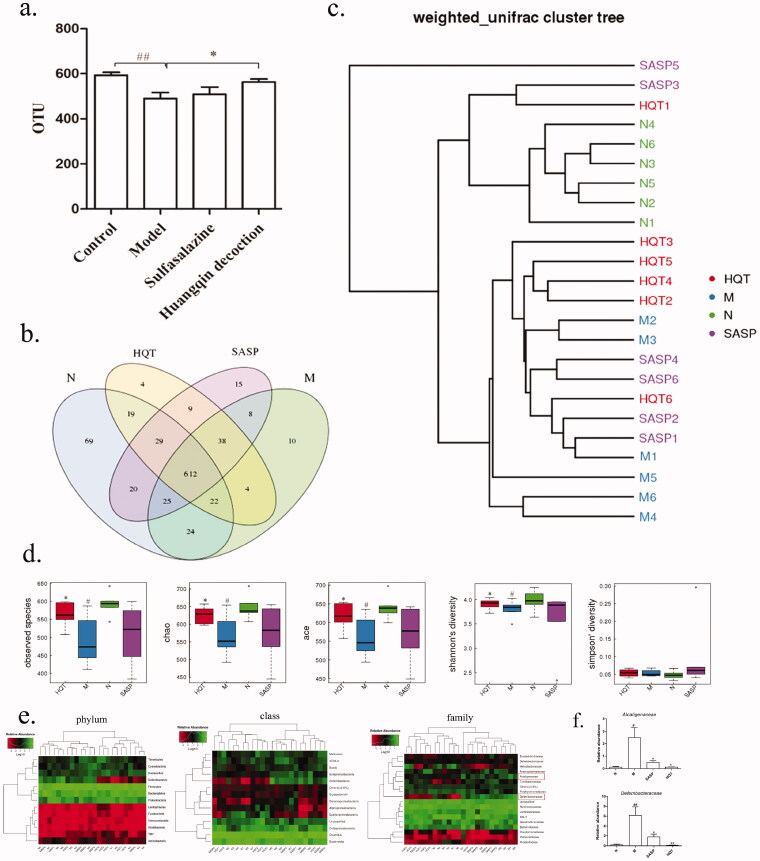
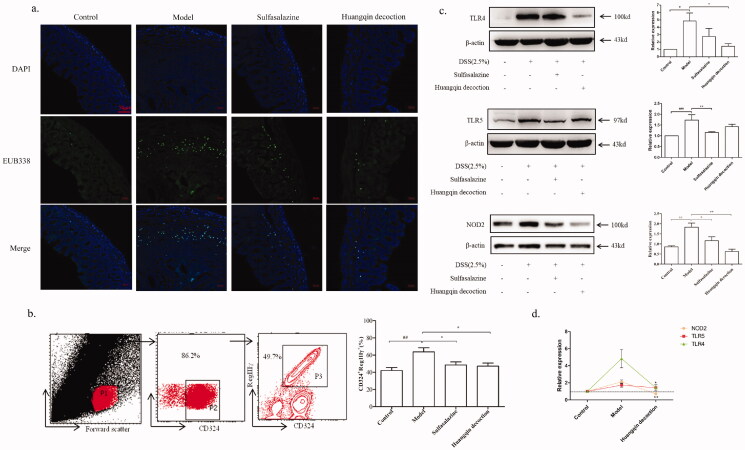
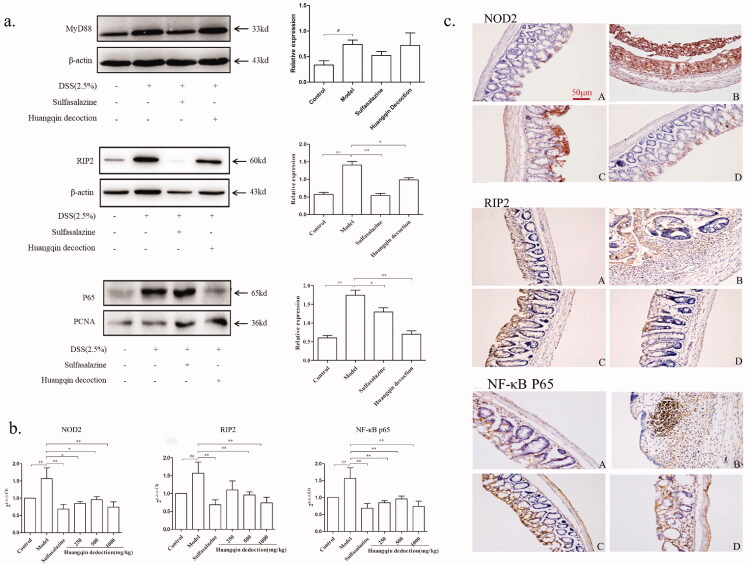
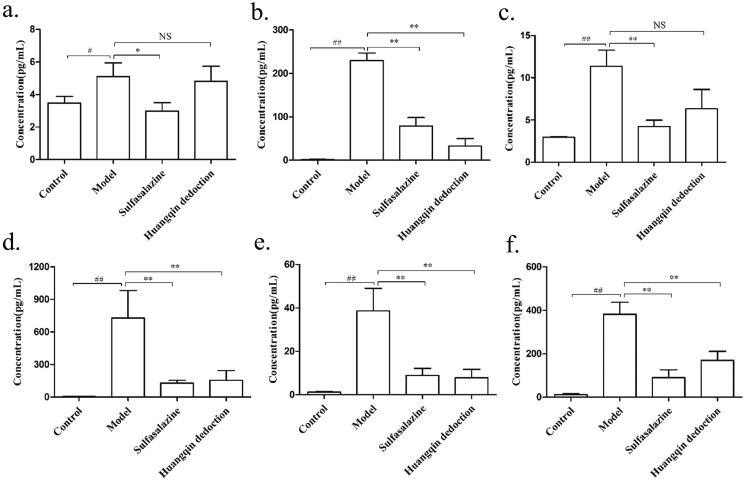
Male C57BL/6 mice were randomly divided into six groups: Control, Model (3% DSS), Sulfasalazine (500 mg/kg), HQD-L (250 mg/kg), HQD-M (500 mg/kg), and HQD-H (1000 mg/kg) groups. Measurement of body weight, colon length, DAI, and haematoxylin-eosin staining were conducted. FISH and 16S rDNA detected colonic bacterial infiltration and intestinal flora changes. The expression of RegIIIγ and PRRs (NOD2, TLR5, TLR4) were detected by FCM and WB, respectively. In addition, WB, qPCR, or IHC were used to detect the expression of NOD2, MyD88, RIP2, and NF-κB p65 in the colon. ELISA was used to determine cytokines.
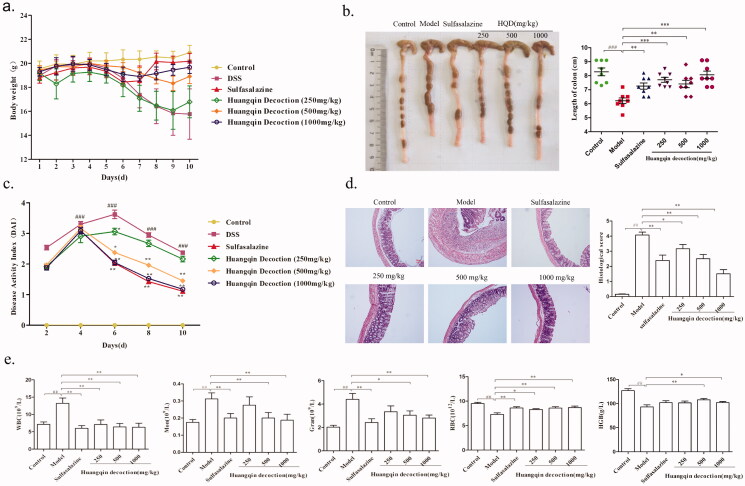
Compared with the model group (DAI score, 2.38 ± 0.05; histological score, 4.08 ± 0.54), HQD treatment significantly reduced the DAI score (L, 2.16 ± 0.09; M, 1.45 ± 0.05; H, 1.18 ± 0.05) and histological score (L, 3.16 ± 0.82; M, 2.50 ± 0.81; H, 1.51 ± 0.76); restored the weight, the colonic length ( < 0.05). 16S rDNA identification showed HQD regulated the balance of intestinal flora. Moreover, HQD suppressed the expression of RegIIIγ ( < 0.05) and prevented colonic bacterial infiltration. Furthermore, WB results showed NOD2, and TLR4 were inhibited by HQD, especially NOD2 ( < 0.01). The data of WB, qPCR, and IHC demonstrated that the NOD2-dependent pathway was inhibited by HQD ( < 0.01).
HQD (1000 mg/kg) regulates the intestinal flora of colitis mice, mainly characterized as inhibition of the NOD2-dependent pathway. These results indicate that HQD has potential.
中药黄芩汤(HQD)可调节溃疡性结肠炎(UC)小鼠的肠道菌群。
本研究阐明 HQD 调节 UC 小鼠肠道菌群的机制。
雄性 C57BL/6 小鼠随机分为六组:对照组、模型组(3%DSS)、柳氮磺胺吡啶(500mg/kg)、HQD-L(250mg/kg)、HQD-M(500mg/kg)和 HQD-H(1000mg/kg)组。测量体重、结肠长度、DAI 和苏木精-伊红染色。FISH 和 16S rDNA 检测结肠细菌浸润和肠道菌群变化。FCM 和 WB 检测 RegIIIγ 和 PRRs(NOD2、TLR5、TLR4)的表达。此外,WB、qPCR 或 IHC 用于检测结肠中 NOD2、MyD88、RIP2 和 NF-κB p65 的表达。ELISA 用于测定细胞因子。
与模型组(DAI 评分 2.38±0.05;组织学评分 4.08±0.54)相比,HQD 治疗显著降低 DAI 评分(L 组 2.16±0.09;M 组 1.45±0.05;H 组 1.18±0.05)和组织学评分(L 组 3.16±0.82;M 组 2.50±0.81;H 组 1.51±0.76);恢复体重、结肠长度(<0.05)。16S rDNA 鉴定表明 HQD 调节肠道菌群平衡。此外,HQD 抑制 RegIIIγ 的表达(<0.05)并防止结肠细菌浸润。此外,WB 结果表明 HQD 抑制 NOD2 和 TLR4,尤其是 NOD2(<0.01)。WB、qPCR 和 IHC 的数据表明 HQD 抑制 NOD2 依赖途径(<0.01)。
HQD(1000mg/kg)调节结肠炎小鼠的肠道菌群,主要表现为抑制 NOD2 依赖途径。这些结果表明 HQD 具有潜力。