Crean College of Health and Behavioral Sciences, Chapman University, Orange, CA, USA.
School of Kinesiology, Western University, London, ON, Canada.
Body Image. 2022 Mar;40:182-199. doi: 10.1016/j.bodyim.2021.12.012. Epub 2021 Dec 28.
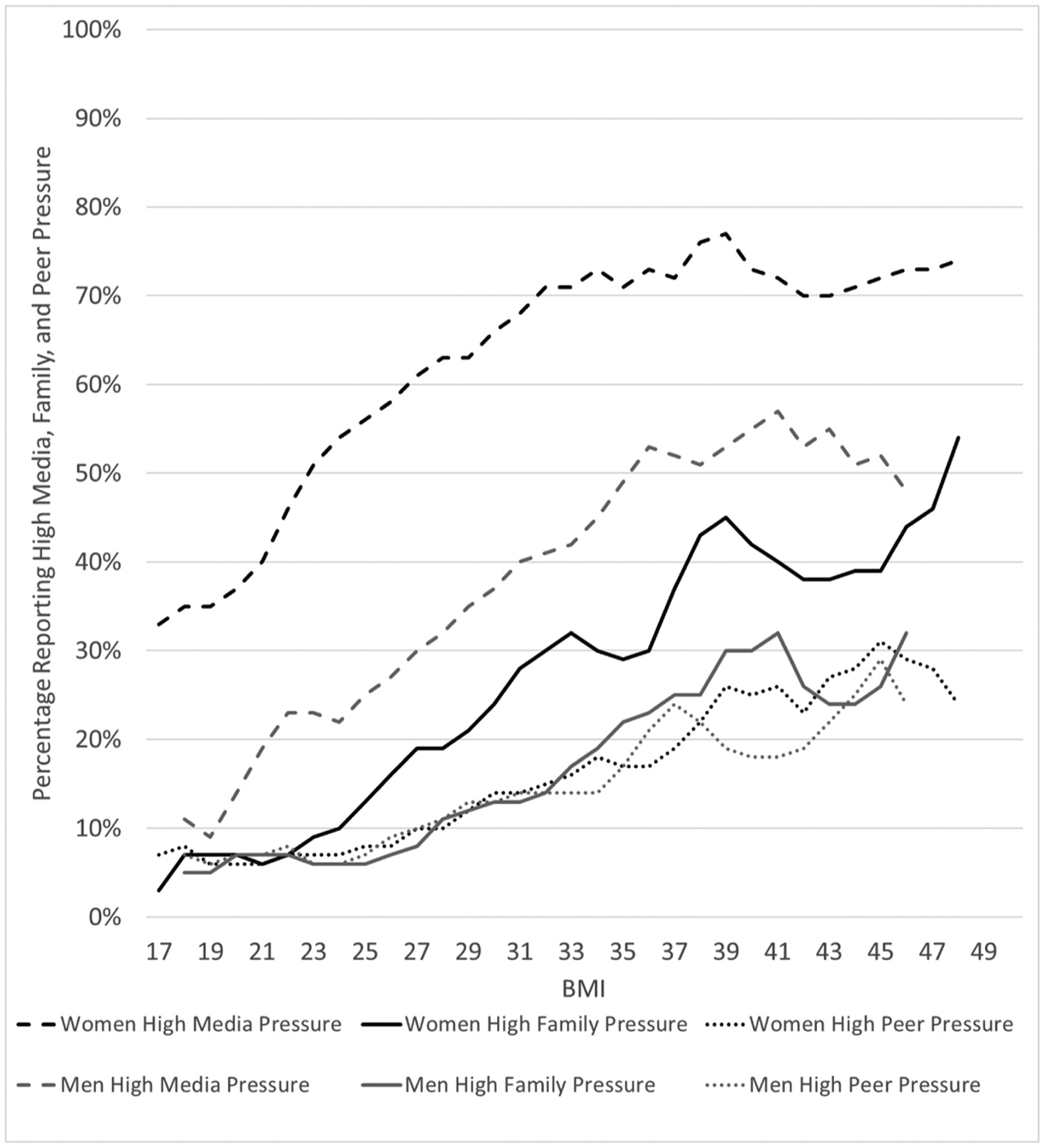
We examined how demographic factors (gender, sexual orientation, racial group, age, body mass) were linked to measures of sociocultural appearance concerns derived from objectification theory and the tripartite influence model (McKinley & Hyde, 1996; Schaefer et al., 2015) among 11,620 adults. Men were less likely than women to report high body surveillance, thin-ideal internalization, appearance-related media pressures, and family pressures; did not differ in peer pressures; and reported greater muscle/athletic internalization. Both men and women expressed greater desire for their bodies to look "very lean" than to look "very thin". Compared to gay men, heterosexual men reported lower body surveillance, thin-ideal internalization, peer pressures, and media pressures. Black women reported lower thin-ideal internalization than White, Hispanic, and Asian women, whereas Asian women reported greater family pressures. Being younger and having higher BMIs were associated with greater sociocultural appearance concerns across most measures. The variation in prevalence of sociocultural appearance concerns across these demographic groups highlights the need for interventions.
我们研究了人口统计学因素(性别、性取向、种族、年龄、体重指数)与从客体化理论和三方影响模型(McKinley 和 Hyde,1996;Schaefer 等人,2015)中得出的社会文化外貌关注措施之间的关系,研究对象为 11620 名成年人。男性比女性更不可能报告高身体监控、瘦理想内化、与外貌相关的媒体压力和家庭压力;在同伴压力方面没有差异;并且报告了更大的肌肉/运动内化。男性和女性都表示更希望自己的身体看起来“非常瘦”,而不是“非常瘦”。与男同性恋者相比,异性恋男性报告的身体监控、瘦理想内化、同伴压力和媒体压力较低。与白人、西班牙裔和亚裔女性相比,黑人女性的瘦理想内化程度较低,而亚裔女性的家庭压力较大。年龄较小和 BMI 较高与大多数指标的社会文化外貌关注增加有关。这些人口统计学群体中社会文化外貌关注的流行率的差异突出表明需要进行干预。