Domai Fleurette M, Agrupis Kristal An, Han Su Myat, Sayo Ana Ria, Ramirez Janine S, Nepomuceno Raphael, Suzuki Shuichi, Villanueva Annavi Marie G, Salva Eumelia P, Villarama Jose Benito, Ariyoshi Koya, Mulholland Kim, Palla Luigi, Takahashi Kensuke, Smith Chris, Miranda Edna
School of Tropical Medicine and Global Health, Nagasaki University, Japan, 852-8523.
San Lazaro Hospital-Nagasaki University Collaborative Research Office, Manila, Philippines.
Lancet Reg Health West Pac. 2021 Dec 15;19:100334. doi: 10.1016/j.lanwpc.2021.100334. eCollection 2022 Feb.
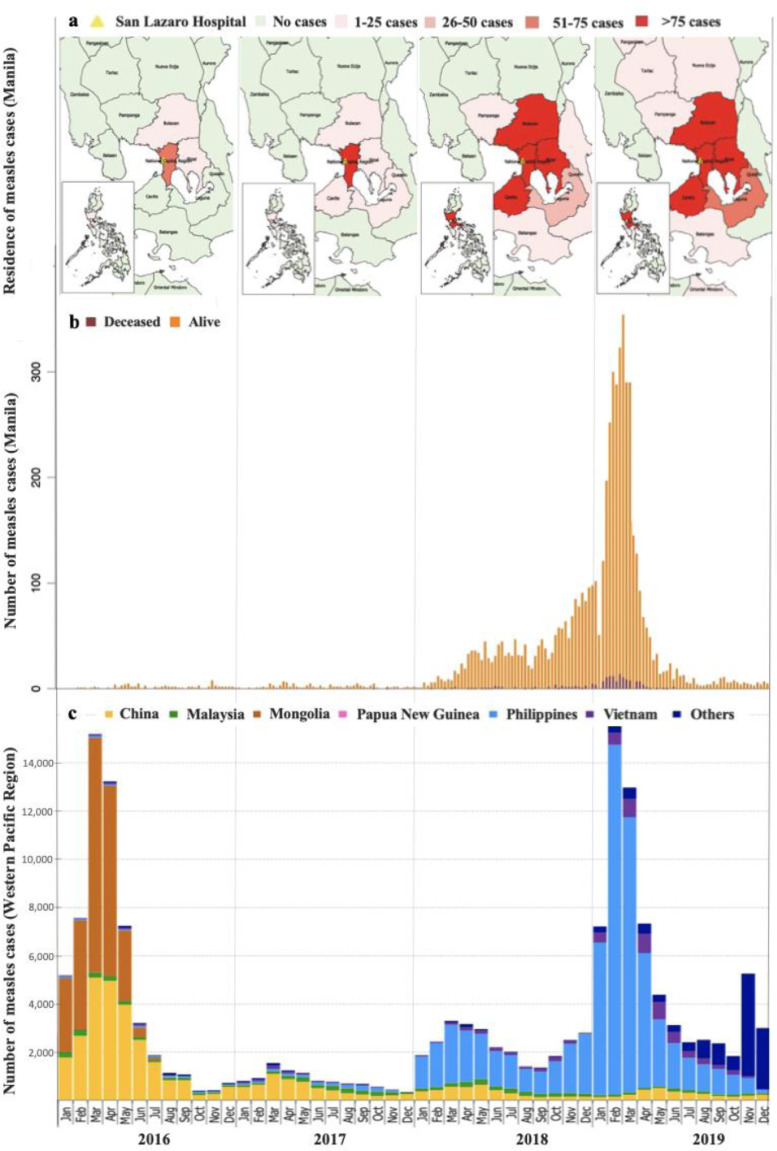
Measles outbreaks increased worldwide during 2017-19. The largest outbreak in the World Health Organisation Western Pacific region occurred in the Philippines where first-dose measles-containing vaccine (MCV1) coverage had reduced to 75% in 2018. The aim of this study was to summarise paediatric measles admissions to the national infectious diseases referral hospital in Manila during 2016 to 2019.
A retrospective single-centre observational study including 5,562 children aged under five years admitted with measles from January 2016 to December 2019. We summarised sociodemographic and clinical characteristics, vaccine status, reported exposures, and outcomes. Univariable and multivariable logistic regression analyses were undertaken to assess associations between different characteristics of hospitalised children and death.
The median age of children hospitalised with measles was 11 months (interquartile range: 7-28). 84·5% of cases were reported not to have received any MCV. The risk of mortality was 3·2%, with 41% of deaths occurring among children aged less than 9 months. No children died who had received two MCV. The following characteristics were significantly associated with mortality in the multivariable analysis: age group, residence outside of the national capital region, not having received any MCV, duration between onset of fever and hospital admission of 7-14 days compared with 0-3 days, not receiving vitamin A supplementation, having pneumonia, and gastroenteritis.
The Philippines remains at risk of future measles epidemics. Routine immunization needs to be strengthened and earlier timing of MCV1 requires further evaluation to reduce measles incidence and mortality.
2017 - 2019年期间,全球麻疹疫情有所增加。世界卫生组织西太平洋区域最大的疫情爆发发生在菲律宾,2018年该国含麻疹成分首剂疫苗(MCV1)接种率降至75%。本研究的目的是总结2016年至2019年期间马尼拉国立传染病转诊医院收治的小儿麻疹病例情况。
一项回顾性单中心观察性研究,纳入了2016年1月至2019年12月期间收治的5562名5岁以下麻疹患儿。我们总结了社会人口统计学和临床特征、疫苗接种状况、报告的暴露情况及转归。采用单变量和多变量逻辑回归分析来评估住院儿童不同特征与死亡之间的关联。
麻疹住院患儿的中位年龄为11个月(四分位间距:7 - 28个月)。84.5%的病例报告未接种任何含麻疹成分疫苗。死亡率为3.2%,41%的死亡发生在9个月以下儿童中。接种过两剂含麻疹成分疫苗的儿童无死亡病例。多变量分析中,以下特征与死亡率显著相关:年龄组、首都地区以外的居住地、未接种任何含麻疹成分疫苗、发热至入院时间为7 - 14天(而不是0 - 3天)、未补充维生素A、患有肺炎和肠胃炎。
菲律宾未来仍有麻疹流行的风险。需要加强常规免疫,MCV1的更早接种时机需要进一步评估,以降低麻疹发病率和死亡率。