Kang Young-Joon, Baek Jong Min, Kim Yong-Seok, Jeon Ye Won, Yoo Tae-Kyung, Rhu Jiyoung, Shin Chang-Hyun, Cho Shijin, Choi Hoon, Oh Se Jeong
Department of Surgery, Incheon St. Mary's Hospital, College of Medicine, The Catholic University of Korea, Incheon, Korea.
Department of Surgery, Yeouido St. Mary's Hospital, College of Medicine, The Catholic University of Korea, Seoul, Korea.
J Breast Cancer. 2021 Dec;24(6):491-503. doi: 10.4048/jbc.2021.24.e55.
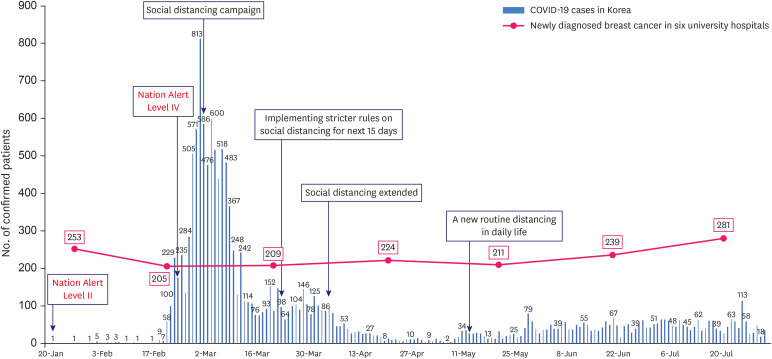
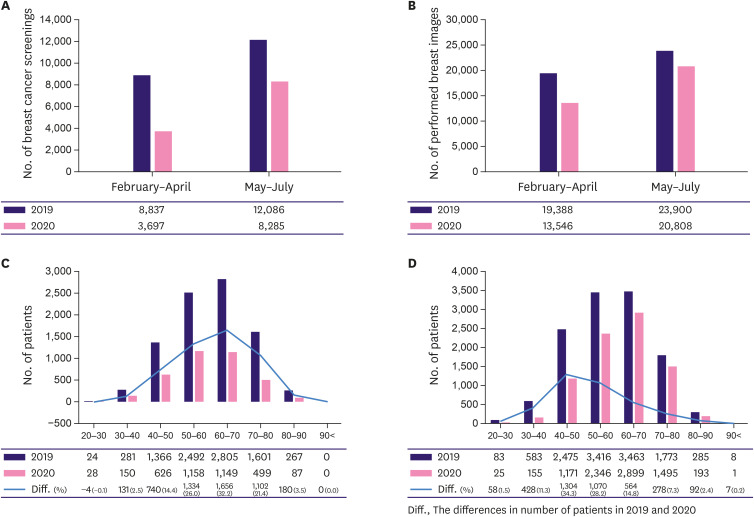
The coronavirus disease 2019 (COVID-19) pandemic has significantly impacted the rates of screening, case identification, and referral for cancer diagnosis. We investigated the diagnosis and surgery status of breast cancer before and after the COVID-19 pandemic at a multi-institutional level.
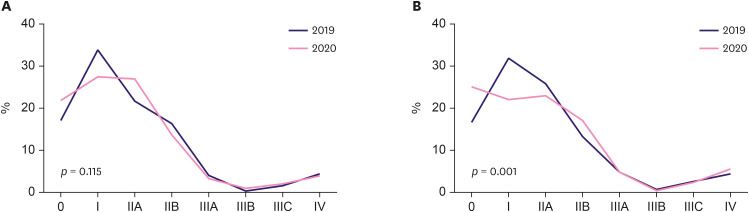
We collected breast cancer data from the clinical data warehouse which contained the medical records of patients from six academic institutions in South Korea. Patients were divided into two groups: February to April (period A) and May to July (period B). The data from the two groups were then compared against the same periods in 2019 and 2020. The primary objective was to investigate the differences in breast cancer stages before and after the COVID-19 pandemic.
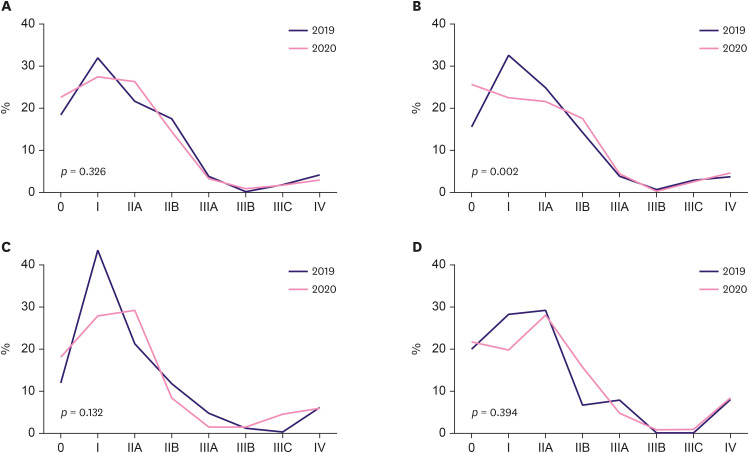
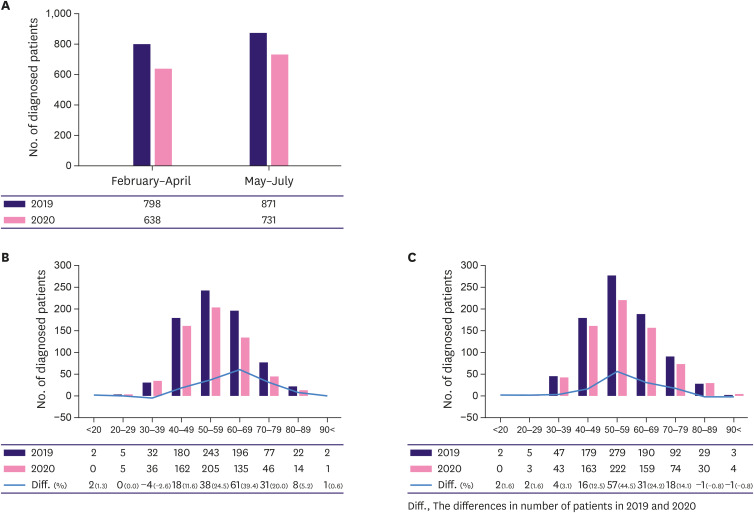
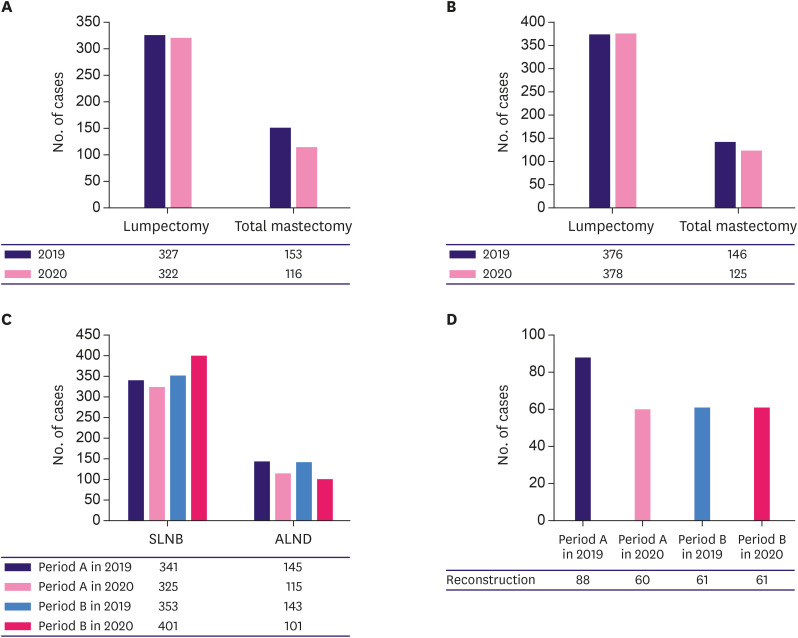
Among 3,038 patients, there was a 9.9% reduction in the number of diagnoses in 2020. This decrease was more significant during period A than period B. The breast cancer stage was not statistically different in period A ( = 0.115), but it was in period B ( = 0.001). In the subset analysis according to age, there was a statistical difference between 2019 and 2020 in period B for patients under the age of 65 years ( = 0.002), but no difference was observed in the other groups.
The number of breast cancer cases declined during the pandemic, and the staging distribution has changed after the pandemic peak.
2019年冠状病毒病(COVID-19)大流行对癌症诊断的筛查率、病例识别率和转诊率产生了重大影响。我们在多机构层面调查了COVID-19大流行前后乳腺癌的诊断和手术状况。
我们从临床数据仓库收集了乳腺癌数据,该仓库包含韩国六家学术机构患者的病历。患者分为两组:2月至4月(A期)和5月至7月(B期)。然后将两组数据与2019年和2020年的同期数据进行比较。主要目的是调查COVID-19大流行前后乳腺癌分期的差异。
在3038例患者中,2020年的诊断数量减少了9.9%。A期的减少幅度比B期更大。A期的乳腺癌分期无统计学差异(P = 0.115),但B期有统计学差异(P = 0.001)。在按年龄进行的亚组分析中,65岁以下患者在B期的2019年和2020年之间存在统计学差异(P = 0.002),但其他组未观察到差异。
大流行期间乳腺癌病例数下降,大流行高峰后分期分布发生了变化。