Division of Geriatric Medicine, Department of Clinical Medicine, University of Turku, Turku, Finland.
Research, Development and Innovation Center, Tampere University Hospital, Tampere, Finland.
Aging Clin Exp Res. 2022 Jun;34(6):1407-1418. doi: 10.1007/s40520-021-02046-z. Epub 2022 Jan 4.
Incontinence and hip fractures are common in older people, especially women, and associated with multiple adverse effects. Incontinence is a risk factor for falls.
We aimed to investigate the prevalence of urinary (UI) and double incontinence (DI, concurrent UI and faecal incontinence), and to identify factors associated with UI and DI 6 months post-fracture.
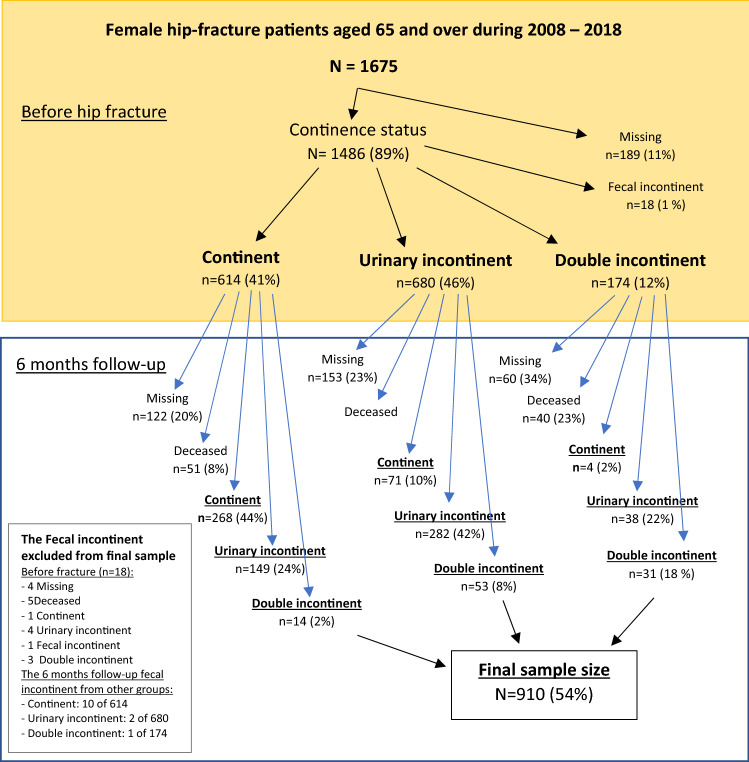
A prospective real-life cohort study was conducted consisting of 910 women aged ≥ 65 who were treated for their first hip fracture in Seinäjoki Central Hospital, Finland, between May 2008 and April 2018. Continence status was elicited at baseline and 6 months postoperatively at our geriatric outpatient clinic where all participants underwent a multidisciplinary comprehensive geriatric assessment (CGA) consisting of an evaluation of cognition, nutrition, mood, mobility, and functional ability.
At baseline, 47% of the patients were continent, 45% had UI and 8% had DI, and at follow up, 38%, 52%, and 11%, respectively. The mean age of the patients was 82.7 ± 6.8. Both UI and DI were associated with functional disability and other factors related to frailty. The associations were particularly prominent for patients with DI who also had the worst performance in the domains of CGA. We identified several modifiable risk factors: depressive mood (odds ratio [OR] 1.81; 95% confidence interval [CI] 1.16-2.84) and constipation (OR 1.48, 95% CI 1.02-2.13) associated with UI and, late removal of urinary catheter (OR 2.33, 95% CI 1.31-4.14), impaired mobility (OR 2.08, 95% CI 1.05-4.15), and poor nutrition (OR 2.31, 95% CI 1.11-4.79) associated with DI.
This study demonstrates a high prevalence of UI and DI in older women with hip fracture and modifiable risk factors, which should be targeted in orthogeriatric management and secondary falls prevention. Patients with DI were found to be an especially vulnerable group.
尿失禁和髋部骨折在老年人中很常见,尤其是女性,且与多种不良后果相关。尿失禁是跌倒的一个风险因素。
我们旨在调查尿失禁(UI)和双重失禁(DI,同时存在尿失禁和粪便失禁)的患病率,并确定与骨折后 6 个月时 UI 和 DI 相关的因素。
进行了一项前瞻性真实队列研究,纳入了 910 名年龄≥65 岁的女性,她们于 2008 年 5 月至 2018 年 4 月在芬兰塞纳约基中央医院接受了首次髋部骨折治疗。在我们的老年门诊诊所,在基线和术后 6 个月时评估了患者的尿失禁状况,所有患者均接受了多学科全面老年评估(CGA),包括认知、营养、情绪、活动能力和功能能力评估。
基线时,47%的患者尿失禁,45%的患者有尿失禁,8%的患者有双重失禁,随访时分别为 38%、52%和 11%。患者的平均年龄为 82.7±6.8 岁。UI 和 DI 均与功能障碍和其他与虚弱相关的因素相关。对于同时存在 DI 的患者,这些关联更为显著,他们在 CGA 各领域的表现也最差。我们确定了几个可改变的危险因素:抑郁情绪(比值比 [OR] 1.81;95%置信区间 [CI] 1.16-2.84)和便秘(OR 1.48,95% CI 1.02-2.13)与 UI 相关,而导尿管延迟拔除(OR 2.33,95% CI 1.31-4.14)、活动能力受损(OR 2.08,95% CI 1.05-4.15)和营养状况不佳(OR 2.31,95% CI 1.11-4.79)与 DI 相关。
本研究表明,髋部骨折的老年女性中 UI 和 DI 的患病率较高,存在可改变的危险因素,应在矫形老年医学管理和继发性跌倒预防中加以关注。患有 DI 的患者是一个特别脆弱的群体。