Murphy Erin S, Dhall Girish, Fangusaro Jason, Bartels Ute, Fouladi Maryam, Shaw Dennis, Khatua Soumen, Hughes Chris Williams, Panigraphy Ashok, Ioakeim-Ioannidou Myrsini, Souweidane Mark, Morris David, Gajjar Amar, Wu Shengjie, Onar-Thomas Arzu, Haas-Kogan Daphne A, MacDonald Shannon M
Department of Radiation Oncology, Taussig Cancer Institute, Cleveland Clinic, Cleveland, Ohio.
UAB Division of Pediatric Hematology, Oncology, and Blood & Marrow Transplantation, Children's of Alabama at University of Alabama at Birmingham, Birmingham, Alabama.
Int J Radiat Oncol Biol Phys. 2022 May 1;113(1):143-151. doi: 10.1016/j.ijrobp.2021.12.166. Epub 2022 Jan 4.
Children's Oncology Group study ACNS1123 tested the efficacy of reduced dose and field of radiation therapy (RT) for patients with localized nongerminomatous germ cell tumors (NGGCT) who achieved a complete (CR) or partial response (PR) to chemotherapy. Here, we evaluate the quality of RT and patterns of failure for patients eligible for reduced RT in this phase 2 trial.
Patients with localized NGGCT with CR/PR after induction chemotherapy received reduced RT to 30.6 Gy whole ventricular irradiation and 54 Gy tumor-bed total dose. An atlas was provided to assist with complex RT volumes. Early interventional review was performed for the initial RT plan. Complete RT plans for all patients and images of relapsed patients were centrally reviewed at completion of therapy.
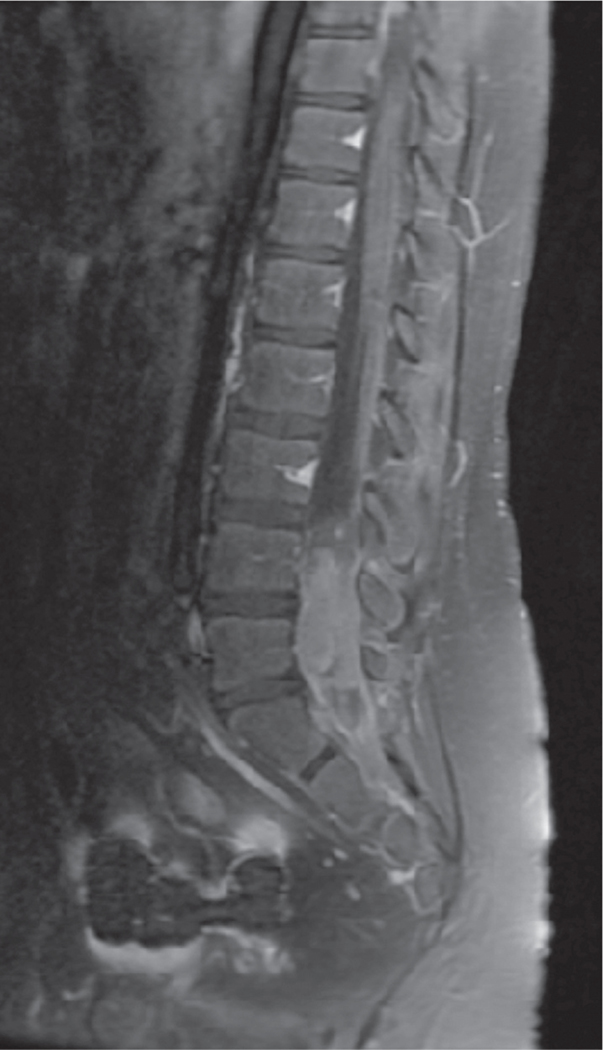
Between May 2012 and September 2016, 107 eligible patients were enrolled and 66 achieved a CR/PR after induction chemotherapy (± second-look surgery) and were eligible for reduced RT. Median follow-up was 4.4 years. Median age was 11.0 years (3.7-21.6), and 75% were male. Progression-free survival and overall survival at 4 years were 87.9% ± 4.0% and 92.4% ± 3.3% for 66 evaluable patients, respectively. Eight patients relapsed: 6 with isolated spinal relapse and 2 with disease in the brain and spine. After central review, 62 (94%) patients had RT targets contoured and dose delivered per protocol. None of the patients with deviations (n = 4) have progressed.
Patterns of failure suggest the spine is at risk for recurrence for patients with localized NGGCT who receive reduced RT after a CR/PR to induction chemotherapy. Although survival data are encouraging, the pattern of failure has influenced the next prospective trial design. RT compliance was excellent despite complexity of radiation volumes, suggesting that providing visual guidance in the form of an online atlas contributes to higher quality RT plans.
儿童肿瘤研究组的ACNS1123研究对局部非生殖细胞性生殖细胞瘤(NGGCT)患者在对化疗取得完全缓解(CR)或部分缓解(PR)后采用减少剂量和照射野的放射治疗(RT)的疗效进行了测试。在此,我们评估了在这项2期试验中符合减少放疗条件的患者的放疗质量和失败模式。
诱导化疗后达到CR/PR的局部NGGCT患者接受减少剂量的放疗,全脑室照射剂量为30.6 Gy,瘤床总剂量为54 Gy。提供了一个图谱以辅助确定复杂的放疗靶区。对初始放疗计划进行早期干预审查。在治疗结束时对所有患者的完整放疗计划和复发患者的影像进行集中审查。
2012年5月至2016年9月期间,107例符合条件的患者入组,66例在诱导化疗(±二次探查手术)后达到CR/PR并符合减少放疗的条件。中位随访时间为4.4年。中位年龄为11.0岁(3.7 - 21.6岁),75%为男性。66例可评估患者4年无进展生存率和总生存率分别为87.9%±4.0%和92.4%±3.3%。8例患者复发:6例为孤立性脊柱复发,2例为脑和脊柱疾病复发。经过集中审查,62例(94%)患者的放疗靶区勾画和剂量给予符合方案。4例有偏差的患者均未进展。
失败模式表明,对于诱导化疗后达到CR/PR并接受减少放疗的局部NGGCT患者,脊柱有复发风险。尽管生存数据令人鼓舞,但失败模式影响了下一项前瞻性试验的设计。尽管放疗靶区复杂,但放疗依从性良好,这表明以在线图谱形式提供视觉指导有助于制定更高质量的放疗计划。