Department of Paleontology and Geology, Hungarian Natural History Museum, Ludovika tér 2, Budapest, 1083, Hungary.
Department of Palaeontology, Institute of Geography and Earth Sciences, ELTE Eötvös Loránd University, Pázmány Péter sétány 1/C, Budapest, 1117, Hungary.
Sci Rep. 2022 Jan 7;12(1):24. doi: 10.1038/s41598-021-03573-5.
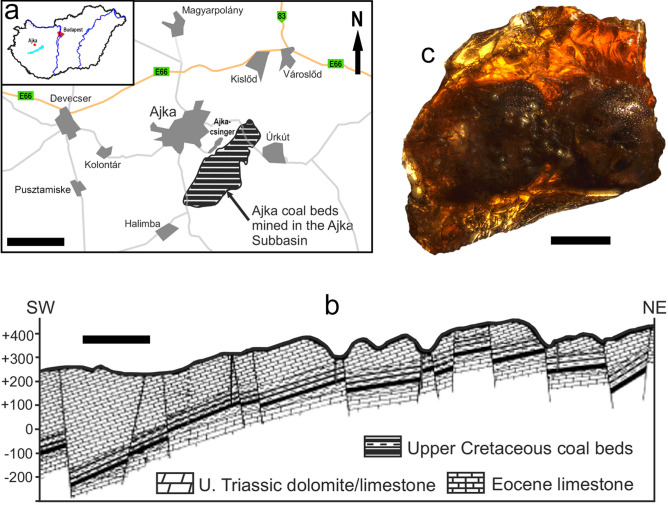
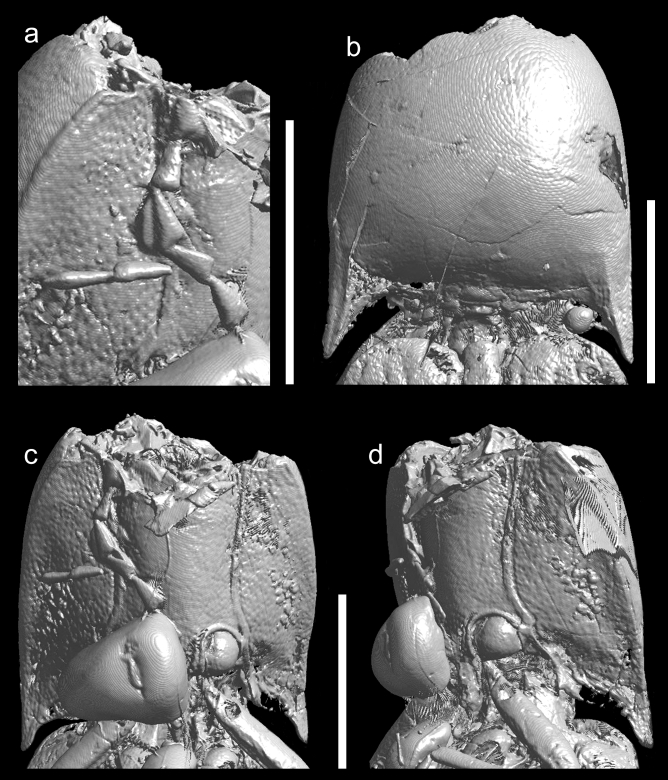
Fossil bioinclusions in amber are invaluable source of information on the past evolution and diversity of various organisms, as well as on the paleoecosystems in general. The click-beetles, Elateridae, which originated and greatly diversified during the Mesozoic, are mostly known from the adpression-like fossils, and their diversity in the Cretaceous ambers is only poorly documented. In this study, we describe a new click-beetle based on an incomplete inclusion in ajkaite, an Upper Cretaceous (Santonian) amber from the Ajka Coal Formation from Hungary. We used X-ray micro-computed tomography scanning to reconstruct its morphology because it is deposited in an opaque piece of amber. Our results suggest that the newly described Ajkaelater merkli gen. et sp. nov. belongs to subfamily Elaterinae. It represents the first Mesozoic beetle reported from Hungary, and the first Mesozoic Elateridae formally described from mainland Europe. Our discovery supports an Eurasian distribution and diversification of Elaterinae already in the Cretaceous. The paleoenvironment of the Ajka Coal Formation agrees well with the presumed habitat preference of the new fossil taxon. The discovery of a presumably saproxylic click-beetle shed further light on the yet poorly known paleoecosystem of the Santonian present-day western Hungary.
琥珀中的化石生物包埋体是了解过去各种生物的进化和多样性以及古生态系统的宝贵信息来源。起源于中生代并经历了巨大多样化的叩甲科(Elateridae),主要以压痕化石的形式为人所知,而其在白垩纪琥珀中的多样性记录则很少。在这项研究中,我们基于匈牙利 Ajka 煤形成的上白垩统(Santonian)琥珀中的 ajkaite 中一个不完整的包埋体描述了一种新的叩甲。我们使用 X 射线微计算机断层扫描技术来重建其形态,因为它被保存在一块不透明的琥珀中。我们的结果表明,新描述的 Ajkaelater merkli gen. et sp. nov. 属于叩甲亚科(Elaterinae)。它代表了在匈牙利发现的第一只中生代甲虫,也是欧洲大陆首次正式描述的中生代叩甲科。我们的发现支持了叩甲亚科在白垩纪已经在欧亚大陆分布和多样化。Ajka 煤形成的古环境与新化石类群假定的栖息地偏好相吻合。发现一只假定的腐木性叩甲,进一步揭示了现今匈牙利西部 Santonian 时期尚未被充分了解的古生态系统。