Division of Hematology, Respiratory Medicine and Oncology, Department of Internal Medicine, Faculty of Medicine, Saga University, 5-1-1 Nabeshima, Saga, 849-8501, Japan.
Department of Clinical Laboratory Medicine, Faculty of Medicine, Saga University, 5-1-1 Nabeshima, Saga, 849-8501, Japan.
Cell Oncol (Dordr). 2022 Feb;45(1):121-134. doi: 10.1007/s13402-021-00656-3. Epub 2022 Jan 8.
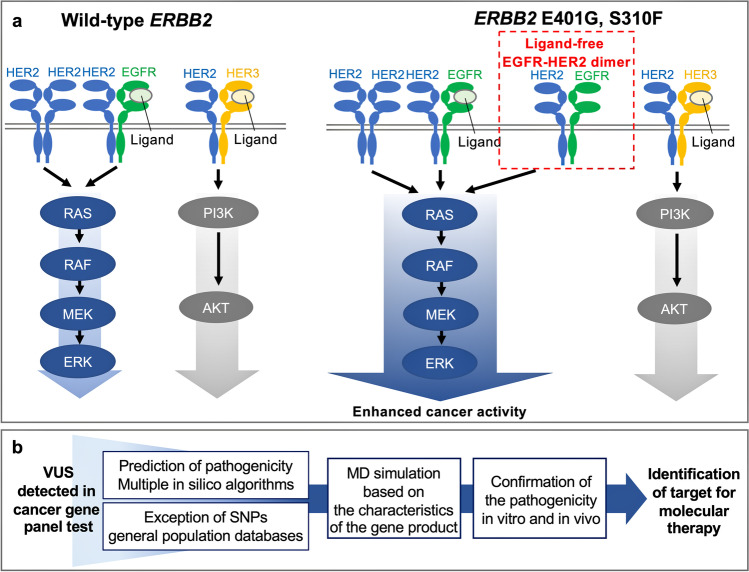
Dealing with variants of unknown significance (VUS) is an important issue in the clinical application of NGS-based cancer gene panel tests. We detected a novel ERBB2 extracellular domain VUS, c.1157A > G p.(E401G), in a cancer gene panel test. Since the mechanisms of activation by ERBB2 extracellular domain (ECD) variants are not fully understood, we aimed to clarify those mechanisms and the biological functions of ERBB2 E401G.
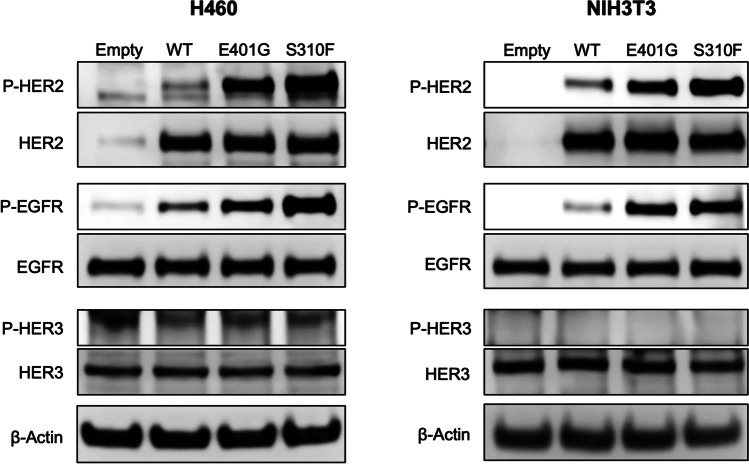
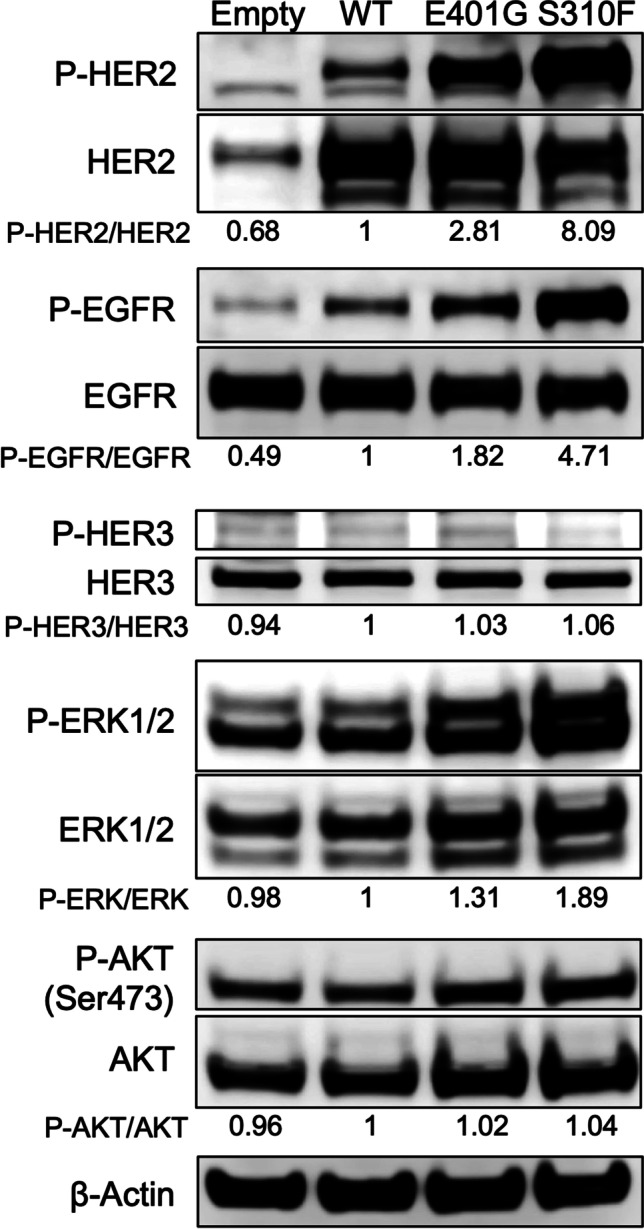
ERBB2 E401G was selected as VUS for analysis because multiple software tools predicted its pathogenicity. We prepared ERBB2 expression vectors with the E401G variant as well as vectors with S310F and E321G, which are known to be activating mutations. On the basis of wild-type ERBB2 or mutant ERBB2 expression in cell lines without ERBB2 amplification or variants, we evaluated the phosphorylation of human epidermal growth factor receptor 2 and related proteins, and investigated with molecular dynamics (MD) simulation the mechanisms conferred by the variants. The biological effects of ERBB2 E401G were also investigated, both in vitro and in vivo.
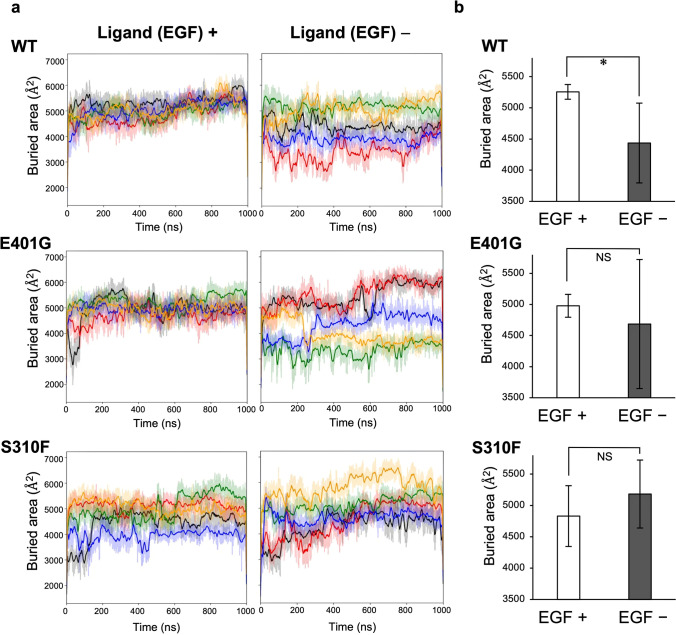
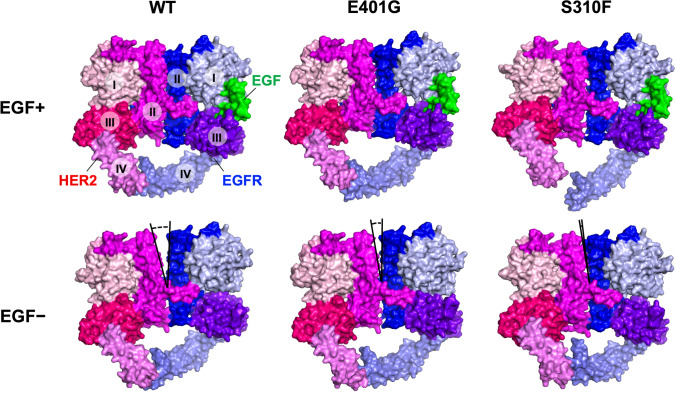
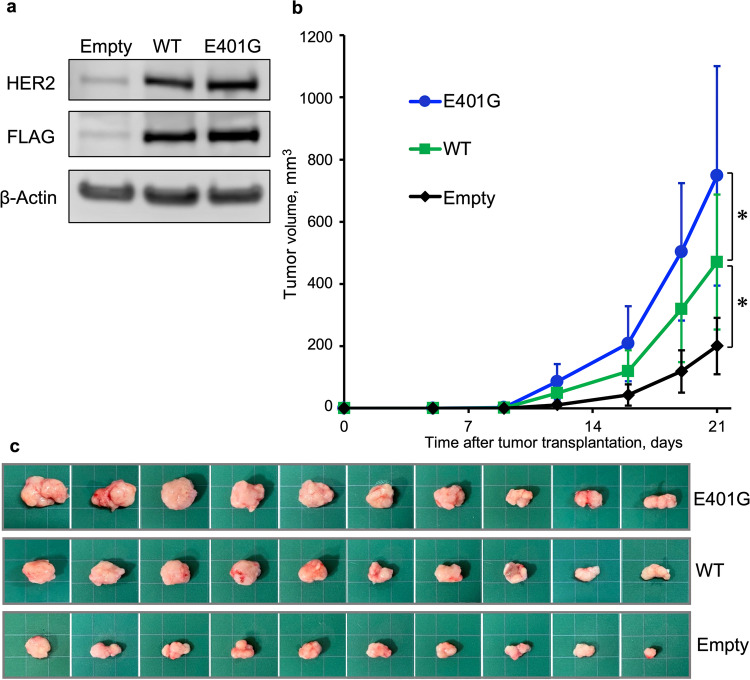
We found that ERBB2 E401G enhances C-terminal phosphorylation in a way similar to S310F. MD simulation analysis revealed that these variants maintain the stability of the EGFR-HER2 heterodimer in a ligand-independent manner. Moreover, ERBB2 E401G-transduced cells showed an increased invasive capacity in vitro and an increased tumor growth capacity in vivo.
Our results provide important information on the activating mechanisms of ERBB2 extracellular domain (ECD) variants and illustrate a model workflow integrating wet and dry bench processes for the analysis of VUS detected with cancer gene panel tests.
在基于 NGS 的癌症基因 panel 检测的临床应用中,处理意义不明的变异(VUS)是一个重要问题。我们在癌症基因 panel 检测中发现了一种新的 ERBB2 细胞外结构域 VUS,c.1157A > G p.(E401G)。由于 ERBB2 细胞外结构域(ECD)变异体的激活机制尚未完全阐明,我们旨在阐明这些机制以及 ERBB2 E401G 的生物学功能。
选择 ERBB2 E401G 作为 VUS 进行分析,因为多种软件工具预测其致病性。我们制备了带有 E401G 变异体的 ERBB2 表达载体,以及带有已知激活突变的 S310F 和 E321G 的载体。基于无 ERBB2 扩增或变异的细胞系中野生型 ERBB2 或突变型 ERBB2 的表达,我们评估了人表皮生长因子受体 2 和相关蛋白的磷酸化,并通过分子动力学(MD)模拟研究了变异体赋予的机制。还在体外和体内研究了 ERBB2 E401G 的生物学效应。
我们发现 ERBB2 E401G 以类似于 S310F 的方式增强 C 端磷酸化。MD 模拟分析表明,这些变异体以配体非依赖性的方式维持 EGFR-HER2 异二聚体的稳定性。此外,转导 ERBB2 E401G 的细胞在体外表现出增强的侵袭能力,在体内表现出增强的肿瘤生长能力。
我们的结果提供了关于 ERBB2 细胞外结构域(ECD)变异体激活机制的重要信息,并说明了一种整合湿实验和干实验流程的模型工作流程,用于分析癌症基因 panel 检测中发现的 VUS。