Alwafi Hassan, Alotaibi Basil, Naser Abdallah Y, Salawati Emad, Qadus Sami, Sweiss Kanar, Dairi Mohammad S, Hassouneh Loay, Aldalameh Yousef, Samannodi Mohammed
Faculty of Medicine, Umm Alqura University, Mecca, Saudi Arabia.
Alnoor Specialist Hospital, Ministry of Health, Makkah, Saudi Arabia.
Saudi Pharm J. 2021 Dec;29(12):1374-1382. doi: 10.1016/j.jsps.2021.11.001. Epub 2021 Nov 12.
Diabetes mellitus (DM) and atrial fibrillation (AF) commonly co-exist. Oral anticoagulants (OACs) are widely used in patients with DM. This review aims to summarise the available literature on the safety (hypoglycaemia or bleeding) and efficacy (stroke or systemic embolism) of the use of OACs in patients with DM.
We searched the Medline, the Excerpta Medica dataBASE (Embase) and Cochrane databases up to the 10th of December 2020. The search strategy was conducted using both keywords and MeSH terms. We included randomised controlled trials (RCTs) and observational studies that reported on the safety and efficacy of the use of OACs in patients with diabetes from all age groups. Study selection, data extraction and quality assessment were conducted independently by two reviewers.
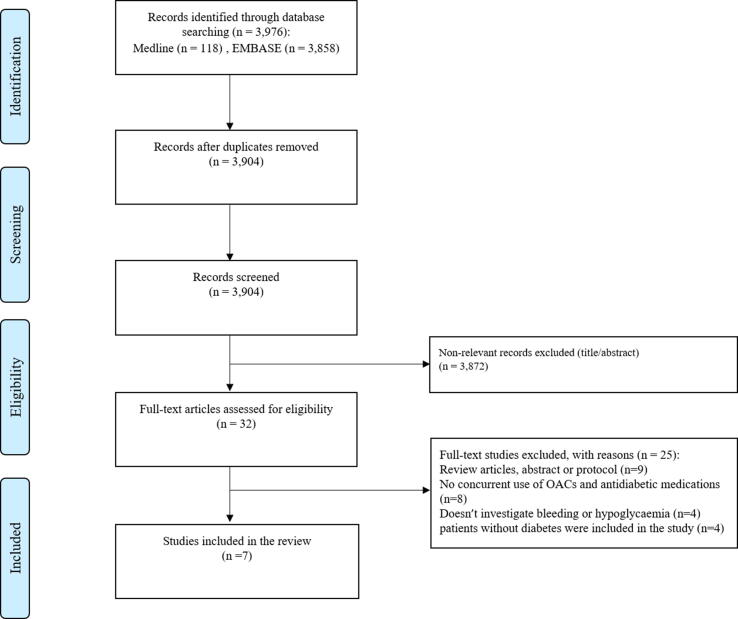
A total of 3,976 articles were identified through the search process, of which seven studies met the inclusion criteria of the systematic review: four observational studies and three studies that were randomised controlled trials, with a total of 703,855 patients. Two observational studies reported that the use of warfarin was associated with a higher risk of hypoglycaemic events, specifically with sulfonylurea. One observational study and three randomised controlled trials reported that the use of warfarin compared to other oral anticoagulants was associated with a higher risk of bleeding. In addition, three randomised controlled trials reported that the use of warfarin compared to other oral anticoagulants was associated with a lower risk of stroke or systemic embolism.
This systematic review found that DOACs had a better efficacy outcome and safer clinical outcomes in comparison to warfarin in patients with diabetes.
糖尿病(DM)与心房颤动(AF)常并存。口服抗凝剂(OACs)广泛应用于糖尿病患者。本综述旨在总结关于OACs在糖尿病患者中使用的安全性(低血糖或出血)和有效性(中风或全身性栓塞)的现有文献。
我们检索了截至2020年12月10日的Medline、医学文摘数据库(Embase)和Cochrane数据库。检索策略使用关键词和医学主题词。我们纳入了所有年龄组糖尿病患者中使用OACs的安全性和有效性的随机对照试验(RCTs)和观察性研究。研究选择、数据提取和质量评估由两名 reviewers 独立进行。
通过检索过程共识别出3976篇文章,其中7项研究符合系统评价的纳入标准:4项观察性研究和3项随机对照试验,共703855例患者。两项观察性研究报告称,使用华法林与低血糖事件风险较高相关,特别是与磺脲类药物相关。一项观察性研究和三项随机对照试验报告称,与其他口服抗凝剂相比,使用华法林出血风险较高。此外,三项随机对照试验报告称,与其他口服抗凝剂相比,使用华法林中风或全身性栓塞风险较低。
本系统评价发现,在糖尿病患者中,与华法林相比,直接口服抗凝剂(DOACs)具有更好的疗效结果和更安全的临床结果。