Department of Endocrinology, The First People's Hospital of Yulin, Yulin, China.
Department of Endocrinology, First Affiliated Hospital of Guangxi Medical University, Nanning, China.
Front Endocrinol (Lausanne). 2021 Dec 23;12:758723. doi: 10.3389/fendo.2021.758723. eCollection 2021.
We aimed to analyze a novel variant of a Chinese patient with suspected maturity-onset diabetes of the young (MODY) and to provide evidence for precise diagnosis and appropriate treatment.
A Chinese family with suspected MODY was recruited in this study, which included a 15-year-old female patient with diabetes. Clinical data and blood samples were collected from the proband and other family members. All of the living relatives were given an oral glucose tolerance test. Next-generation sequencing was performed to identify the mutated genes in the proband. Sanger sequencing was utilized to confirm the location of the pathogenic variant in all subjects. Further treatment was referred to targeted family members according to genetic testing.
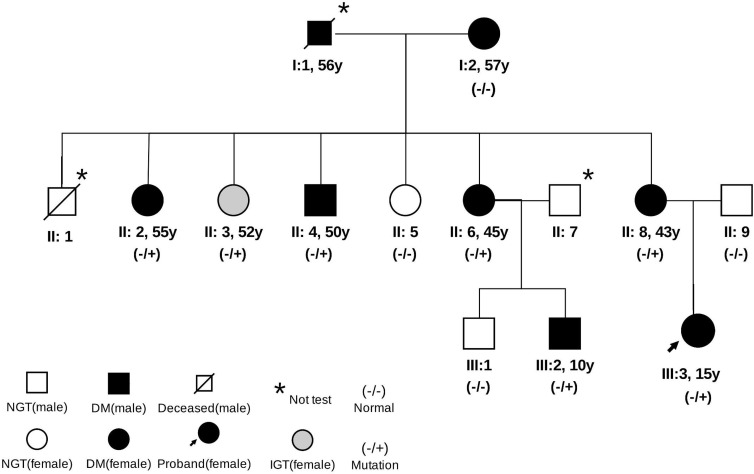
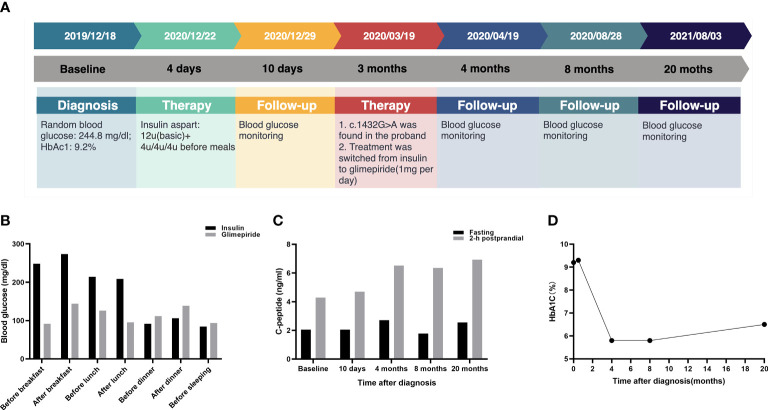
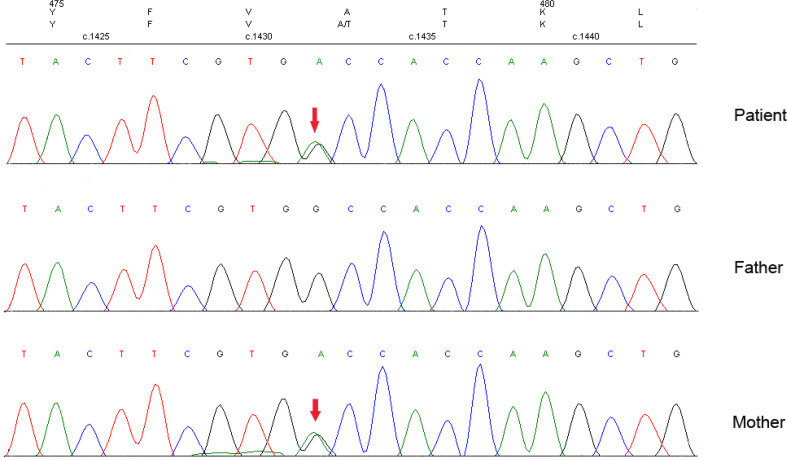
The proband was found to have a random blood glucose level of 244.8 mg/dl and an HbA1c level of 9.2%. Before this investigation, her grandparents had been diagnosed with diabetes. The second uncle, two aunts, mother, and cousin of the proband were diagnosed with diabetes by abnormal HbA1C (6.5-12.1%) and fasting blood glucose (FBG, 91.4-189.7 mg/dl). The second aunt of the proband had impaired glucose homeostasis (HbA1C = 6.4% and FBG = 88.0 mg/dl). One novel missense variant c.1432G>A (p.A478T) in exon 9 of the gene was detected in the proband with suspected MODY. The variant was also found in six family members with diabetes or impaired glucose homeostasis, including her second uncle, two aunts, mother, and cousin. After the treatment was switched to glimepiride, the fasting blood glucose was adjusted to 99.54 mg/dl, the 2-h postprandial blood glucose was 153.54 mg/dl, serum fructosamine was 259 μmol/l, and HbA1c was 5.8%. The glycemic control remained optimal, and no hypoglycemic episodes were observed in the living relatives.
This study revealed one novel missense variant of the gene in Chinese families. The present findings indicated that the members of this family responded to treatment with sulfonylureas as previously seen in MODY.
本研究旨在分析一位中国疑似青少年起病型糖尿病(MODY)患者的新型变异体,为精准诊断和恰当治疗提供依据。
纳入一个疑似 MODY 的中国家系,该家系包括一位 15 岁的糖尿病女性患者。采集先证者及其它家系成员的临床资料和血样。所有在世亲属均行口服葡萄糖耐量试验。对先证者进行下一代测序以鉴定突变基因。应用 Sanger 测序对所有受检者的致病性变异进行定位。根据基因检测结果对目标家系成员进行进一步治疗。
先证者随机血糖 244.8 mg/dl,HbA1c 9.2%。入组前,其爷爷奶奶已诊断为糖尿病。先证者的二叔、二姑、母亲和表姐也因 HbA1C(6.5-12.1%)和空腹血糖(FBG,91.4-189.7 mg/dl)异常而被诊断为糖尿病。先证者的二姑表现为糖代谢受损(HbA1c=6.4%,FBG=88.0 mg/dl)。该疑似 MODY 先证者携带基因第 9 外显子的 1432G>A (p.A478T)错义变异,该变异也存在于携带糖尿病或糖代谢受损的 6 名家系成员中,包括其二叔、二姑、母亲和表姐。改用格列美脲治疗后,空腹血糖调整至 99.54 mg/dl,餐后 2 h 血糖 153.54 mg/dl,血清果糖胺 259 μmol/L,HbA1c 5.8%。血糖控制依然良好,且在世亲属均未发生低血糖事件。
本研究揭示了一个中国家系中 基因的新型错义变异。本研究结果表明,该家系成员对磺脲类药物治疗的反应与先前报道的 MODY 患者相似。