Chan Chloe Xiaoyun, Mohammad Ashik Bin Zainuddin
Department of Orthopaedic Surgery, 5 Lower Kent Ridge Road, Singapore.
Department of Orthopaedic Surgery, KK Women's and Children's Hospital, Singapore, 100 Bukit Timah Road, Level 4, Children's Tower, Singapore.
J Orthop Case Rep. 2021 Aug;11(8):11-15. doi: 10.13107/jocr.2021.v11.i08.2344.
Isolated congenital ACLD is a rare condition with limited literature on the optimal management approach. At present, patients with instability symptoms have been managed with ACL reconstruction in case reports. We present a case report of symptomatic isolated congenital anterior cruciate ligament deficiency (ACLD) managed effectively with gradual correction of biplanar proximal tibial deformity alone.
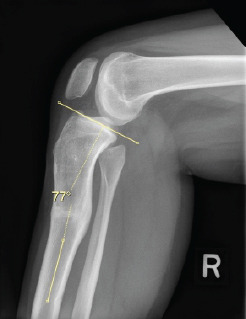
This was a case of bilateral isolated congenital ACLD in a 15-year-old girl with chronic bilateral knee instability, bilateral mild genu valgum, and positive Lachman's tests. Biplanar tibial deformity was evident with a 5 proximal tibia valgus and a posterior tibial slope angle of 26 on the more symptomatic right knee. This was treated with a proximal tibial osteotomy and gradual correction with a hexapod frame using the CORA method. The right knee alignment was restored to normal. At 2-year post-surgery, her symptoms of instability had resolved, and there was a soft end point on the Lachman's test.
We recommend that symptomatic isolated congenital ACLD be treated by correction of any existing bony deformities first, keeping in view of ACL reconstruction if instability persists thereafter. To date, there are no reports on correction of proximal tibial deformities as the first-line treatment in isolated congenital ACLD before consideration of ACL reconstruction. To the best of our knowledge, this is the first report of symptomatic isolated congenital ACLD managed with correction of the biplanar deformity of the proximal tibia alone. Our management strategy proved to be effective in the treatment of this patient's instability, with good post-operative outcomes.
孤立性先天性前交叉韧带缺如(ACLD)是一种罕见病症,关于其最佳治疗方法的文献有限。目前,在病例报告中,有不稳定症状的患者已接受前交叉韧带重建治疗。我们报告一例有症状的孤立性先天性前交叉韧带缺如病例,仅通过逐步矫正双平面胫骨近端畸形就得到了有效治疗。
这是一名15岁女孩双侧孤立性先天性ACLD的病例,她有双侧慢性膝关节不稳定、双侧轻度膝外翻以及Lachman试验阳性。在症状更明显的右膝,双平面胫骨畸形明显,胫骨近端外翻5°,胫骨后倾角度为26°。采用胫骨近端截骨术,并使用六足框架通过CORA方法进行逐步矫正。右膝力线恢复正常。术后2年,她的不稳定症状消失,Lachman试验出现软终点。
我们建议,对于有症状的孤立性先天性ACLD,应首先矫正任何现有的骨畸形,如果此后仍存在不稳定,则考虑进行前交叉韧带重建。迄今为止,尚无关于在考虑前交叉韧带重建之前将胫骨近端畸形矫正作为孤立性先天性ACLD一线治疗方法的报道。据我们所知,这是首例仅通过矫正胫骨近端双平面畸形治疗有症状的孤立性先天性ACLD的报告。我们的治疗策略在治疗该患者的不稳定方面被证明是有效的,术后效果良好。