Burrell Rebecca, Jones Cheryl A, Britton Philip N
Faculty of Medicine and Health, Sydney Medical School, The University of Sydney, Sydney, NSW, Australia.
The Children's Hospital at Westmead, Sydney, NSW, Australia.
Front Pediatr. 2021 Dec 24;9:667719. doi: 10.3389/fped.2021.667719. eCollection 2021.
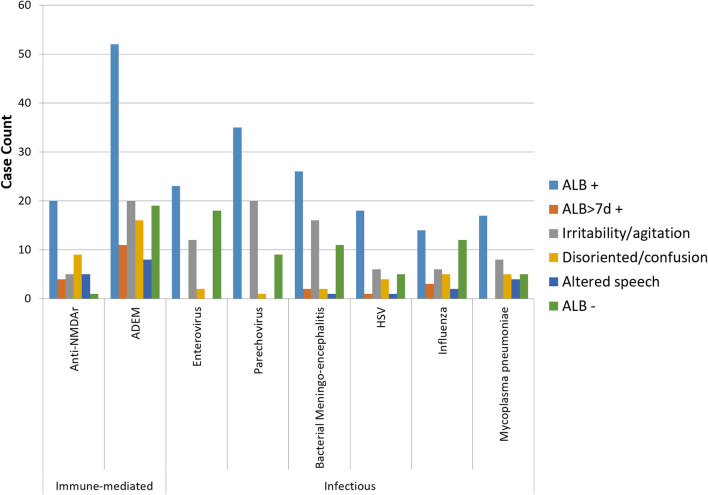
Altered mental status is a major criterion for a diagnosis of encephalitis to be made with alteration in behavior, a key manifestation of altered mental status. We reviewed all evaluated cases identified by the Australian Childhood Encephalitis study between May 2013 and June 2018, to review the frequency and features of altered behavior (ALB). ALB was reported in >72% of cases of childhood encephalitis in all three major etiologic groups (infectious, immune-mediated, and unknown). The duration of ALB was >7 days in a minority, but significantly more frequent in immune-mediated compared with infectious encephalitis (27 and 10%, respectively, < 0.01). ALB was most frequently characterized as irritability/agitation (47%), which predominated in children aged <1 year, and among the leading infectious causes in this age group (enterovirus, parechovirus, and bacterial meningoencephalitis). ALB in the form of disorientation/confusion (25%) was most prominent in those aged >1 year and most frequent in immune-mediated encephalitis. Hallucinations, paranoia, and aggression were all infrequent; suicidality/self-harm was not observed. ALB was reported in 20 of 21 cases of anti--methyl-d-aspartate receptor (anti-NMDAr), 19% for >7 days, and disorientation/confusion was the most frequent feature. Only one case was reported as presenting with "psychosis" and was diagnosed with anti-NMDAr encephalitis. Clinician-reported ALB is frequent but most often non-specific in childhood encephalitis. A longer duration of ALB is associated with an immune-mediated cause. More specific psychiatric symptoms (hallucinations, paranoia) are very infrequent. ALB is a hallmark of anti-NMDAr encephalitis, but psychosis is uncommon in contrast to the disorder in adults.
精神状态改变是诊断脑炎的主要标准,行为改变是精神状态改变的关键表现。我们回顾了澳大利亚儿童脑炎研究在2013年5月至2018年6月期间确定的所有评估病例,以审查行为改变(ALB)的频率和特征。在所有三个主要病因组(感染性、免疫介导性和不明病因)的儿童脑炎病例中,超过72%报告有ALB。少数情况下ALB持续时间超过7天,但与感染性脑炎相比,免疫介导性脑炎中更为常见(分别为27%和10%,P<0.01)。ALB最常见的特征是易怒/烦躁(47%),在1岁以下儿童中占主导,也是该年龄组主要感染病因(肠道病毒、副肠道病毒和细菌性脑膜脑炎)中的主要表现。定向障碍/意识混乱形式的ALB(25%)在1岁以上儿童中最为突出,在免疫介导性脑炎中最为常见。幻觉、偏执和攻击行为都不常见;未观察到自杀/自伤行为。在21例抗N-甲基-D-天冬氨酸受体(抗NMDAr)脑炎病例中有20例报告有ALB,19%持续超过7天,定向障碍/意识混乱是最常见的特征。仅1例报告有“精神病”表现并被诊断为抗NMDAr脑炎。临床医生报告的ALB在儿童脑炎中很常见,但大多是非特异性的。ALB持续时间较长与免疫介导性病因有关。更具特异性的精神症状(幻觉、偏执)非常少见。ALB是抗NMDAr脑炎的标志,但与成人疾病不同,精神病并不常见。