Pagkopoulou Eleni, Soulaidopoulos Stergios, Triantafyllidou Eva, Malliari Afrodite, Kitas George D, Garyfallos Alexandros, Dimitroulas Theodoros
Fourth Department of Internal Medicine, Hippokration Hospital, Aristotle University of Thessaloniki, Thessaloniki, Greece.
First Department of Cardiology, Hippokration General Hospital, National and Kapodistrian University of Athens, Athens, Greece.
Front Med (Lausanne). 2021 Dec 24;8:806925. doi: 10.3389/fmed.2021.806925. eCollection 2021.
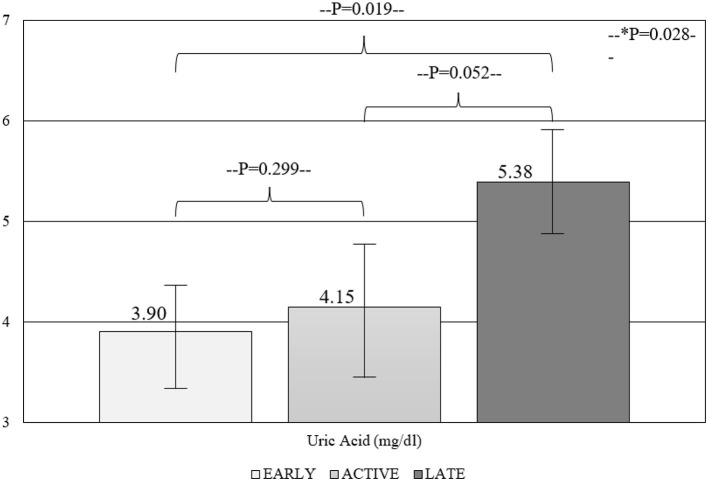
The key element in the pathogenesis of systemic sclerosis (SSc) is microcirculatory changes in several vascular beds. Uric acid is associated with endothelial dysfunction and therefore, microvascular damage. The aim of this study was to examine the association between uric acid (UA) and peripheral microvascular involvement in patients with SSc. We included consecutive, consenting patients with SSc. Serum UA, urea and creatinine were measured, and glomerular filtration rate (GFR) was calculated with CKD-EPI. All participants underwent nailfold video-capillaroscopy (NVC) to evaluate the microcirculation. A total of 64 patients (95.3% women) were included in the study. UA levels were significantly associated with the number of avascular areas ( = 0.290; = 0.020), whereas no correlation was shown for the GFR ( = -0.065; = 0.609). A significant trend of UA in the three capillaroscopic patterns was shown (3.90 ± 1.52 vs. 4.15 ± 0.98 vs. 5.38 ± 2.26; for early, active, and late patterns respectively, = 0.028). Multivariate analysis showed that male gender (β = 3.049; 95% CI = 0.997-5.101) and UA (β = 0.352; 95% CI = 0.117-0.588) were independently associated with the number of avascular areas. These data suggest that UA levels are significantly associated with the capillaroscopic patterns, reflecting a progressive microvasculopathy.
系统性硬化症(SSc)发病机制的关键要素是多个血管床的微循环变化。尿酸与内皮功能障碍相关,因此也与微血管损伤相关。本研究的目的是探讨尿酸(UA)与SSc患者外周微血管受累之间的关系。我们纳入了连续的、自愿参与的SSc患者。测量血清UA、尿素和肌酐,并使用CKD-EPI公式计算肾小球滤过率(GFR)。所有参与者均接受甲襞视频毛细血管镜检查(NVC)以评估微循环。共有64例患者(95.3%为女性)纳入本研究。UA水平与无血管区数量显著相关(r = 0.290;P = 0.020),而与GFR无相关性(r = -0.065;P = 0.609)。在三种毛细血管镜检查模式中,UA呈现出显著趋势(早期、活动期和晚期模式分别为3.90±1.52、4.15±0.98和5.38±2.26;P = 0.028)。多变量分析显示,男性(β = 3.049;95%置信区间 = 0.997 - 5.101)和UA(β = 0.352;95%置信区间 = 0.117 - 0.588)与无血管区数量独立相关。这些数据表明,UA水平与毛细血管镜检查模式显著相关,反映了进行性微血管病变。