Kan Chao, Lu Xu, Zhang Rui
Department of Clinical Medicine, Changchun University of Chinese Medicine, Changchun 130000, Jilin Province, China.
Department of Nephrology, Zhuhai People's Hospital (Zhuhai Hospital Affiliated with Jinan University), Zhuhai 519070, Guangdong Province, China.
World J Clin Cases. 2021 Dec 6;9(34):10616-10625. doi: 10.12998/wjcc.v9.i34.10616.
Abnormal bone metabolism and renal anemia seriously affect the prognosis of patients with chronic kidney disease (CKD). Existing studies have mostly addressed the pathogenesis and treatment of bone metabolism abnormality and anemia in patients with CKD, but few have evaluated their mutual connection. Administration of exogenous erythropoietin to CKD patients with anemia used to be the mainstay of therapeutic approaches; however, with the availability of hypoxia-inducible factor (HIF) stabilizers such as roxadustat, more therapeutic choices for renal anemia are expected in the future. However, the effects posed by the hypoxic environment on both CKD complications remain incompletely understood.
To summarize the relationship between renal anemia and abnormal bone metabolism, and to discuss the influence of hypoxia on bone metabolism.
CNKI and PubMed searches were performed using the key words "chronic kidney disease," "abnormal bone metabolism," "anemia," "hypoxia," and "HIF" to identify relevant articles published in multiple languages and fields. Reference lists from identified articles were reviewed to extract additional pertinent articles. Then we retrieved the Abstract and Introduction and searched the results from the literature, classified the extracted information, and summarized important information. Finally, we made our own conclusions.
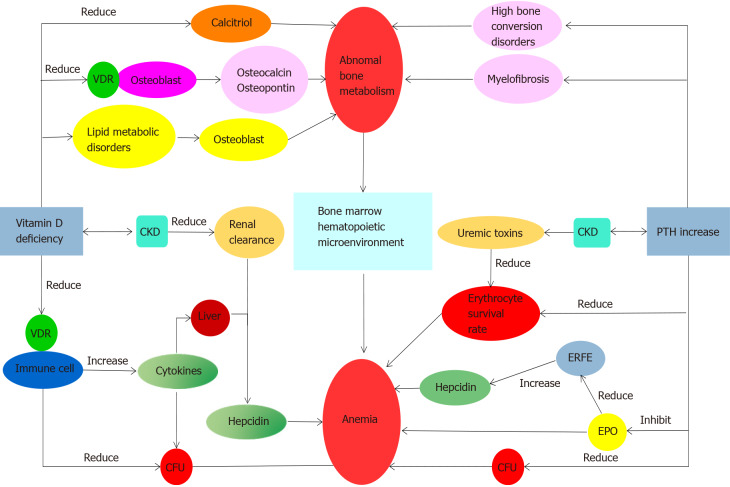
There is a bidirectional relationship between renal anemia and abnormal bone metabolism. Abnormal vitamin D metabolism and hyperparathyroidism can affect bone metabolism, blood cell production, and survival rates through multiple pathways. Anemia will further attenuate the normal bone growth. The hypoxic environment regulates bone morphogenetic protein, vascular endothelial growth factor, and neuropilin-1, and affects osteoblast/osteoclast maturation and differentiation through bone metabolic changes. Hypoxia preconditioning of mesenchymal stem cells (MSCs) can enhance their paracrine effects and promote fracture healing. Concurrently, hypoxia reduces the inhibitory effect on osteocyte differentiation by inhibiting the expression of fibroblast growth factor 23. Hypoxia potentially improves bone metabolism, but it still carries potential risks. The optimal concentration and duration of hypoxia remain unclear.
There is a bidirectional relationship between renal anemia and abnormal bone metabolism. Hypoxia may improve bone metabolism but the concentration and duration of hypoxia remain unclear and need further study.
骨代谢异常和肾性贫血严重影响慢性肾脏病(CKD)患者的预后。现有研究大多聚焦于CKD患者骨代谢异常和贫血的发病机制及治疗,但很少评估二者之间的相互联系。以往,对CKD贫血患者给予外源性促红细胞生成素是主要治疗手段;然而,随着罗沙司他等缺氧诱导因子(HIF)稳定剂的出现,未来肾性贫血有望有更多治疗选择。然而,缺氧环境对这两种CKD并发症的影响仍不完全清楚。
总结肾性贫血与骨代谢异常之间的关系,并探讨缺氧对骨代谢的影响。
使用关键词“慢性肾脏病”“骨代谢异常”“贫血”“缺氧”和“HIF”在CNKI和PubMed数据库中进行检索,以识别多种语言和领域发表的相关文章。对已识别文章的参考文献列表进行回顾,以提取其他相关文章。然后我们检索摘要和引言,并从文献中搜索结果,对提取的信息进行分类,并总结重要信息。最后,得出我们自己的结论。
肾性贫血与骨代谢异常之间存在双向关系。维生素D代谢异常和甲状旁腺功能亢进可通过多种途径影响骨代谢、血细胞生成和存活率。贫血会进一步削弱正常的骨骼生长。缺氧环境调节骨形态发生蛋白、血管内皮生长因子和神经纤毛蛋白-1,并通过骨代谢变化影响成骨细胞/破骨细胞的成熟和分化。间充质干细胞(MSCs)的缺氧预处理可增强其旁分泌作用并促进骨折愈合。同时,缺氧通过抑制成纤维细胞生长因子23的表达降低对骨细胞分化的抑制作用。缺氧可能改善骨代谢,但仍存在潜在风险。缺氧的最佳浓度和持续时间尚不清楚。
肾性贫血与骨代谢异常之间存在双向关系。缺氧可能改善骨代谢,但缺氧的浓度和持续时间尚不清楚,需要进一步研究。