Amphansap Tanawat, Rattanaphonglekha Chayaphong, Vechasilp Jaruwat, Stitkitti Nitirat, Apiromyanont Kamonchalat, Therdyothin Atiporn
Department of Orthopedics, Police General Hospital, Bangkok, Thailand.
Department of Radiology, Police General Hospital, Bangkok, Thailand.
Osteoporos Sarcopenia. 2021 Dec;7(4):134-139. doi: 10.1016/j.afos.2021.11.004. Epub 2021 Dec 4.
To compare bone mineral density (BMD) in Thai postmenopausal women with and without distal radius fracture, and to investigate the role of vertebral fracture assessment (VFA) in diagnosing osteoporosis after distal radius fracture.
A cross-sectional study was conducted in Thai postmenopausal women with and without distal radius fracture. BMDs of the femoral neck (FN), total hip (TH), lumbar spine (LS), and VFA were obtained within 2 weeks of injury. BMD were compared between groups. Participants were classified into osteoporosis, osteopenia or normal using BMD alone, and BMD plus VFA, where a mere presence of vertebral compression fracture indicated osteoporosis.
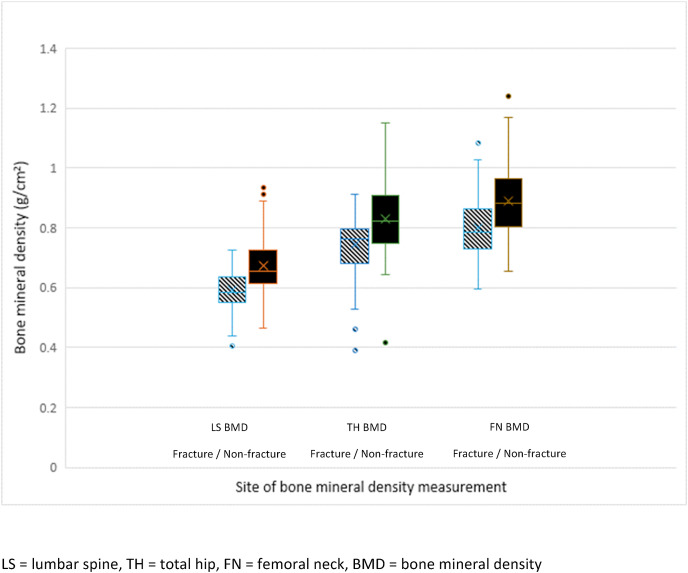
Fifty postmenopausal women with distal radius fractures and 111 non-fracture postmenopausal women participated. The mean BMD was significantly lower at all sites in the fracture group (FN BMD 0.590 ± 0.075 vs 0.671 ± 0.090, p = 0.007; TH BMD 0.742 ± 0.103 vs 0.828 ± 0.116, P = 0.009; LS BMD 0.799 ± 0.107 vs 0.890 ± 0.111, P = 0.009 in the fracture vs non-fracture group respectively). VFA increased the prevalence of osteoporosis from 16 (32%) to 23 (46%) in the fracture group, and 7 (6.31%) to 17 (16.22%) in the non-fracture group, with a number needed to treat 9.
Postmenopausal women with distal radius fractures had lower BMD. Incorporating VFA into diagnosis of osteoporosis increased the prevalence of osteoporosis in both fracture and non-fracture groups. Postmenopausal women aged 50 years or older with distal radius fracture are a good target for the investigation of osteoporosis.
比较有和无桡骨远端骨折的泰国绝经后女性的骨密度(BMD),并探讨椎体骨折评估(VFA)在桡骨远端骨折后骨质疏松症诊断中的作用。
对有和无桡骨远端骨折的泰国绝经后女性进行横断面研究。在受伤后2周内获取股骨颈(FN)、全髋(TH)、腰椎(LS)的骨密度以及VFA数据。比较两组之间的骨密度。参与者仅根据骨密度,以及骨密度加VFA被分为骨质疏松症、骨量减少或正常,其中仅椎体压缩骨折的存在即表明为骨质疏松症。
50例有桡骨远端骨折的绝经后女性和111例无骨折的绝经后女性参与了研究。骨折组所有部位的平均骨密度均显著较低(骨折组与非骨折组相比,FN骨密度0.590±0.075对0.671±0.090,p = 0.007;TH骨密度0.742±0.103对0.828±0.116,P = 0.009;LS骨密度0.799±0.107对0.890±0.111,P = 0.009)。VFA使骨折组骨质疏松症的患病率从16例(32%)增加到23例(46%),非骨折组从7例(6.31%)增加到17例(16.22%),治疗所需人数为9。
有桡骨远端骨折的绝经后女性骨密度较低。将VFA纳入骨质疏松症诊断可增加骨折组和非骨折组骨质疏松症的患病率。50岁及以上有桡骨远端骨折的绝经后女性是骨质疏松症调查的良好对象。