Roth Lilian, Russo Linda, Ulugoel Sima, Freire Dos Santos Rafael, Breuer Eva, Gupta Anurag, Lehmann Kuno
Surgical Oncology Research Laboratory, Department of Surgery & Transplantation, University Hospital of Zurich, Raemistrasse 100, 8091 Zurich, Switzerland.
University of Zurich, 8006 Zurich, Switzerland.
Cancers (Basel). 2021 Dec 23;14(1):60. doi: 10.3390/cancers14010060.
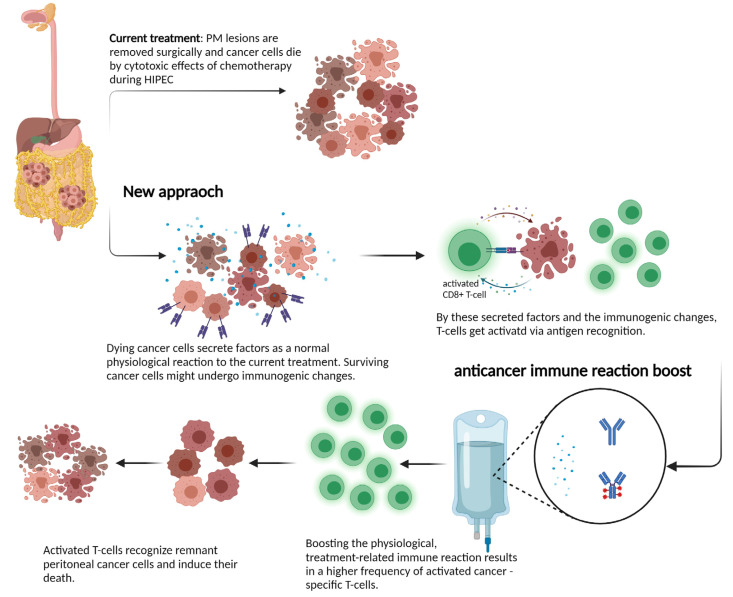
Peritoneal metastasis (PM) originating from gastrointestinal cancer was considered a terminal disease until recently. The advent of better systemic treatment, a better understanding of prognostic factors, and finally, the advent of novel loco-regional therapies, has opened the door for the multimodal treatment of PM. These strategies, including radical surgery and hyperthermic intraperitoneal chemotherapy (HIPEC) showed surprisingly good results, leading to the prolonged survival of patients with peritoneal metastasis. This has triggered a significant body of research, leading to the molecular characterization of PM, which may further help in the development of novel treatments. This review summarizes current evidence on peritoneal metastasis and explores potential novel mechanisms and therapeutic approaches to treat patients with peritoneal metastasis.
直到最近,源自胃肠道癌的腹膜转移(PM)都被视为一种终末期疾病。更好的全身治疗方法的出现、对预后因素更深入的了解,以及最终新型局部区域治疗方法的出现,为PM的多模式治疗打开了大门。这些策略,包括根治性手术和腹腔内热化疗(HIPEC),都取得了惊人良好的效果,延长了腹膜转移患者的生存期。这引发了大量研究,促成了PM的分子特征分析,这可能进一步有助于新型治疗方法的开发。本综述总结了目前关于腹膜转移的证据,并探讨了治疗腹膜转移患者的潜在新机制和治疗方法。