Muzellec Léa, Bourien Héloïse, Edeline Julien
Department of Medical Oncology, Centre Eugène Marquis, 35000 Rennes, France.
Cancers (Basel). 2021 Dec 30;14(1):179. doi: 10.3390/cancers14010179.
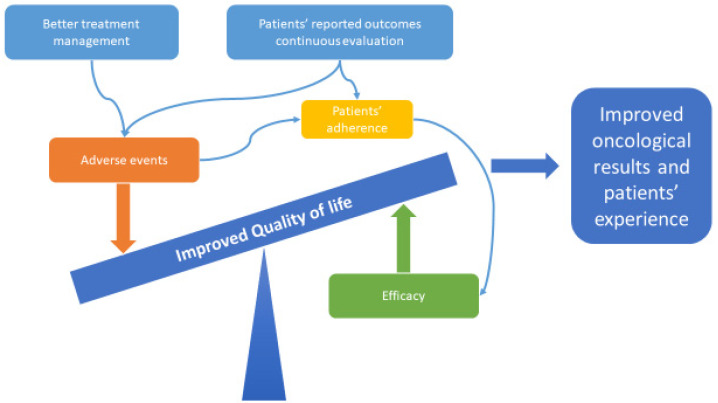
Quality of life (QoL) in oncology is an outcome becoming more and more important and relevant to explore. Some studies have demonstrated its prognostic impact in different cancers, such as colorectal, breast, and prostate cancers, but also in hepatocellular carcinoma (HCC). Different tools have been developed for assessing quality of life, some general, such as EORTC QLQ-C30, but also specific tools depending on cancer origin which seem to be more pertinent for patients. Systemic treatments and specific symptoms due to cancer evolution could decrease quality of life. For approval of new systemic treatments, authorities ask for benefit in terms of efficacy but also benefit in quality of life, which is crucial for patients. This review reports data about QoL in HCC, including specific tools used, impact of systemic treatments and prognosis for QoL for HCC patients. Management of adverse events is essential to enhance compliance with treatment and quality of life. Assessing quality of life in clinical trials appears quite systematic, but its application in clinical routine requires development.
肿瘤学中的生活质量(QoL)是一个越来越重要且值得探索的结果。一些研究已经证明了它在不同癌症中的预后影响,如结直肠癌、乳腺癌和前列腺癌,也包括肝细胞癌(HCC)。已经开发了不同的工具来评估生活质量,一些是通用的,如欧洲癌症研究与治疗组织生活质量核心问卷(EORTC QLQ-C30),但也有根据癌症起源的特定工具,这些工具似乎对患者更具针对性。由于癌症进展导致的全身治疗和特定症状可能会降低生活质量。为了批准新的全身治疗方法,当局不仅要求在疗效方面有获益,还要求在生活质量方面有获益,这对患者至关重要。这篇综述报告了有关肝细胞癌生活质量的数据,包括所使用的特定工具、全身治疗的影响以及肝细胞癌患者生活质量的预后。不良事件的管理对于提高治疗依从性和生活质量至关重要。在临床试验中评估生活质量似乎相当系统,但在临床常规中的应用还需要进一步发展。