Unidade de Genética Molecular, Centro de Genética Médica Doutor Jacinto Magalhães, Centro Hospitalar Universitário do Porto (CHUPorto), 4099-028 Porto, Portugal.
Unidade Multidisciplinar de Investigação Biomédica (UMIB), Instituto de Ciências Biomédicas Abel Salazar (ICBAS) e Laboratório Para a Investigação Integrativa e Translacional em Saúde Populacional (ITR), Universidade do Porto, 4050-313 Porto, Portugal.
Int J Mol Sci. 2021 Dec 22;23(1):59. doi: 10.3390/ijms23010059.
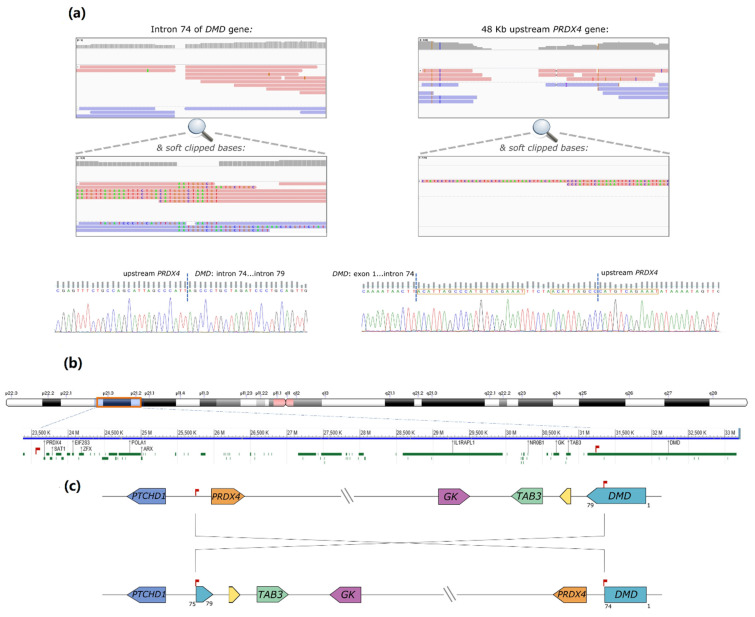
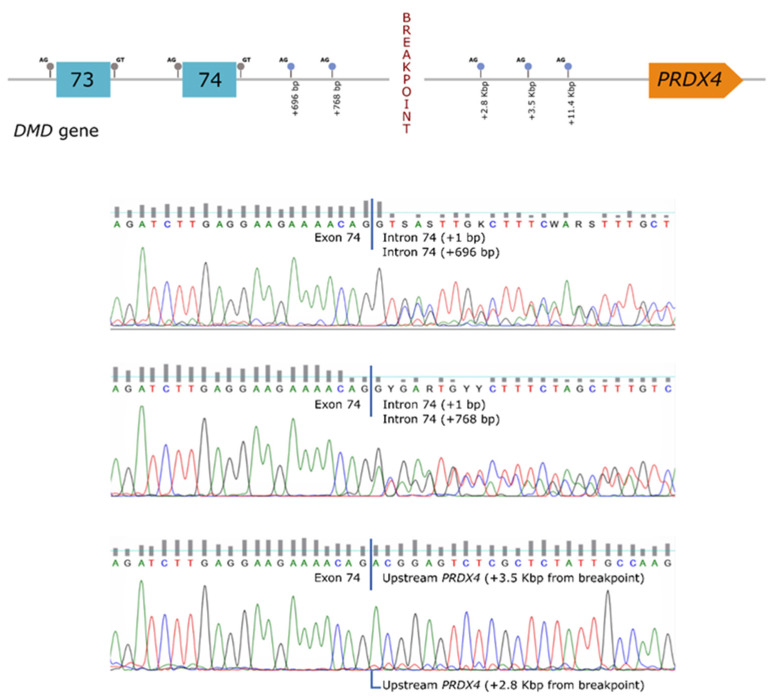
While in most patients the identification of genetic alterations causing dystrophinopathies is a relatively straightforward task, a significant number require genomic and transcriptomic approaches that go beyond a routine diagnostic set-up. In this work, we present a Becker Muscular Dystrophy patient with elevated creatinine kinase levels, progressive muscle weakness, mild intellectual disability and a muscle biopsy showing dystrophic features and irregular dystrophin labelling. Routine molecular techniques (Southern-blot analysis, multiplex PCR, MLPA and genomic DNA sequencing) failed to detect a defect in the gene. Muscle transcript analysis (RT-PCR and cDNA-MLPA) showed the absence of exons 75 to 79, seen to be present at the genomic level. These results prompted the application of low-coverage linked-read whole-genome sequencing (WGS), revealing a possible rearrangement involving intron 74 and a region located upstream of the gene. Breakpoint PCR and Sanger sequencing confirmed the presence of a ~8 Mb genomic inversion. Aberrant transcripts were subsequently identified, some of which contained segments from the region upstream of . Besides expanding the mutational spectrum of the disorder, this study reinforces the importance of transcript analysis in the diagnosis of dystrophinopathies and shows how WGS has a legitimate role in clinical laboratory genetics.
虽然在大多数患者中,确定导致肌营养不良症的基因突变相对较为直接,但仍有相当数量的患者需要采用超出常规诊断设置的基因组和转录组方法。在这项工作中,我们介绍了一位贝克尔型肌营养不良症患者,其肌酸激酶水平升高,进行性肌肉无力,轻度智力障碍,肌肉活检显示出营养不良的特征和不规则的肌营养不良蛋白标记。常规的分子技术(Southern-blot 分析、多重 PCR、MLPA 和基因组 DNA 测序)未能检测到 基因的缺陷。肌肉转录分析(RT-PCR 和 cDNA-MLPA)显示外显子 75 至 79 缺失,而在基因组水平上观察到这些外显子存在。这些结果促使我们应用低覆盖度连锁读取全基因组测序(WGS),揭示了可能涉及 74 号内含子和 基因上游区域的重排。断点 PCR 和 Sanger 测序证实了约 8Mb 基因组倒位的存在。随后鉴定出异常的 转录本,其中一些包含 基因上游区域的片段。除了扩展该疾病的突变谱外,这项研究还强调了转录分析在肌营养不良症诊断中的重要性,并展示了 WGS 在临床实验室遗传学中的合法作用。