Mangaraj Satyabrata, Paikaray Rabindra Kumar, Maitra Sagar, Pradhan Shriram Ratan, Garnayak Lalita Mohan, Satapathy Manoranjan, Swain Barsita, Jena Satyananda, Nayak Bijayalaxmi, Shankar Tanmoy, Alorabi Mohammed, Gaber Ahmed, Hossain Akbar
Department of Agronomy, Odisha University of Agriculture and Technology, Bhubaneswar 751003, Odisha, India.
Department of Agronomy, Centurion University of Technology and Management, Paralakhemundi 761211, Odisha, India.
Plants (Basel). 2022 Jan 5;11(1):142. doi: 10.3390/plants11010142.
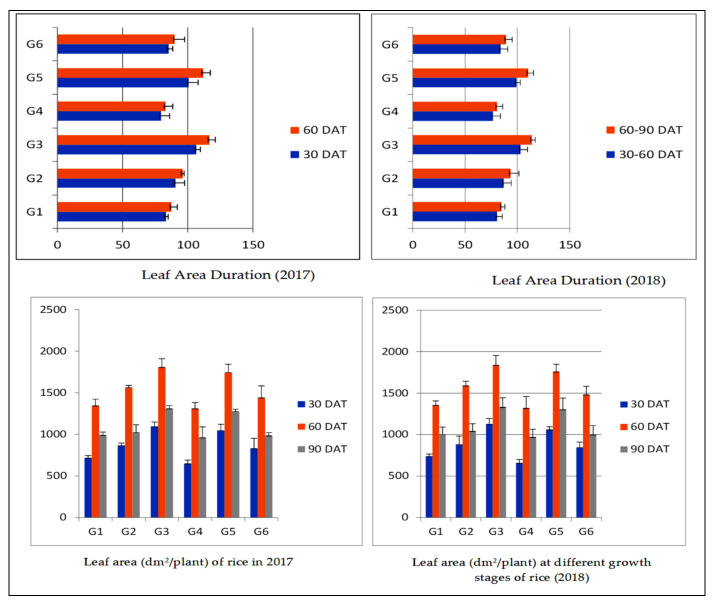
Continuous mono-cropping of rice has resulted in decline or stagnation of yield output due to the occurrence of multiple nutrient deficiencies and worsening of soil physicochemical properties accompanying increased pressure of insect pests and diseases. The basic concept of integrated nutrient management (INM) is maintenance or adjustment of soil fertility and supply of plant nutrients to an optimum level for sustaining the desired crop productivity through optimisation of benefits from all possible sources of plant nutrients in an integrated way. Augmenting a rice-based cropping system with pulses is a prevalent and indigenous cropping system under rainfed conditions. Considering the above facts, experiments were conducted to evaluate the impacts of integrated nutrient management on productivity of aromatic rice-greengram cropping system and nutrient balance of the post-harvest soil for agricultural sustainability under rainfed conditions in two consecutive years (2017-2018 and 2018-2019) with six main plots and three subplots. The experimental findings revealed that the treatment comprised of 50% recommended dose of fertiliser (RDF) through chemicals + 50% recommended dose of nitrogen (RDN) through farmyard manure (FYM) increased the plant height, tillers, dry matter accumulation, leaf area and leaf area duration, and yield parameters in short grain aromatic rice. Similarly, preceding application of 50% RDF + 50% RDN through FYM to rice and further application 75% RDF + + phosphate solubilizing bacteria (PSB) to greengram increased the growth characteristics and yield parameters-such as pods/plant, seeds/pod, grain yield, stover yield, and harvest index-in greengram. It was concluded that the treatment consisting of 50% RDF (chemical fertiliser) + 50% RDN (FYM) to rice and 75% RDF + + PSB to greengram increased the productivity of the rice-greengram cropping system. Furthermore, the adoption of INM has positively impacted post-harvest soil nutrient balance.
由于出现多种养分缺乏以及土壤理化性质恶化,同时病虫害压力增加,水稻连作导致产量下降或停滞。综合养分管理(INM)的基本概念是通过以综合方式优化所有可能的植物养分来源的效益,维持或调整土壤肥力,并将植物养分供应至最佳水平,以维持所需的作物生产力。在雨养条件下,用豆类作物强化以水稻为主的种植系统是一种普遍的本土种植系统。考虑到上述事实,连续两年(2017 - 2018年和2018 - 2019年)进行了试验,设置六个主区和三个副区,以评估综合养分管理对雨养条件下香稻 - 绿豆种植系统生产力及收获后土壤养分平衡的影响,以实现农业可持续性。实验结果表明,通过化学肥料施用50%推荐施肥量(RDF) + 通过农家肥(FYM)施用50%推荐氮量(RDN)的处理增加了短粒香稻的株高、分蘖数、干物质积累、叶面积和叶面积持续时间以及产量参数。同样,在水稻种植前通过FYM施用50% RDF + 50% RDN,随后在绿豆种植时施用75% RDF + 解磷细菌(PSB),增加了绿豆的生长特性和产量参数,如每株豆荚数、每荚种子数、籽粒产量、秸秆产量和收获指数。得出的结论是,对水稻采用50% RDF(化学肥料) + 50% RDN(FYM)以及对绿豆采用75% RDF + 解磷细菌的处理提高了香稻 - 绿豆种植系统的生产力。此外,采用综合养分管理对收获后土壤养分平衡产生了积极影响。