Purchase Callun Keith, Al Zulayq Dhafer Manna, O'Brien Bio Talakatoa, Kowalewski Matthew Joseph, Berenjian Aydin, Tarighaleslami Amir Hossein, Seifan Mostafa
School of Engineering, The University of Waikato, Hamilton 3240, New Zealand.
Materials (Basel). 2021 Dec 23;15(1):76. doi: 10.3390/ma15010076.
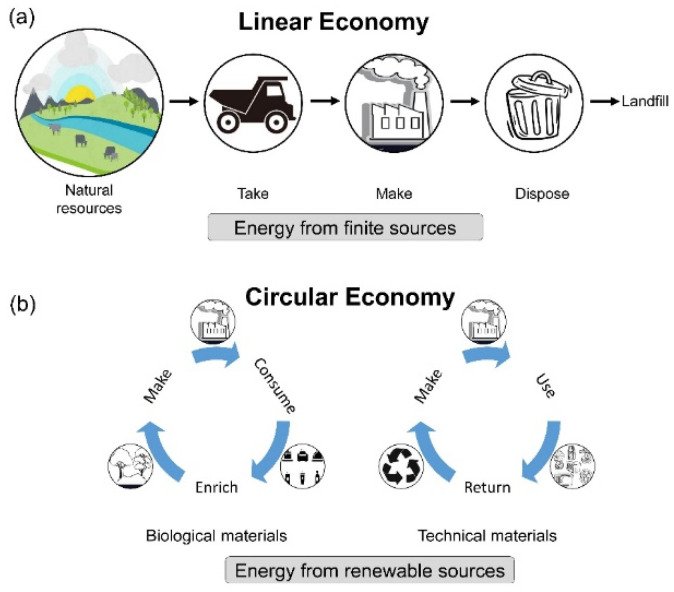
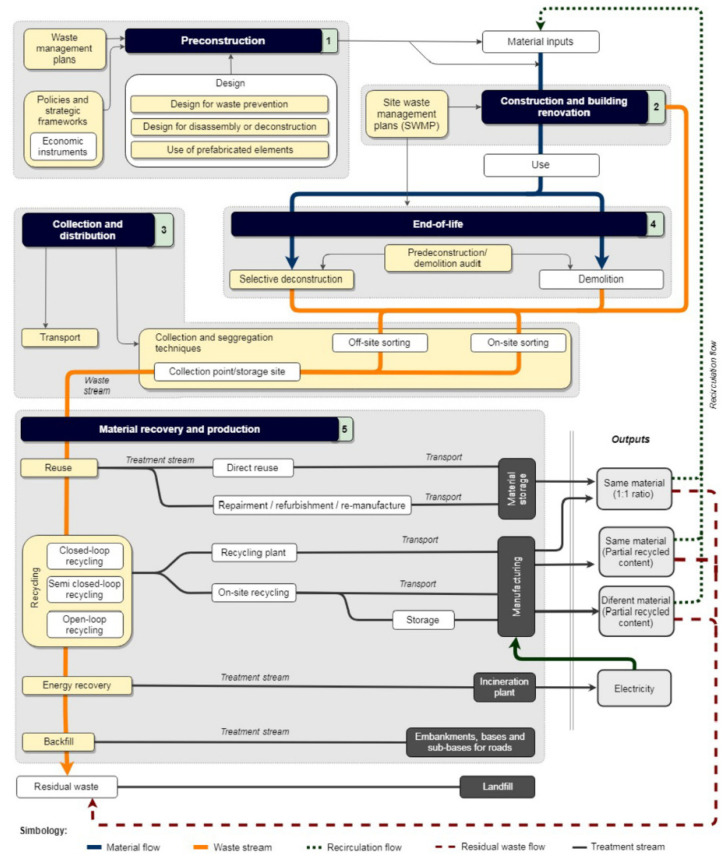
Conventionally, in a linear economy, C&D (Construction and Demolition) waste was considered as zero value materials, and, as a result of that, most C&D waste materials ended up in landfills. In recent years, with the increase in the awareness around sustainability and resource management, various countries have started to explore new models to minimize the use of limited resources which are currently overused, mismanaged, or quickly depleting. In this regard, the implementation of CE (Circular Economy) has emerged as a potential model to minimize the negative impact of C&D wastes on the environment. However, there are some challenges hindering a full transition to CE in the construction and demolition sectors. Therefore, this review paper aims to critically scrutinize different aspects of C&D waste and how CE can be integrated into construction projects. Reviewing of the literature revealed that the barriers in the implementation of CE in C&D waste sectors fall in five main domains, namely legal, technical, social, behavioral, and economic aspects. In this context, it was found that policy and governance, permits and specifications, technological limitation, quality and performance, knowledge and information, and, finally, the costs associated with the implementation of CE model at the early stage are the main barriers. In addition to these, from the contractors' perspective, C&D waste dismantling, segregation, and on-site sorting, transportation, and local recovery processes are the main challenges at the start point for small-scale companies. To address the abovementioned challenges, and also to minimize the ambiguity of resulting outcomes by implementing CE in C&D waste sectors, there is an urgent need to introduce a global framework and a practicable pathway to allow companies to implement such models, regardless of their scale and location. Additionally, in this paper, recommendations on the direction for areas of future studies for a reduction in the environmental impacts have been provided. To structure an effective model approach, the future direction should be more focused on dismantling practices, hazardous material handling, quality control on waste acceptance, and material recovery processes, as well as a incentivization mechanism to promote ecological, economic, and social benefits of the CE for C&D sectors.
传统上,在线性经济中,建筑与拆除(C&D)废物被视为零价值材料,因此,大多数建筑与拆除废物最终都被填埋。近年来,随着可持续性和资源管理意识的提高,各国开始探索新模式,以尽量减少对目前过度使用、管理不善或迅速枯竭的有限资源的使用。在这方面,循环经济(CE)的实施已成为一种潜在模式,以尽量减少建筑与拆除废物对环境的负面影响。然而,在建筑和拆除行业,仍存在一些阻碍向循环经济全面转型的挑战。因此,本文旨在批判性地审视建筑与拆除废物的不同方面,以及如何将循环经济融入建设项目。对文献的回顾表明,在建筑与拆除废物领域实施循环经济的障碍主要集中在五个主要领域,即法律、技术、社会、行为和经济方面。在此背景下,发现政策与治理、许可与规范、技术限制、质量与性能、知识与信息,以及最后,在早期实施循环经济模式的相关成本是主要障碍。除此之外,从承包商的角度来看,建筑与拆除废物的拆除、分类以及现场分拣、运输和本地回收过程是小规模公司在起点面临的主要挑战。为应对上述挑战,并尽量减少在建筑与拆除废物领域实施循环经济所产生结果的模糊性,迫切需要引入一个全球框架和一条可行的途径,以使公司能够实施此类模式,无论其规模和位置如何。此外,本文还提供了关于未来研究方向的建议,以减少环境影响。为构建一个有效的模型方法,未来方向应更侧重于拆除实践、危险材料处理、废物接收的质量控制、材料回收过程,以及促进建筑与拆除行业循环经济的生态、经济和社会效益的激励机制。