Department of Information and Communication Engineering, Chaoyang University of Technology, Taichung City 413310, Taiwan.
Smart System Institute, Institute for Information Industry, Taipei City 10622, Taiwan.
Sensors (Basel). 2022 Jan 3;22(1):340. doi: 10.3390/s22010340.
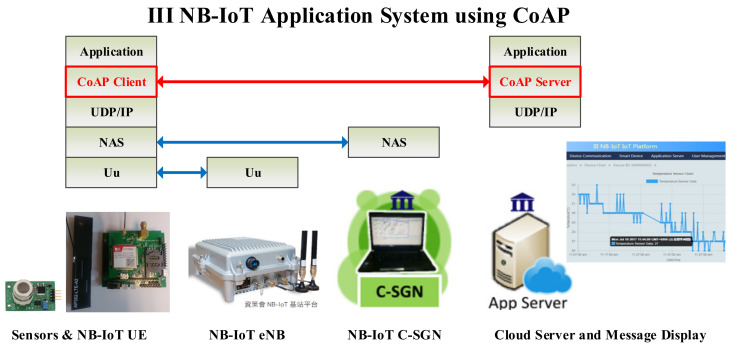
The ecosystem for an Internet of Things (IoT) generally comprises endpoint clients, network devices, and cloud servers. Thus, data transfers within the network present multiple security concerns. The recent boom in IoT applications has accelerated the need for a network infrastructure that provides timely and safe information exchange services. A shortcoming of many existing networks is the use of static key authentication. To enable the use of automatic key update mechanisms in IoT devices and enhance security in lightweight machine-to-machine (M2M) communications, we propose a key update mechanism, namely, double OTP (D-OTP), which combines both one-time password (OTP) and one-time pad to achieve an IoT ecosystem with theoretically unbreakable security. The proposed D-OTP was implemented into the Constrained Application Protocol (CoAP) through the commonly used libcoap library. The experimental results revealed that an additional 8.93% latency overhead was required to obtain an unbreakable guarantee of data transfers in 100 CoAP communication sessions.
物联网(IoT)的生态系统通常包括端点客户端、网络设备和云服务器。因此,网络内的数据传输存在多种安全隐患。最近物联网应用的蓬勃发展加速了对提供及时、安全信息交换服务的网络基础设施的需求。许多现有网络的一个缺点是使用静态密钥认证。为了在物联网设备中启用自动密钥更新机制,并增强轻量级机器对机器(M2M)通信中的安全性,我们提出了一种密钥更新机制,即双 OTP(D-OTP),它结合了一次性密码(OTP)和一次性密码本,以实现具有理论上不可破解安全性的物联网生态系统。所提出的 D-OTP 通过常用的 libcoap 库被实现到约束应用协议(CoAP)中。实验结果表明,在 100 次 CoAP 通信会话中,需要额外的 8.93%的延迟开销,才能获得数据传输的不可破解保证。