Shah Muhammad Khurshid Alam, Azad Abul Kalam, Nawaz Asif, Ullah Shafi, Latif Muhammad Shahid, Rahman Habibur, Alsharif Khalaf F, Alzahrani Khalid J, El-Kott Attalla F, Albrakati Ashraf, Abdel-Daim Mohamed M
Advanced Drug Delivery Lab, Gomal Center of Pharmaceutical Sciences, Faculty of Pharmacy, Gomal University, Dera Ismail Khan 29050, Pakistan.
Pharmaceutical Technology Unit, Faculty of Pharmacy, AIMST University, Bedong 08100, Kedah, Malaysia.
Polymers (Basel). 2021 Dec 30;14(1):135. doi: 10.3390/polym14010135.
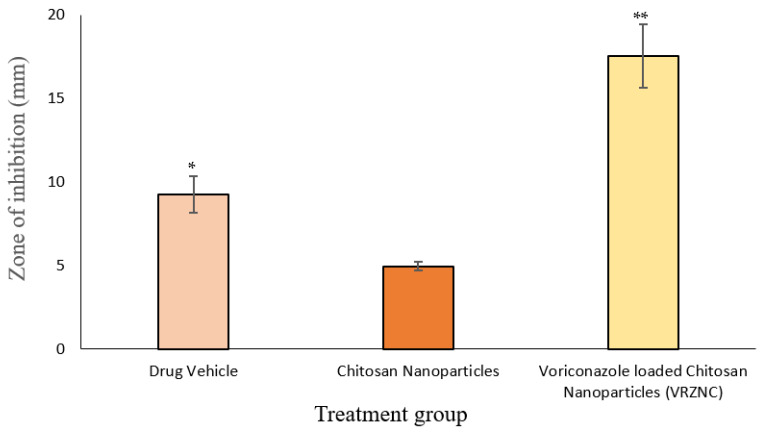
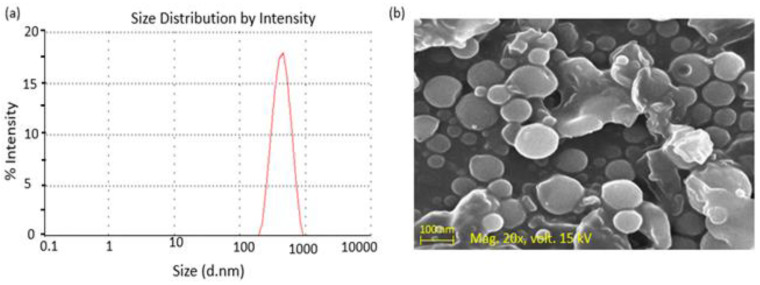
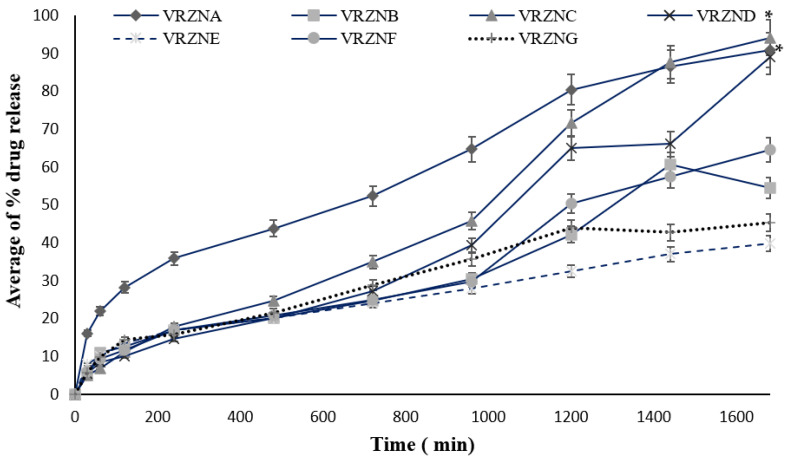
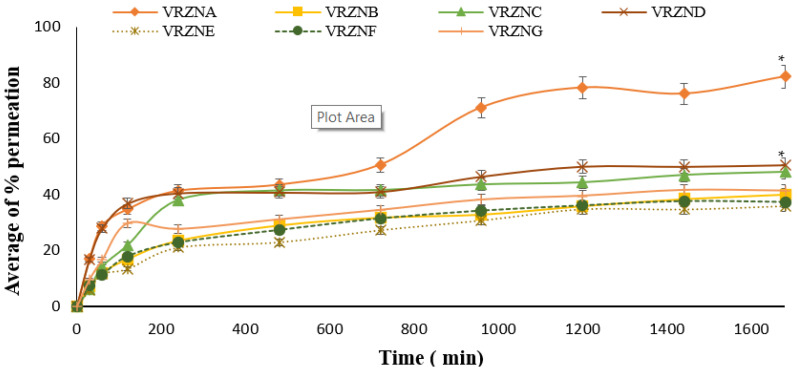
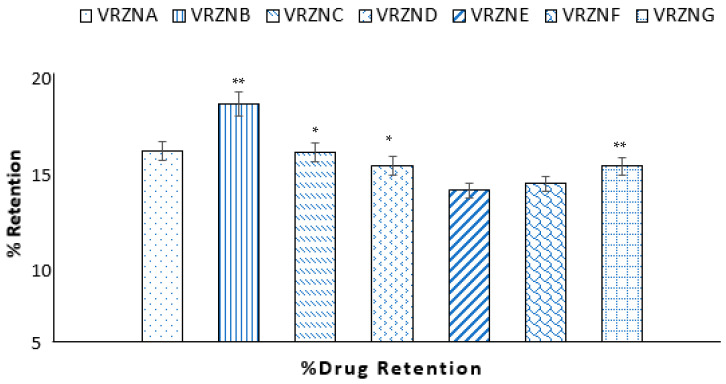
This study aims to develop chitosan-based voriconazole nanoparticles (NPs) using spray-drying technique. The effect of surfactants and polymers on the physicochemical properties, in vitro release, and permeation of NPs was investigated. The prepared NPs containing various surfactants and polymers (e.g., Tween 20 (T20), Tween 80 (T80), sodium lauryl sulfate (SLS), propylene glycol (PG), and Polyethylene glycol-4000 (PEG-4000)) were physiochemically evaluated for size, zeta potential, drug content, percent entrapment efficiency, in vitro release, and permeation across rats' skin. A Franz diffusion cell was used for evaluating the in vitro release and permeation profile. The voriconazole-loaded NPs were investigated for antifungal activity against (). The prepared NPs were in the nano range (i.e., 160-500 nm) and positively charged. Images taken by a scanning electron microscope showed that all prepared NPs were spherical and smooth. The drug content of NPs ranged from 75% to 90%. Nanoparticle formulations exhibited a good in vitro release profile and transport voriconazole across the rat's skin in a slow control release manner. The NPs containing SLS, T80, and PG exhibited the best penetration and skin retention profile. In addition, the formulation exhibited a potential antifungal effect against . It was concluded that the development of chitosan NPs has a great potential for the topical delivery of voriconazole against fungal infection.
本研究旨在采用喷雾干燥技术制备基于壳聚糖的伏立康唑纳米粒(NPs)。研究了表面活性剂和聚合物对NPs的物理化学性质、体外释放及渗透的影响。对含有各种表面活性剂和聚合物(如吐温20(T20)、吐温80(T80)、十二烷基硫酸钠(SLS)、丙二醇(PG)和聚乙二醇-4000(PEG-4000))的制备的NPs进行了物理化学性质评估,包括粒径、zeta电位、药物含量、包封率、体外释放以及对大鼠皮肤的渗透。使用Franz扩散池评估体外释放和渗透情况。对负载伏立康唑的NPs进行了抗()真菌活性研究。制备的NPs处于纳米范围(即160 - 500 nm)且带正电荷。扫描电子显微镜拍摄的图像显示,所有制备的NPs均呈球形且表面光滑。NPs的药物含量在75%至90%之间。纳米粒制剂表现出良好的体外释放特性,并以缓慢控释的方式使伏立康唑透过大鼠皮肤。含有SLS、T80和PG的NPs表现出最佳的渗透和皮肤滞留特性。此外,该制剂对()表现出潜在的抗真菌作用。得出结论,壳聚糖纳米粒的开发在伏立康唑局部递送治疗真菌感染方面具有巨大潜力。