A.I.Virtanen Institute for Molecular Sciences, University of Eastern Finland, Kuopio, Finland.
Department of Human Genetics, Leiden University Medical Center, Leiden, The Netherlands.
J Headache Pain. 2022 Jan 10;23(1):4. doi: 10.1186/s10194-021-01383-8.
Migraine is a common brain disorder that predominantly affects women. Migraine pain seems mediated by the activation of mechanosensitive channels in meningeal afferents. Given the role of transient receptor potential melastatin 3 (TRPM3) channels in mechanical activation, as well as hormonal regulation, these channels may play a role in the sex difference in migraine. Therefore, we investigated whether nociceptive firing induced by TRPM3 channel agonists in meningeal afferents was different between male and female mice. In addition, we assessed the relative contribution of mechanosensitive TRPM3 channels and that of mechanosensitive Piezo1 channels and transient receptor potential vanilloid 1 (TRPV1) channels to nociceptive firing relevant to migraine in both sexes.
Ten- to 13-week-old male and female wildtype (WT) C57BL/6 J mice were used. Nociceptive spikes were recorded directly from nerve terminals in the meninges in the hemiskull preparations.
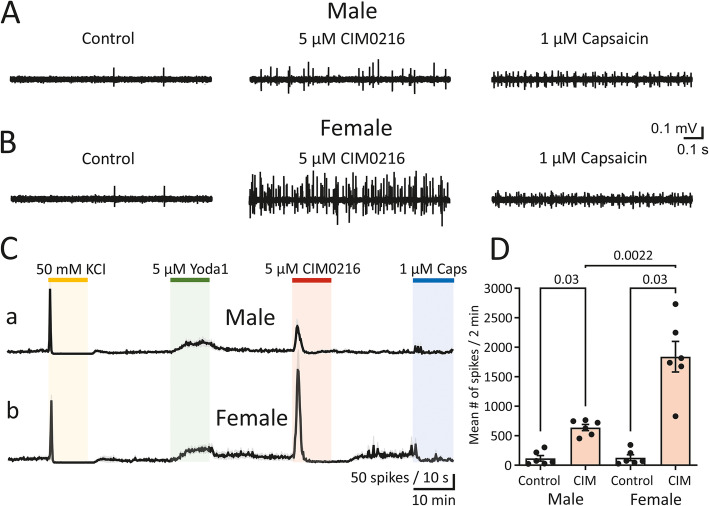
Selective agonists of TRPM3 channels profoundly activated peripheral trigeminal nerve fibres in mouse meninges. A sex difference was observed for nociceptive firing induced by either PregS or CIM0216, both agonists of TRPM3 channels, with the induced firing being particularly prominent for female mice. Application of Yoda1, an agonist of Piezo1 channels, or capsaicin activating TRPV1 channels, although also leading to increased nociceptive firing of meningeal fibres, did not reveal a sex difference. Cluster analyses of spike activities indicated a massive and long-lasting activation of TRPM3 channels with preferential induction of large-amplitude spikes in female mice. Additional spectral analysis revealed a dominant contribution of spiking activity in the α- and β-ranges following TRPM3 agonists in female mice.
Together, we revealed a specific mechanosensitive profile of nociceptive firing in females and suggest TRPM3 channels as a potential novel candidate for the generation of migraine pain, with particular relevance to females.
偏头痛是一种常见的脑部疾病,主要影响女性。偏头痛疼痛似乎是由脑膜传入纤维中的机械敏感通道激活介导的。鉴于瞬时受体电位 melastatin 3(TRPM3)通道在机械激活以及激素调节中的作用,这些通道在偏头痛的性别差异中可能发挥作用。因此,我们研究了 TRPM3 通道激动剂在脑膜传入纤维中引起的伤害性放电是否在雄性和雌性小鼠之间存在差异。此外,我们评估了机械敏感 TRPM3 通道以及机械敏感 Piezo1 通道和瞬时受体电位香草素 1(TRPV1)通道对两性与偏头痛相关的伤害性放电的相对贡献。
使用 10-13 周龄的雄性和雌性野生型(WT)C57BL/6J 小鼠。直接从颅骨半脑制备物的脑膜中的神经末梢记录伤害性 spikes。
TRPM3 通道的选择性激动剂可强烈激活小鼠脑膜中的外周三叉神经纤维。无论是 PregS 还是 CIM0216(TRPM3 通道的激动剂)引起的伤害性放电均观察到性别差异,而雌性小鼠引起的放电尤其明显。尽管应用 Piezo1 通道激动剂 Yoda1 或激活 TRPV1 通道的辣椒素也会导致脑膜纤维的伤害性放电增加,但并未发现性别差异。尖峰活动的聚类分析表明,TRPM3 通道的大量且持久激活,在雌性小鼠中优先诱导大振幅尖峰。额外的频谱分析表明,在雌性小鼠中,TRPM3 激动剂后,α-和β-范围的尖峰活动占主导地位。
综上所述,我们揭示了雌性中伤害性放电的特定机械敏感特征,并提出 TRPM3 通道可能是偏头痛疼痛产生的潜在新候选物,特别是与女性相关。