Faculty of Nursing, Department of Public Health Nursing, Aydın Adnan Menderes University, Aydın, Turkey.
Faculty of Medicine, Department of Public Health, Ege University, İzmir, Turkey.
BMC Geriatr. 2022 Jan 10;22(1):37. doi: 10.1186/s12877-021-02706-9.
The objective of this study is to analyze the data of the 2018 Turkey Demographic and Health Survey and determine personal and demographic factors associated with elderly who are 60 and older and living alone.
This cross-sectional study is the secondary analysis of the national data obtained with the 2018 Turkey Demographic and Health Survey. Logistic regression analysis was used to estimate differences in living alone based on gender, age, welfare status, region of residence, urban/rural residence, whether the person is working in a paid job and home ownership. Independent effect of every variable is observed in the first stage and then checked for all variables in the equation.
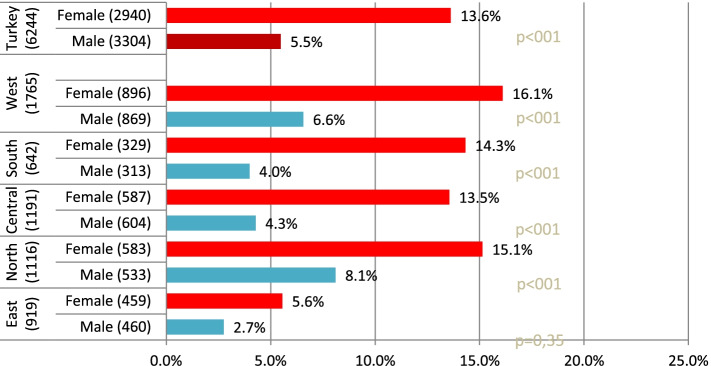
There is a total of 37,897 participants' data in the Turkey Demographic and Health Survey Database. In the study, there are 6244 (16.5%) older adults in 11,056 households and 9.79% of the elderly population is alone. The percentage of elderly women living alone is 13.62% while this percentage is 5.48% for elderly men (p < 0.001). The risk of living alone for elderly women is 2.74 times more than elderly men (95% Cl 2.28-3.31). Being poor increases the risk of living alone for elderly people 2.84 fold compared to being rich (95% Cl 2.17-3.71). Those who have high school and higher education level have 2.38 (95% Cl 1.73-3.29) fold higher risk of living alone than people with lower education. Older adults living in the Western region of the country have 3.18 (95% Cl 2.20-4.59) times higher risk of living alone than older adults living in the Eastern region of the country. The risk of living alone for older adults increases 1.90 fold (95% Cl 1.55-2.32) if the house they live in do not belong to a household member.
Based on these findings, needs of older adults under risk should be met to allow them to be healthy and live their lives in better social, economic and cultural conditions.
本研究旨在分析 2018 年土耳其人口与健康调查数据,确定与 60 岁及以上独居老年人相关的个人和人口统计学因素。
本横断面研究是对 2018 年土耳其人口与健康调查获得的全国数据进行的二次分析。采用 logistic 回归分析,根据性别、年龄、福利状况、居住地区、城乡居住、是否从事有薪工作和住房所有权,估计独居的差异。在第一阶段观察每个变量的独立影响,然后检查方程中的所有变量。
土耳其人口与健康调查数据库共有 37897 名参与者的数据。在这项研究中,11056 户家庭中有 6244 名(16.5%)老年人,9.79%的老年人口独居。独居老年女性的比例为 13.62%,而独居老年男性的比例为 5.48%(p<0.001)。老年女性独居的风险是老年男性的 2.74 倍(95%Cl 2.28-3.31)。与富裕人群相比,贫困人群独居的风险增加 2.84 倍(95%Cl 2.17-3.71)。与教育程度较低的人相比,具有中学及以上学历的人独居的风险高 2.38 倍(95%Cl 1.73-3.29)。居住在该国西部地区的老年人独居的风险是居住在该国东部地区老年人的 3.18 倍(95%Cl 2.20-4.59)。如果老年人居住的房屋不属于家庭成员所有,其独居的风险将增加 1.90 倍(95%Cl 1.55-2.32)。
根据这些发现,应满足处于风险中的老年人的需求,以使他们能够在更好的社会、经济和文化条件下保持健康和生活。