BNLMS, College of Chemistry and Molecular Engineering, Peking Universitygrid.11135.37, Beijing, China.
Center for Quantitative Biology, Academy for Advanced Interdisciplinary Studies, Peking Universitygrid.11135.37, Beijing, China.
mSystems. 2022 Feb 22;7(1):e0108421. doi: 10.1128/msystems.01084-21. Epub 2022 Jan 11.
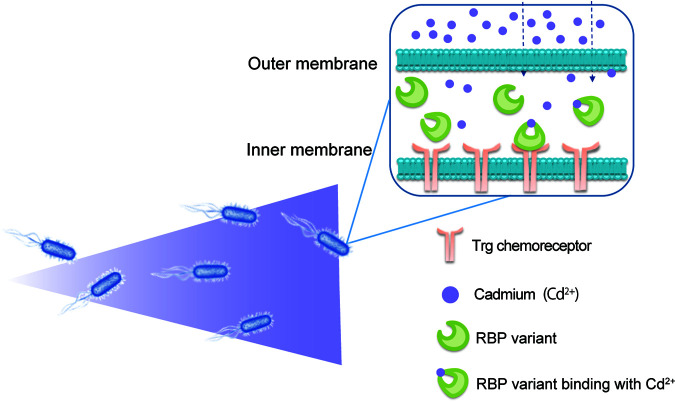
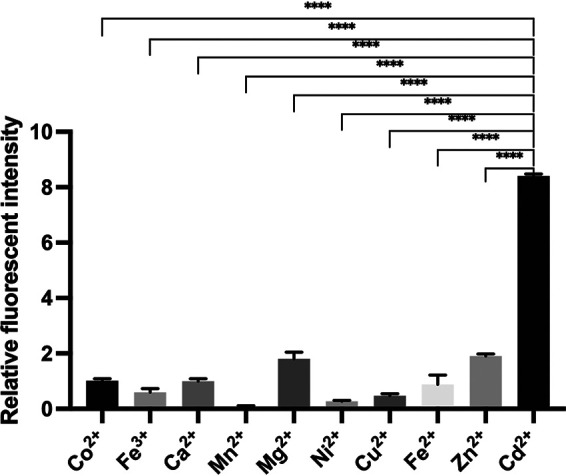
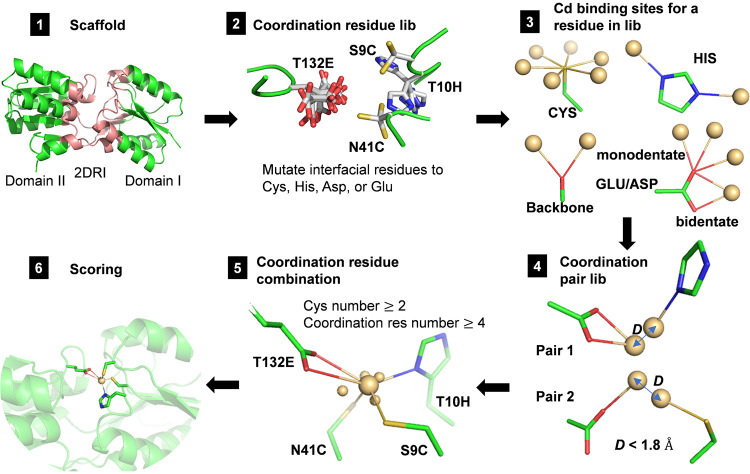
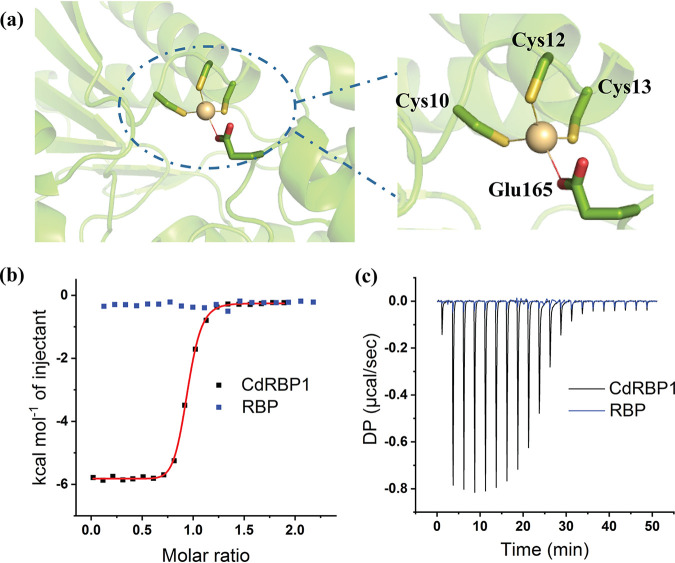
Periplasmic binding proteins such as ribose-binding proteins (RBPs) are involved in the bacterial chemotaxis two-component system. RBP selectively identifies and interacts with ribose to induce a conformational change that leads to chemotaxis. Here, we report the development of an engineered Escherichia coli (E. coli) strain expressing a redesigned RBP that can effectively sense cadmium ions and regulate chemotactic movement of cells toward a cadmium ion gradient. RBP was computationally redesigned to bind cadmium ions and produce the conformational change required for chemoreceptor binding. The successful design, CdRBP1, binds to cadmium ions with a dissociation constant of 268 nM. When CdRBP1 was expressed in the periplasmic space of E. coli, the bacteria became live cadmium ion hunters with high selectivity over other divalent metal ions. This work presents an example of making cadmium ions, which are toxic for most organisms, as an attractant to regulate cells movement. Our approach also demonstrates that RBP can be precisely designed to develop metal-detecting living systems for potential applications in synthetic biology and environmental studies. Cadmium pollution is one of the major environmental problems due to excessive release and accumulation. New technologies that can auto-detect cadmium ions with good biocompatibility are in urgent need. In this study, we engineered the bacterial chemotaxis system to positively sense cadmium ions by redesigning ribose-binding protein (RBP) to tightly bind cadmium ion and produce the right conformational change for receptor binding and signaling. Our engineered E. coli cells can auto-detect and chase cadmium ions with divalent metal ion selectivity. Many attempts have been carried out to redesign RBP at the ribose binding site with little success. Instead of the ribose binding site, we introduced the cadmium binding site in the opening of the ribose binding pocket by a specially developed computational algorithm. Our design strategy can be applied to engineer live bacteria with autonomous detection and remediation abilities for metal ions or other chemicals in the future.
周质结合蛋白(如核糖结合蛋白(RBP))参与细菌趋化性双组分系统。RBP 选择性地识别和与核糖相互作用,诱导构象变化,从而导致趋化性。在这里,我们报告了一种工程大肠杆菌(E. coli)菌株的开发,该菌株表达了一种经过重新设计的 RBP,该 RBP 可以有效地感应镉离子并调节细胞向镉离子梯度的趋化运动。RBP 经过计算重新设计以结合镉离子并产生趋化受体结合所需的构象变化。成功设计的 CdRBP1 与镉离子的解离常数为 268 nM。当 CdRBP1 在大肠杆菌的周质空间中表达时,细菌成为对其他二价金属离子具有高选择性的活镉离子猎手。这项工作提供了一个将对大多数生物体有毒的镉离子作为吸引力来调节细胞运动的例子。我们的方法还表明,RBP 可以经过精确设计,开发用于潜在应用于合成生物学和环境研究的金属检测生物系统。镉污染是由于过度释放和积累而导致的主要环境问题之一。急需具有良好生物相容性的自动检测镉离子的新技术。在这项研究中,我们通过重新设计核糖结合蛋白(RBP)以紧密结合镉离子并产生用于受体结合和信号传导的正确构象变化,使细菌趋化系统能够积极感应镉离子。我们设计的大肠杆菌细胞可以具有二价金属离子选择性地自动检测和追逐镉离子。许多尝试都试图在核糖结合位点重新设计 RBP,但收效甚微。我们通过专门开发的计算算法,在核糖结合口袋的开口处引入了镉结合位点,而不是核糖结合位点。我们的设计策略可用于未来工程化具有自主检测和修复金属离子或其他化学物质能力的活细菌。