MRC/Wits Developmental Pathways for Health Research Unit, Department of Pediatrics, Faculty of Health Sciences, University of the Witwatersrand, Johannesburg, South Africa.
Sydney Brenner Institute for Molecular Bioscience, Faculty of Health Sciences, University of the Witwatersrand, Johannesburg, South Africa.
Diabetes Care. 2022 Mar 1;45(3):717-723. doi: 10.2337/dc21-0365.
Polygenic prediction of type 2 diabetes (T2D) in continental Africans is adversely affected by the limited number of genome-wide association studies (GWAS) of T2D from Africa and the poor transferability of European-derived polygenic risk scores (PRSs) in diverse ethnicities. We set out to evaluate if African American, European, or multiethnic-derived PRSs would improve polygenic prediction in continental Africans.
Using the PRSice software, ethnic-specific PRSs were computed with weights from the T2D GWAS multiancestry meta-analysis of 228,499 case and 1,178,783 control subjects. The South African Zulu study (n = 1,602 case and 981 control subjects) was used as the target data set. Validation and assessment of the best predictive PRS association with age at diagnosis were conducted in the Africa America Diabetes Mellitus (AADM) study (n = 2,148 case and 2,161 control subjects).
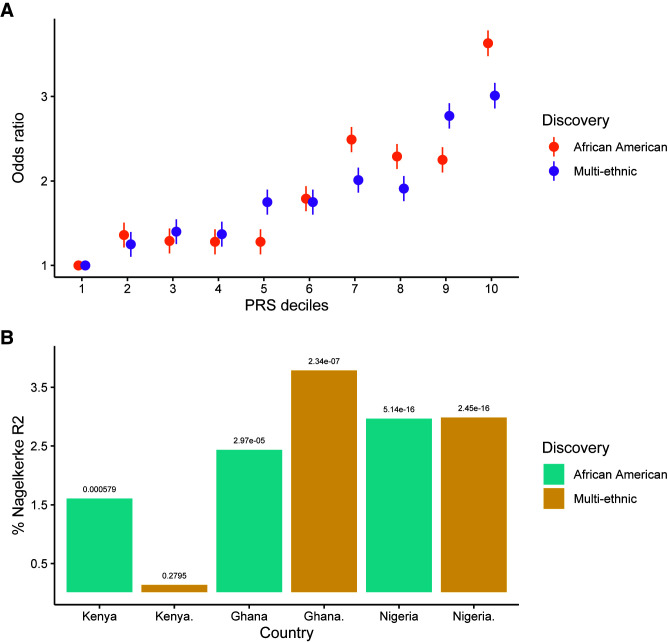
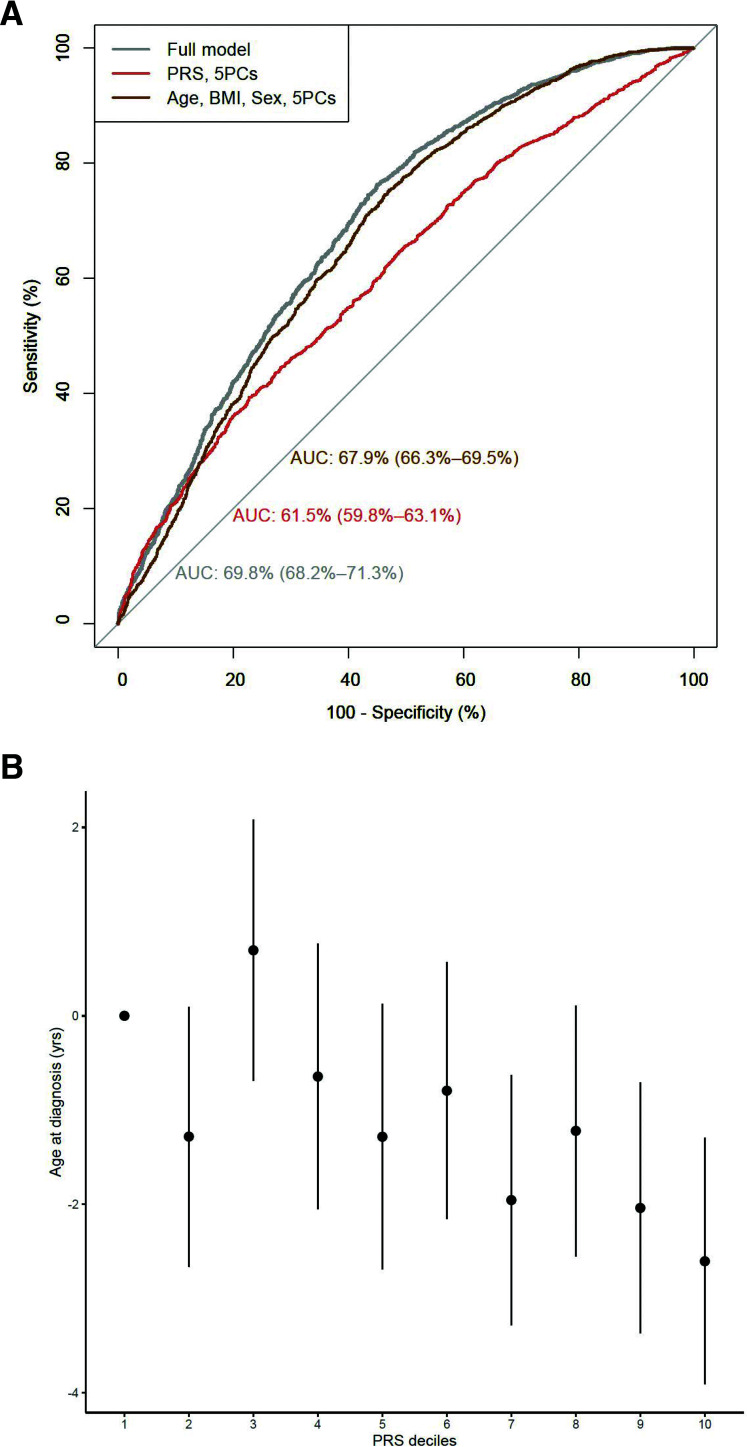
The discriminatory ability of the African American and multiethnic PRSs was similar. However, the African American-derived PRS was more transferable in all the countries represented in the AADM cohort and predictive of T2D in the country combined analysis compared with the European and multiethnic-derived scores. Notably, participants in the 10th decile of this PRS had a 3.63-fold greater risk (odds ratio 3.63; 95% CI 2.19-4.03; P = 2.79 × 10⁻¹⁷) per risk allele of developing diabetes and were diagnosed 2.6 years earlier than those in the first decile.
African American-derived PRS enhances polygenic prediction of T2D in continental Africans. Improved representation of non-European populations (including Africans) in GWAS promises to provide better tools for precision medicine interventions in T2D.
在非洲大陆人中,2 型糖尿病(T2D)的多基因预测受到来自非洲的 T2D 全基因组关联研究(GWAS)数量有限以及欧洲衍生的多基因风险评分(PRS)在不同种族中转移能力差的影响。我们着手评估非洲裔美国人、欧洲人或多种族衍生的 PRS 是否会改善大陆非洲人中的多基因预测。
使用 PRSice 软件,根据来自 228499 例病例和 1178783 例对照的多民族 GWAS 荟萃分析中的权重,计算了特定于种族的 PRS。南非祖鲁研究(n=1602 例病例和 981 例对照)被用作目标数据集。在非洲裔美国人糖尿病研究(AADM)中(n=2148 例病例和 2161 例对照),对与诊断时年龄最佳预测 PRS 关联的验证和评估进行了评估。
非洲裔美国人和多种族 PRS 的区分能力相似。然而,与欧洲和多种族衍生的评分相比,非洲裔美国衍生的 PRS 在 AADM 队列中代表的所有国家中更具转移性,并且可以预测该国家的 T2D。值得注意的是,在这种 PRS 的第 10 个十分位数的参与者中,每增加一个风险等位基因,发生糖尿病的风险增加 3.63 倍(优势比 3.63;95%CI 2.19-4.03;P=2.79×10⁻¹⁷),并且比第一十分位数的参与者早诊断出 2.6 年。
非洲裔美国衍生的 PRS 增强了大陆非洲人中 T2D 的多基因预测。非欧洲人群(包括非洲人)在 GWAS 中的代表性提高,有望为 T2D 的精准医学干预提供更好的工具。