Eades Lauren, Drozd Michael, Cubbon Richard M
Leeds Institute of Cardiovascular and Metabolic Medicine, The University of Leeds, Clarendon Way, Leeds LS2 9JT, U.K.
Biochem Soc Trans. 2022 Feb 28;50(1):413-422. doi: 10.1042/BST20210857.
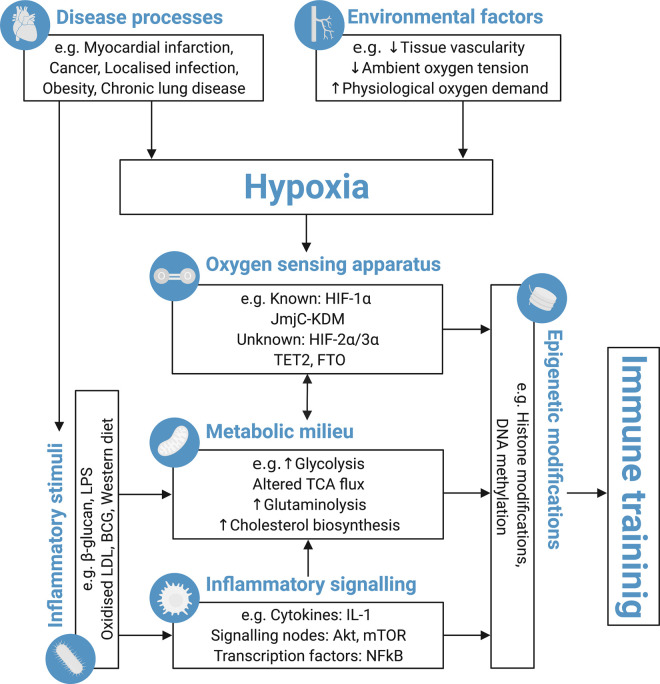
Innate immune function is shaped by prior exposures in a phenomenon often referred to as 'memory' or 'training'. Diverse stimuli, ranging from pathogen-associated molecules to atherogenic lipoproteins, induce long-lasting training, impacting on future responses, even to distinct stimuli. It is now recognised that epigenetic modifications in innate immune cells, and their progenitors, underpin these sustained behavioural changes, and that rewired cellular metabolism plays a key role in facilitating such epigenetic marks. Oxygen is central to cellular metabolism, and cells exposed to hypoxia undergo profound metabolic rewiring. A central effector of these responses are the hypoxia inducible factors (or HIFs), which drive transcriptional programmes aiming to adapt cellular homeostasis, such as by increasing glycolysis. These metabolic shifts indirectly promote post-translational modification of the DNA-binding histone proteins, and also of DNA itself, which are retained even after cellular oxygen tension and metabolism normalise, chronically altering DNA accessibility and utilisation. Notably, the activity of HIFs can be induced in some normoxic circumstances, indicating their broad importance to cell biology, irrespective of oxygen tension. Some HIFs are implicated in innate immune training and hypoxia is present in many disease states, yet many questions remain about the association between hypoxia and training, both in health and disease. Moreover, it is now appreciated that cellular responses to hypoxia are mediated by non-HIF pathways, suggesting that other mechanisms of training may be possible. This review sets out to define what is already known about the topic, address gaps in our knowledge, and provide recommendations for future research.
先天免疫功能受先前暴露的影响而形成,这一现象通常被称为“记忆”或“训练”。从病原体相关分子到致动脉粥样硬化脂蛋白等多种刺激,都会诱导产生持久的训练,影响未来对不同刺激的反应。现在人们认识到,先天免疫细胞及其祖细胞中的表观遗传修饰是这些持续行为变化的基础,而重新布线的细胞代谢在促进这种表观遗传标记方面起着关键作用。氧气是细胞代谢的核心,暴露于低氧环境中的细胞会经历深刻的代谢重新布线。这些反应的一个核心效应因子是低氧诱导因子(或HIFs),它驱动旨在适应细胞稳态的转录程序,例如通过增加糖酵解。这些代谢变化间接促进了DNA结合组蛋白以及DNA本身的翻译后修饰,即使在细胞氧张力和代谢恢复正常后,这些修饰仍会保留,从而长期改变DNA的可及性和利用率。值得注意的是,在某些常氧情况下也能诱导HIFs的活性,这表明它们对细胞生物学具有广泛的重要性,与氧张力无关。一些HIFs与先天免疫训练有关,并且低氧存在于许多疾病状态中,但关于低氧与训练在健康和疾病中的关联仍有许多问题。此外,现在人们认识到细胞对低氧的反应是由非HIF途径介导的,这表明可能存在其他训练机制。本综述旨在界定关于该主题的已知内容,填补我们知识上的空白,并为未来研究提供建议。