College of Veterinary Medicine, Henan Agricultural Universitygrid.108266.b, Zhengzhou, People's Republic of China.
Institute of Animal Husbandry and Veterinary Research, Henan Academy of Agricultural Sciences, Zhengzhou, People's Republic of China.
Microbiol Spectr. 2022 Feb 23;10(1):e0165721. doi: 10.1128/spectrum.01657-21. Epub 2022 Jan 12.
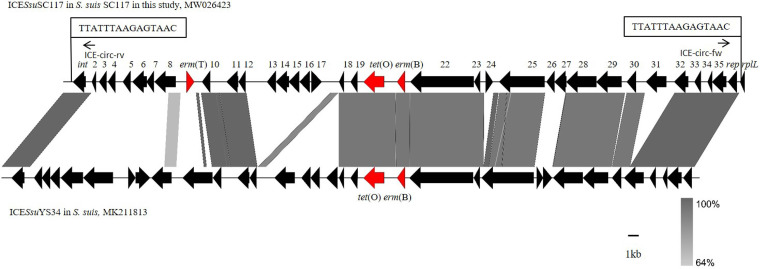
To investigate the presence and location of (T) in clinical Streptococcus suis isolates and explore the transmission ability and fitness cost of (T)-carrying mobile genetic elements among S. suis isolates, MICs were determined by broth microdilution. The presence of (T) in S. suis was detected by PCR. The genetic environment of (T) in S. suis was explored by whole-genome sequencing (WGS) analysis. Intraspecies and interspecies transmission were examined by electrotransformation. The fitness cost associated with the carriage of an (T)-harboring plasmid or an integrative and conjugative element (ICE) was examined by competition experiments. Of 237 nonduplicate strains, (T) was detected in 2 S. suis strains (SC262-ST954 and SC117-ST1314), with its location on a 5,125-bp plasmid in S. suis SC262 and on a 64,013-bp ICESC117 in S. suis SC117, respectively. Both the (T)-carrying plasmid pSC262 and the ICESC117 were transmissible by transformation. Plasmid pSC262 can replicate and express macrolide-lincosamide resistance in heterologous hosts, including S. aureus and S. pneumoniae. Both the (T)-carrying plasmid and the ICE posed a fitness cost to the host S. suis isolate. To the best of our knowledge, this is the first report of the macrolide-lincosamide-streptogramin B resistance gene (T) in S. suis. Its location on a plasmid or an ICE will aid in its transmission. The low detection rate of (T) gene among the S. suis population might be due to the fitness cost of the (T)-carrying plasmid and ICE. Macrolide and lincosamide resistance due to the presence of (T) have posed a challenge for the treatment of Gram-positive pathogens. Although the low detection rate of (T) gene among the S. suis population due to the fitness cost of the (T)-carrying plasmid and ICE, the presence of (T) in S. suis and its potential transmission to other Gram-positive pathogens will be of important significance.
为了研究临床猪链球菌分离株中(T)的存在和位置,并探索携带(T)的移动遗传元件在猪链球菌分离株中的传播能力和适应性代价,采用肉汤微量稀释法测定 MIC。通过 PCR 检测猪链球菌中(T)的存在。通过全基因组测序(WGS)分析探索猪链球菌中(T)的遗传环境。通过电转化检测种内和种间传播。通过竞争实验研究携带(T)质粒或整合和共轭元件(ICE)的适应性代价。在 237 个非重复菌株中,在 2 株猪链球菌(SC262-ST954 和 SC117-ST1314)中检测到(T),其位置分别位于猪链球菌 SC262 的 5125bp 质粒和猪链球菌 SC117 的 64013bp ICESC117 上。携带(T)的质粒 pSC262 和 ICESC117 均可通过转化进行传播。质粒 pSC262 可在异源宿主(包括金黄色葡萄球菌和肺炎链球菌)中复制和表达大环内酯-林可酰胺-链阳性菌素 B 耐药基因。携带(T)的质粒和 ICE 都会给宿主猪链球菌分离株带来适应性代价。据我们所知,这是猪链球菌中大环内酯-林可酰胺-链阳性菌素 B 耐药基因(T)的首次报道。其位于质粒或 ICE 上有助于其传播。在猪链球菌种群中(T)基因的低检出率可能是由于携带(T)的质粒和 ICE 的适应性代价。由于(T)的存在,大环内酯类和林可酰胺类耐药性给革兰氏阳性病原体的治疗带来了挑战。尽管由于携带(T)的质粒和 ICE 的适应性代价,猪链球菌种群中(T)基因的检出率较低,但(T)在猪链球菌中的存在及其向其他革兰氏阳性病原体的潜在传播将具有重要意义。