Reproductive Medicine Center, The First Affiliated Hospital of Sun Yat-sen University, Guangzhou, 510080, Guangdong, China.
Guangdong Provincial Key Laboratory of Reproductive Medicine, Guangzhou, Guangdong, China.
BMC Genomics. 2022 Jan 18;23(1):62. doi: 10.1186/s12864-022-08294-1.
In preimplantation genetic testing for aneuploidy (PGT-A), appropriate evaluation of mosaic embryos is important because of the adverse implications of transferring embryos with high-level mosaicism or discarding those with low-level mosaicism. Despite the availability of multiple reliable techniques for PGT-A, data comparing the detection of mosaicism using these techniques are scarce. To address this gap in the literature, we compared the detection ability of the two most commonly used PGT-A platforms, next-generation sequencing (NGS) and the single-nucleotide polymorphism (SNP) array, for mosaic embryos.
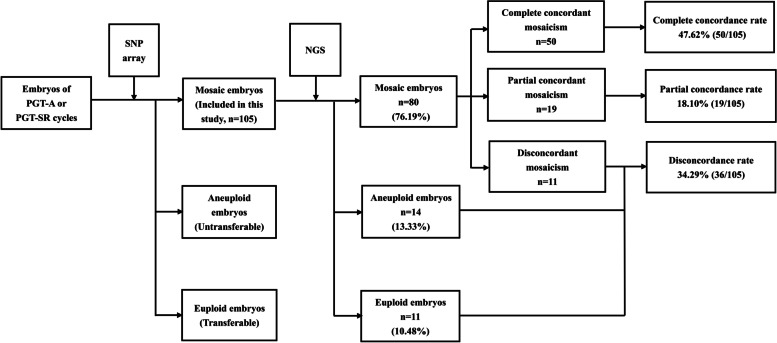
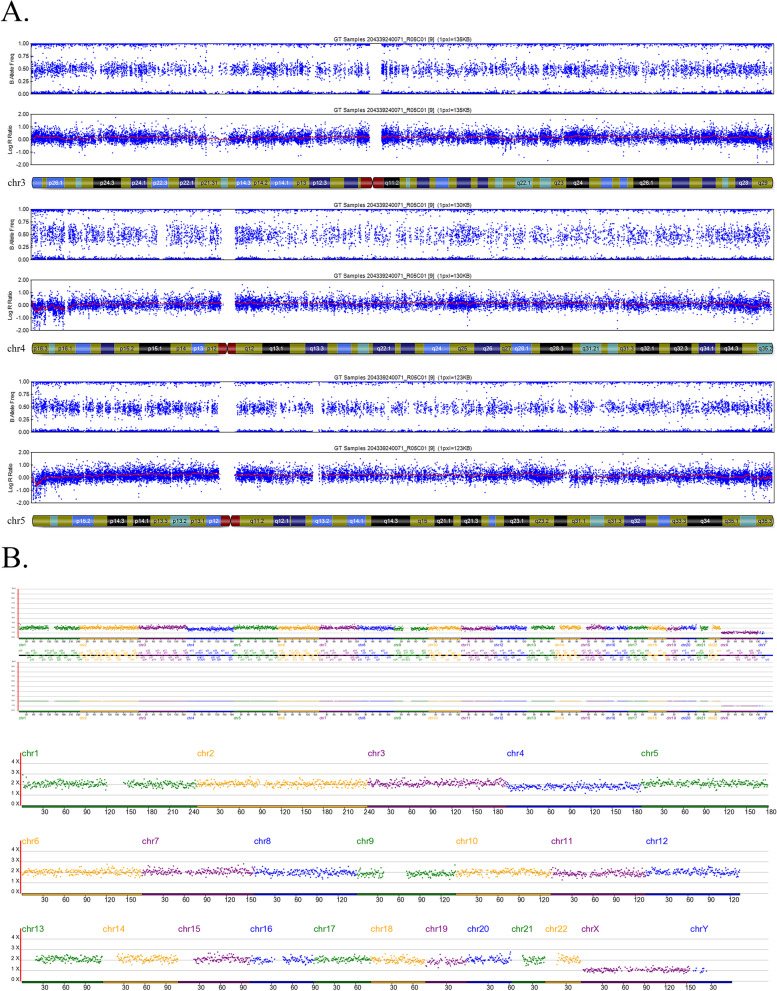
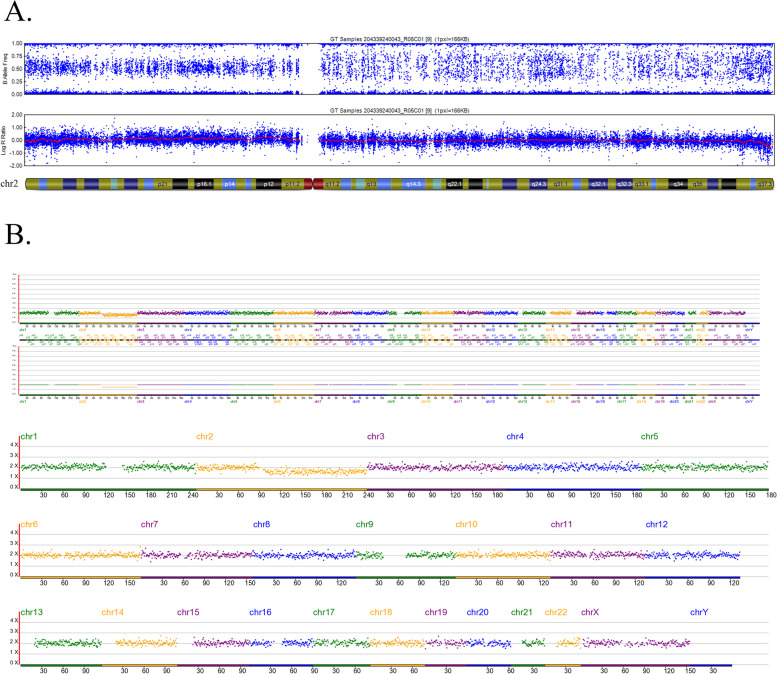
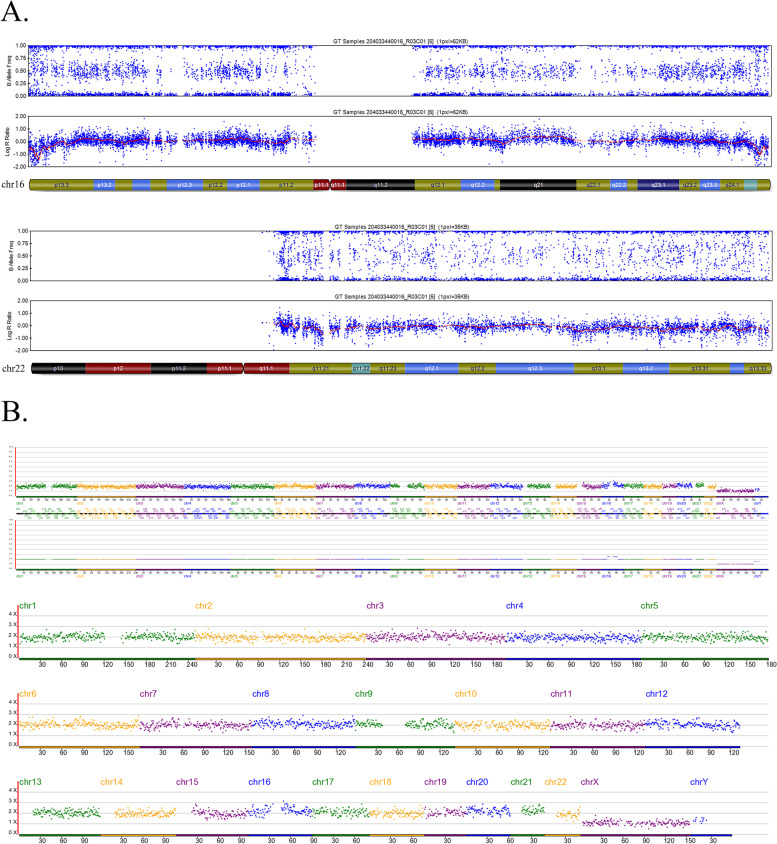
We retrospectively reviewed the data of PGT-A or preimplantation genetic testing for chromosomal structural rearrangements (PGT-SR) conducted at our center from January 2018 to October 2020, and selected blastocysts that underwent aneuploidy screening with both an SNP array and NGS. Trophectoderm biopsy, multiple displacement amplification (MDA), and aneuploidy screening with an SNP array were conducted on the enrolled blastocysts. When the SNP array indicated mosaicism, NGS was performed on the corresponding MDA product for verification. Among the 105 blastocysts diagnosed with mosaicism with the SNP array, 80 (76.19%) showed mosaicism in NGS, with complete and partial concordance rates of 47.62% (50/105) and 18.10% (19/105), respectively. The complete discordance rate of the two platforms was 34.29% (36/105). That is, 10.48% (11/105) of the blastocysts were diagnosed with completely different types of mosaicism with the two platforms, while 13.33% (14/105) and 10.48% (11/105) of the embryos diagnosed as showing mosaicism with SNP were detected as showing aneuploidy and euploidy with NGS, respectively.
The consistency of NGS and the SNP array in the diagnosis of embryo mosaicism is extremely low, indicating the need for larger and well-designed studies to determine which platform is more accurate in detecting mosaic embryos.
在胚胎植入前遗传学检测非整倍体(PGT-A)中,评估嵌合体胚胎非常重要,因为转移高水平嵌合体胚胎或丢弃低水平嵌合体胚胎都有不良影响。尽管有多种可靠的 PGT-A 技术,但比较这些技术检测嵌合体的数据却很少。为了解决文献中的这一空白,我们比较了两种最常用的 PGT-A 平台,即下一代测序(NGS)和单核苷酸多态性(SNP)阵列,用于检测嵌合体胚胎。
我们回顾性分析了我们中心 2018 年 1 月至 2020 年 10 月进行的 PGT-A 或胚胎植入前染色体结构重排遗传学检测(PGT-SR)的数据,并选择了同时进行 SNP 阵列和 NGS 非整倍体筛查的囊胚。对入组囊胚进行滋养外胚层活检、多重置换扩增(MDA)和 SNP 阵列的非整倍体筛查。当 SNP 阵列提示嵌合体时,对相应的 MDA 产物进行 NGS 验证。在 SNP 阵列诊断为嵌合体的 105 个囊胚中,80 个(76.19%)在 NGS 中显示嵌合体,完全和部分一致性率分别为 47.62%(50/105)和 18.10%(19/105)。两种平台的完全不一致率为 34.29%(36/105)。也就是说,两种平台诊断为完全不同类型嵌合体的囊胚比例为 10.48%(11/105),而 SNP 诊断为嵌合体的胚胎中,分别有 13.33%(14/105)和 10.48%(11/105)被 NGS 检测为非整倍体和整倍体。
NGS 和 SNP 阵列在胚胎嵌合体诊断中的一致性极低,表明需要进行更大规模和精心设计的研究,以确定哪种平台在检测嵌合体胚胎方面更准确。