
对豆科植物根病原体宿主适应性相关分泌蛋白组的综合评估
A Comprehensive Assessment of the Secretome Responsible for Host Adaptation of the Legume Root Pathogen .
作者信息
Kiselev Andrei, San Clemente Hélène, Camborde Laurent, Dumas Bernard, Gaulin Elodie
机构信息
Laboratoire de Recherche en Sciences Végétales (LRSV), Université de Toulouse, CNRS, UPS, Toulouse INP, 31320 Toulouse, France.
出版信息
J Fungi (Basel). 2022 Jan 17;8(1):88. doi: 10.3390/jof8010088.
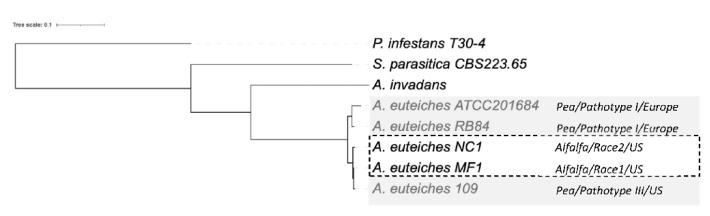
The soil-borne oomycete pathogen causes devastating root rot diseases in legumes such as pea and alfalfa. The different pathotypes of have been shown to exhibit differential quantitative virulence, but the molecular basis of host adaptation has not yet been clarified. Here, we re-sequenced a pea field reference strain of ATCC201684 with PacBio long-reads and took advantage of the technology to generate the mitochondrial genome. We identified that the secretome of is characterized by a large portfolio of secreted proteases and carbohydrate-active enzymes (CAZymes). We performed Illumina sequencing of four strains of with contrasted specificity to pea or alfalfa and found in different geographical areas. Comparative analysis showed that the core secretome is largely represented by CAZymes and proteases. The specific secretome is mainly composed of a large set of small, secreted proteins (SSP) without any predicted functional domain, suggesting that the legume preference of the pathogen is probably associated with unknown functions. This study forms the basis for further investigations into the mechanisms of interaction of with legumes.
土壤传播的卵菌病原体在豌豆和苜蓿等豆科植物中引发毁灭性的根腐病。已证明该病原体的不同致病型表现出不同程度的定量毒力,但宿主适应性的分子基础尚未阐明。在此,我们利用PacBio长读长对豌豆田间参考菌株ATCC201684进行了重测序,并借助该技术生成了线粒体基因组。我们发现该病原体的分泌蛋白组以大量分泌蛋白酶和碳水化合物活性酶(CAZymes)为特征。我们对四株对豌豆或苜蓿具有不同特异性且来自不同地理区域的该病原体菌株进行了Illumina测序。比较分析表明,核心分泌蛋白组主要由CAZymes和蛋白酶组成。特异性分泌蛋白组主要由一大组没有任何预测功能域的小分泌蛋白(SSP)组成,这表明该病原体对豆科植物的偏好可能与未知功能有关。本研究为进一步探究该病原体与豆科植物相互作用的机制奠定了基础。



 Zotero 插件