
基于小波的大规模溶酶体轨迹分析及溶酶体与纳米颗粒货物的共运动。
Large-Scale, Wavelet-Based Analysis of Lysosomal Trajectories and Co-Movements of Lysosomes with Nanoparticle Cargos.
机构信息
Center for Soft and Living Matter, Institute for Basic Science (IBS), Ulsan 44919, Korea.
Department of Biomedical Engineering, Ulsan National Institute of Science and Technology (UNIST), 50 UNIST-gil, Ulsan 44919, Korea.
出版信息
Cells. 2022 Jan 13;11(2):270. doi: 10.3390/cells11020270.
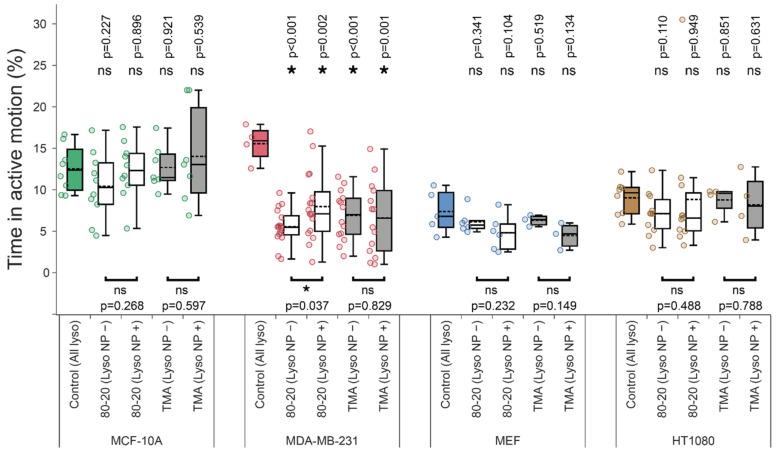
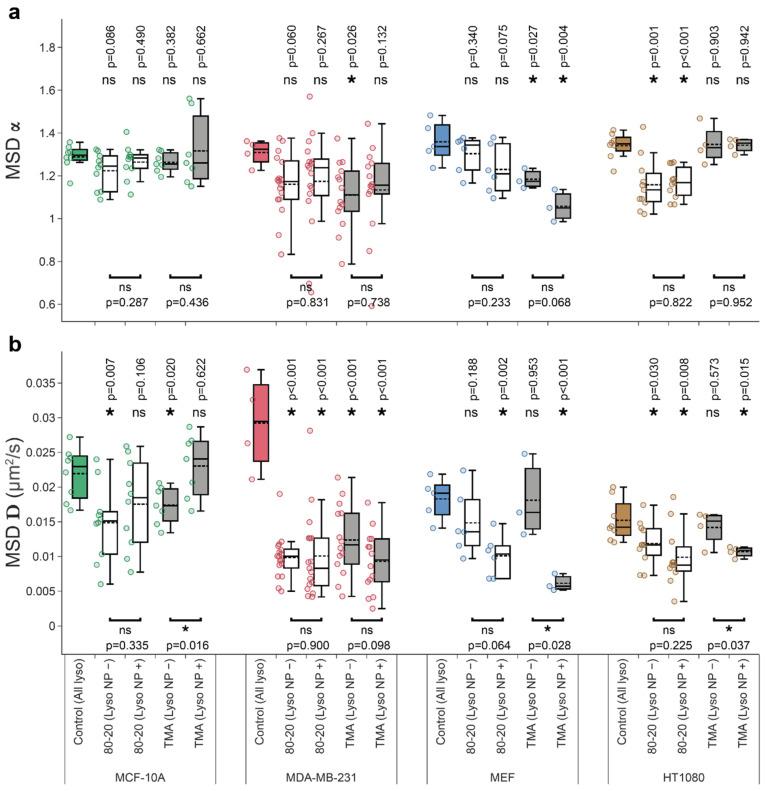
Lysosomes-that is, acidic organelles known for degradation/recycling-move through the cytoplasm alternating between bursts of active transport and short, diffusive motions or even pauses. While their mobility is essential for lysosomes' fusogenic and non-fusogenic interactions with target organelles, their movements have not been characterized in adequate detail. Here, large-scale statistical analysis of lysosomal movement trajectories reveals that lysosome trajectories in all examined cell types-both cancer and noncancerous ones-are superdiffusive and characterized by heavy-tailed distributions of run and flight lengths. Consideration of Akaike weights for various potential models (lognormal, power law, truncated power law, stretched exponential, and exponential) indicates that the experimental data are best described by the lognormal distribution, which, in turn, can be related to one of the space-search strategies particularly effective when "thorough" search needs to balance search for rare target(s) (organelles). In addition, automated, wavelet-based analysis allows for co-tracking the motions of lysosomes and the cargos they carry-particularly the nanoparticle aggregates known to cause selective lysosome disruption in cancerous cells. The methods we describe here could help study nanoparticle assemblies, viruses, and other objects transported inside various vesicle types, as well as coordinated movements of organelles/particles in the cytoplasm. Custom-written code that includes integrated workflow for our analyses is made available for academic use.
溶酶体——即那些以降解/回收为功能的酸性细胞器——在细胞质中通过活跃的运输和短暂的扩散运动或甚至停顿之间的爆发交替移动。虽然它们的流动性对于溶酶体与靶细胞器的融合和非融合相互作用至关重要,但它们的运动尚未得到充分详细的描述。在这里,对溶酶体运动轨迹进行大规模的统计分析表明,在所有被检查的细胞类型中——包括癌症和非癌症细胞——溶酶体轨迹都是超扩散的,并以运行和飞行长度的重尾分布为特征。考虑到各种潜在模型(对数正态分布、幂律分布、截断幂律分布、拉伸指数分布和指数分布)的 Akaike 权重,实验数据最好用对数正态分布来描述,反过来,对数正态分布又可以与一种空间搜索策略联系起来,当需要平衡对稀有目标(细胞器)的搜索时,这种策略特别有效。此外,自动化的、基于小波的分析可以同时跟踪溶酶体及其携带的货物(特别是纳米颗粒聚集体)的运动,这些聚集体已知会在癌细胞中引起选择性溶酶体破坏。我们在这里描述的方法可以帮助研究纳米颗粒组装体、病毒和其他在各种囊泡类型中运输的物体,以及细胞质中细胞器/颗粒的协调运动。我们的分析所包含的集成工作流程的定制编写代码可供学术使用。


 Zotero 插件