Perrin Byron M, Southon Jessica, McCaig Jane, Skinner Isabelle, Skinner Timothy C, Kingsley Michael I C
La Trobe Rural Health School, La Trobe University, Bendigo 3550, Australia.
Castlemaine Health, Castlemaine 3450, Australia.
Medicina (Kaunas). 2021 Dec 30;58(1):59. doi: 10.3390/medicina58010059.
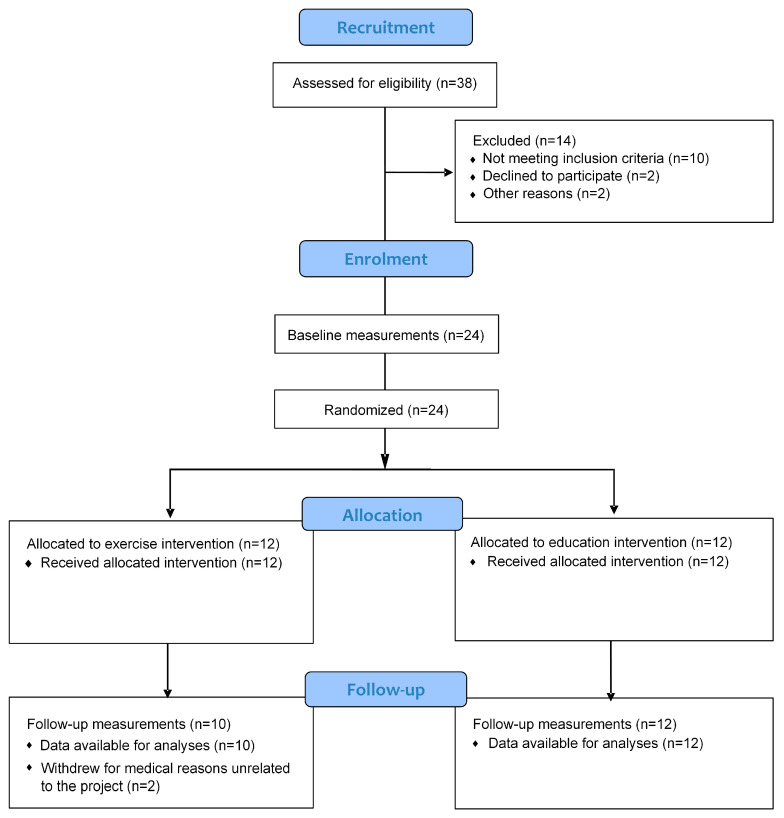
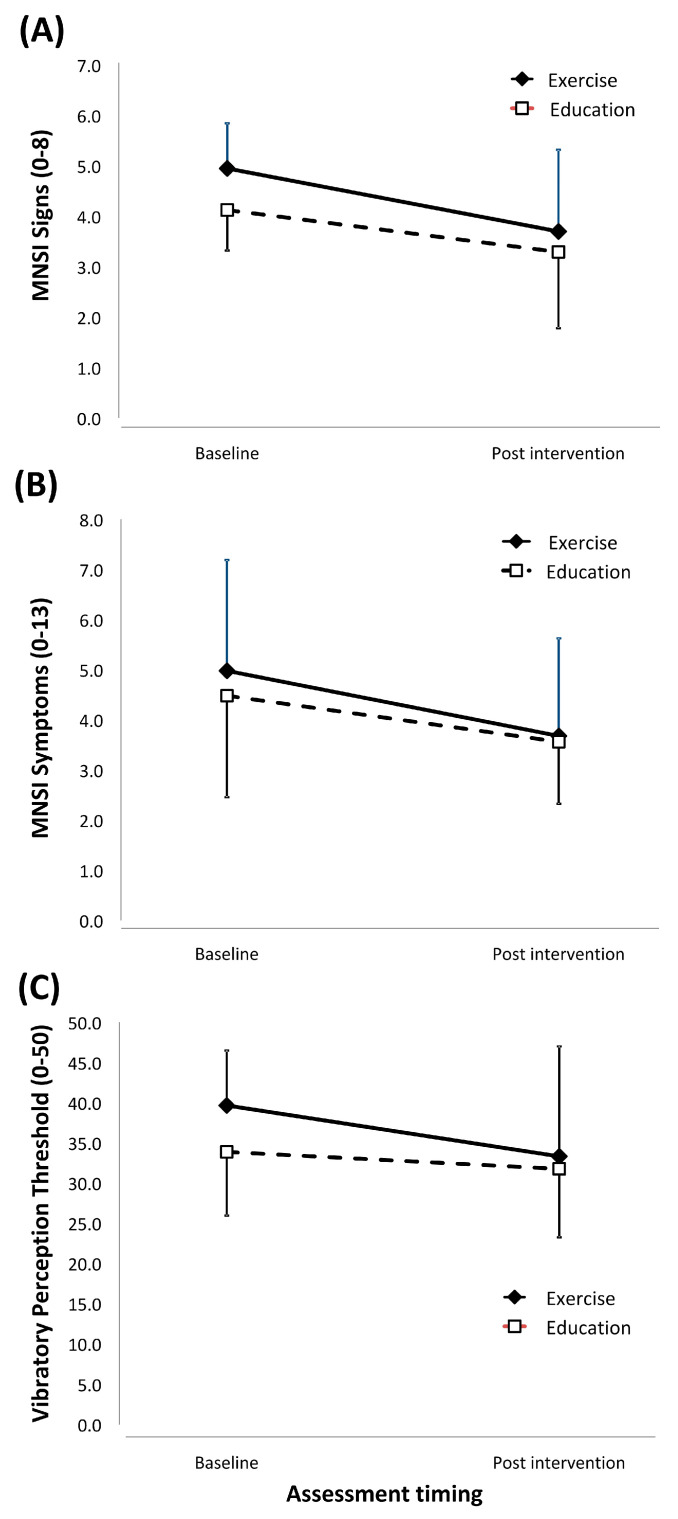
: Lifestyle interventions such as exercise prescription and education may play a role in the management of peripheral neuropathy in people with diabetes. The aim of this study was to determine the effect of undertaking an exercise program in comparison with an education program on the signs and symptoms of peripheral neuropathy in people with diabetes at risk of neuropathic foot ulceration. Twenty-four adult participants with diabetes and peripheral neuropathy were enrolled in this parallel-group, assessor blinded, randomised clinical trial. Participants were randomly allocated to one of two 8-week lifestyle interventions, exercise or education. The primary outcome measures were the two-part Michigan Neuropathy Screening Instrument (MNSI) and vibratory perception threshold (VPT). Secondary outcome measures included aerobic fitness, balance and lower limb muscular endurance. Participants in both lifestyle interventions significantly improved over time for MNSI clinical signs (MD: -1.04, 95% CI: -1.68 to -0.40), MNSI symptoms (MD: -1.11, 95% CI: -1.89 to -0.33) and VPT (MD: -4.22, 95% CI: -8.04 to -0.40). Although the interaction effects did not reach significance, changes in values from pre to post intervention favoured exercise in comparison to control for MNSI clinical signs (MD -0.42, 95% CI -1.72 to 0.90), MNSI clinical symptoms (MD -0.38, 95% CI -1.96 to 1.2) and VPT (MD -4.22, 95% CI -12.09 to 3.65). Eight weeks of exercise training or lifestyle education can improve neuropathic signs and symptoms in people with diabetes and peripheral neuropathy. These findings support a role for lifestyle interventions in the management of peripheral neuropathy.
运动处方和教育等生活方式干预可能在糖尿病患者周围神经病变的管理中发挥作用。本研究的目的是确定与教育项目相比,进行运动项目对有神经性足部溃疡风险的糖尿病患者周围神经病变的体征和症状的影响。24名患有糖尿病和周围神经病变的成年参与者被纳入了这项平行组、评估者盲法、随机临床试验。参与者被随机分配到两种为期8周的生活方式干预中的一种,即运动或教育。主要结局指标是两部分的密歇根神经病变筛查工具(MNSI)和振动觉阈值(VPT)。次要结局指标包括有氧适能、平衡和下肢肌肉耐力。两种生活方式干预的参与者在MNSI临床体征(MD:-1.04,95%CI:-1.68至-0.40)、MNSI症状(MD:-1.11,95%CI:-1.89至-0.33)和VPT(MD:-4.22,95%CI:-8.04至-0.40)方面均随时间显著改善。尽管交互作用未达到显著水平,但与对照组相比,干预前后的值变化在MNSI临床体征(MD -0.42,95%CI -1.72至0.90)、MNSI临床症状(MD -0.38,95%CI -1.96至1.2)和VPT(MD -4.22,95%CI -12.09至3.65)方面更有利于运动。八周的运动训练或生活方式教育可改善糖尿病和周围神经病变患者的神经病变体征和症状。这些发现支持生活方式干预在周围神经病变管理中的作用。