
根据一天中的时间和一周中的天数,院外心脏骤停时的公民响应者激活情况。
Citizen Responder Activation in Out-of-Hospital Cardiac Arrest by Time of Day and Day of Week.
机构信息
Copenhagen University Hospital - Copenhagen Emergency Medical Services Copenhagen Denmark.
Department of Clinical Medicine University of Copenhagen Denmark.
出版信息
J Am Heart Assoc. 2022 Feb;11(3):e023413. doi: 10.1161/JAHA.121.023413. Epub 2022 Jan 21.
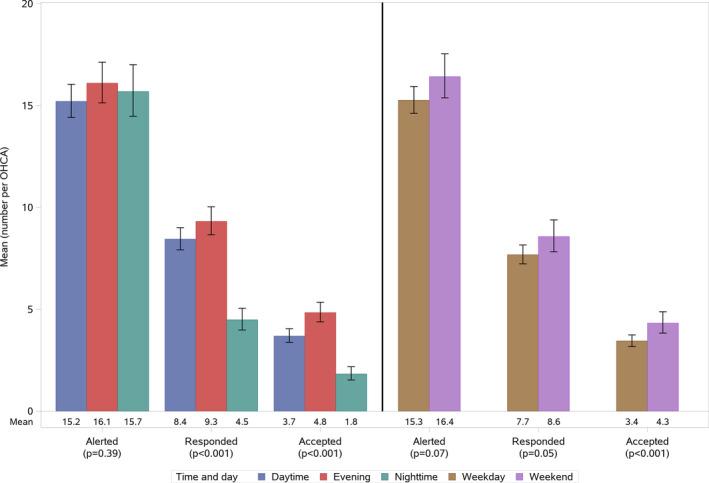
Background We aim to examine diurnal and weekday variations in citizen responder availability and intervention at out-of-hospital cardiac arrest (OHCA) resuscitation. Methods and Results We included confirmed OHCAs where citizen responders were activated by a smartphone application in the Capital Region of Denmark between September 1, 2017 and August 31, 2018. OHCAs were analyzed by time of day (daytime: 07:00 am-03:59 pm, evening: 4:00-11:59 pm, and nighttime: 12:00-06:59 am) and day of week (Monday-Friday or Saturday-Sunday/public holidays). We included 438 OHCAs where 6836 citizen responders were activated. More citizen responders accepted alarms in the evening (mean 4.8 [95% CI, 4.4-5.3]) compared with daytime (3.7 [95% CI, 3.4-4.4]) and nighttime (1.8 [95% CI, 1.5-2.2]) (<0.001), and more accepted alarms during weekends (4.3 [95% CI, 3.8-4.9]) compared with weekdays (3.4 [95% CI, 3.2-3.7]) (<0.001). Proportion of OHCAs where at least 1 citizen responder arrived before Emergency Medical Services were significantly different between day (42.9%), evening (50.3%), and night (26.1%) (<0.001), and between weekdays (37.2%) and weekends (53.5%) (=0.002). When responders arrived before Emergency Medical Services, there was no difference of bystander cardiopulmonary resuscitation or defibrillation between daytime, evening, and nighttime (=0.75 and =0.22, respectively) or between weekend and weekdays (=0.29 and =0.12, respectively). Conclusions Citizen responders were more likely to accept OHCA alarms during evening and weekends, with the highest proportion of responders arriving before Emergency Medical Services in the evening. However, there was no significant difference in delivering cardiopulmonary resuscitation or early defibrillation among cases where citizen responders arrived before Emergency Medical Services. Registration URL: https://www.clinicaltrials.gov; Unique identifier: NCT03835403.
背景 我们旨在研究院外心脏骤停(OHCA)复苏期间公民响应者的可用性和干预的昼夜和工作日变化。
方法和结果 我们纳入了 2017 年 9 月 1 日至 2018 年 8 月 31 日期间丹麦首都地区通过智能手机应用程序激活公民响应者的确诊 OHCA。OHCA 按一天中的时间(白天:上午 7:00 至下午 3:59,傍晚:下午 4:00 至晚上 11:59,夜间:晚上 12:00 至早上 6:59)和一周中的天数(周一至周五或周六至周日/公共假日)进行分析。我们纳入了 438 例 OHCA,其中有 6836 名公民响应者被激活。与白天(3.7 [95%CI,3.4-4.4])和夜间(1.8 [95%CI,1.5-2.2])相比,傍晚时更多的公民响应者接受警报(平均 4.8 [95%CI,4.4-5.3])(<0.001),并且在周末(4.3 [95%CI,3.8-4.9])接受警报的比例更高与平日(3.4 [95%CI,3.2-3.7])(<0.001)。至少有 1 名公民响应者在紧急医疗服务之前到达的 OHCA 比例在白天(42.9%)、傍晚(50.3%)和夜间(26.1%)之间存在显著差异(<0.001),在工作日(37.2%)和周末(53.5%)之间也存在显著差异(=0.002)。当响应者在紧急医疗服务之前到达时,在白天、傍晚和夜间之间,旁观者心肺复苏或除颤的差异无统计学意义(=0.75 和 =0.22,分别)或在周末和工作日之间(=0.29 和 =0.12,分别)。
结论 在傍晚和周末,公民响应者更有可能接受 OHCA 警报,并且在傍晚,到达紧急医疗服务之前的响应者比例最高。然而,在公民响应者在紧急医疗服务之前到达的情况下,进行心肺复苏或早期除颤之间没有显著差异。
注册网址


 Zotero 插件