Sonenthal Paul D, Nyirenda Mulinda, Kasomekera Noel, Marsh Regan H, Wroe Emily B, Scott Kirstin W, Bukhman Alice, Connolly Emilia, Minyaliwa Tadala, Katete Martha, Banda-Katha Grace, Mukherjee Joia S, Rouhani Shada A
Brigham and Women's Hospital, Division of Pulmonary and Critical Care Medicine, 75 Francis St, Boston, MA 02115, USA.
Harvard Medical School, 25 Shattuck St, Boston, MA 02115, USA.
EClinicalMedicine. 2022 Jan 13;44:101245. doi: 10.1016/j.eclinm.2021.101245. eCollection 2022 Feb.
Data on emergency and critical care (ECC) capacity in low-income countries (LICs) are needed to improve outcomes and make progress towards realizing the goal of Universal Health Coverage.
We developed a novel research instrument to assess public sector ECC capacity and service readiness in LICs. From January 20th to February 18th, 2020 we administered the instrument at all four central hospitals and a simple random sample of nine of 24 district hospitals in Malawi, a landlocked and predominantly rural LIC of 19·1 million people in Southern Africa. The instrument contained questions on the availability of key resources across three domains and was administered to hospital administrators and clinicians from outpatient departments, emergency departments, and inpatient units. Results were used to generate an ECC Readiness Score, with a possible range of 0 to 1, for each facility.
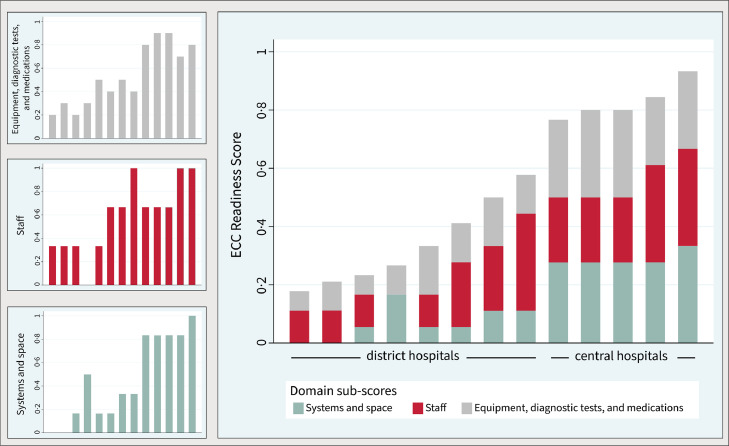
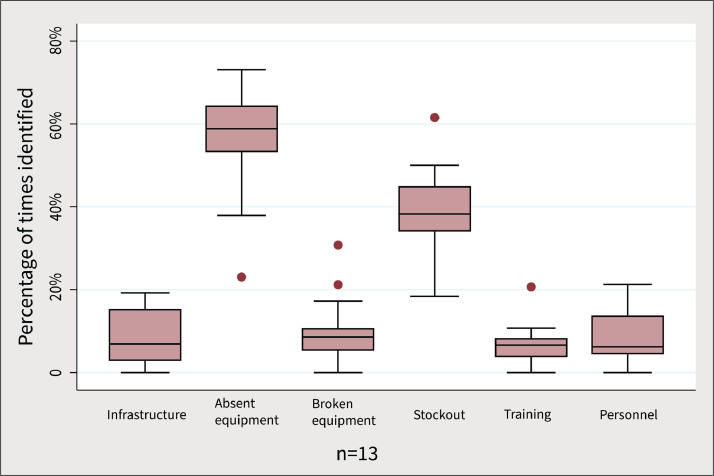
A total of 114 staff members across 13 hospitals completed interviews for this study. Three (33%) district hospitals and all four central hospitals had ECC Readiness Scores above 0·5 (-value 0·070). Absent equipment was identified as the most common barrier to ECC Readiness. Central hospitals had higher median ECC Readiness Scores with less variability 0·82 (interquartile range: 0·80-0·89) than district hospitals (0·33, 0·23 to 0·50, -value 0·021).
This is the first study to employ a systematic approach to assessing ECC capacity and service readiness at both district and central hospitals in Malawi and provides a framework for measuring ECC capacity in other LICs. Prior ECC assessments potentially overestimated equipment availability and our methodology may provide a more accurate approach. There is an urgent need for investments in ECC services, particularly at district hospitals which are more accessible to Malawi's predominantly rural population. These findings highlight the need for long-term investments in health systems strengthening and underscore the importance of understanding capacity in LIC settings to inform these efforts.
Division of Pulmonary and Critical Care Medicine, Brigham and Women's Hospital and Department of Emergency Medicine, Brigham and Women's Hospital.
低收入国家(LICs)需要有关急诊和重症护理(ECC)能力的数据,以改善治疗效果并朝着实现全民健康覆盖的目标取得进展。
我们开发了一种新颖的研究工具,以评估低收入国家公共部门的ECC能力和服务准备情况。2020年1月20日至2月18日,我们在马拉维的所有四家中心医院以及从24家地区医院中随机抽取的9家医院(马拉维是非洲南部一个内陆且主要为农村地区的国家,人口1910万)使用了该工具。该工具包含有关三个领域关键资源可用性的问题,并向医院管理人员以及门诊、急诊和住院科室的临床医生进行了调查。结果用于为每个机构生成一个ECC准备情况评分,范围为0至1。
13家医院的114名工作人员完成了本研究的访谈。三家(33%)地区医院和所有四家中心医院的ECC准备情况评分高于0.5(P值0.070)。设备缺失被确定为ECC准备情况的最常见障碍。中心医院的ECC准备情况评分中位数较高,变异性较小,为0.82(四分位间距:0.80 - 0.89),高于地区医院(0.33,0.23至0.50,P值0.021)。
这是第一项采用系统方法评估马拉维地区医院和中心医院ECC能力及服务准备情况的研究,并为衡量其他低收入国家的ECC能力提供了一个框架。先前的ECC评估可能高估了设备可用性,而我们的方法可能提供一种更准确的途径。迫切需要对ECC服务进行投资,特别是在马拉维农村人口更容易到达的地区医院。这些发现凸显了对加强卫生系统进行长期投资的必要性,并强调了了解低收入国家环境下的能力以指导这些努力的重要性。
布莱根妇女医院肺科和重症医学科以及布莱根妇女医院急诊科。