SHIP Research Group, Research Centre for Health, Glasgow Caledonian University, Cowcaddens Road, Glasgow, G4 0BA, Scotland, UK.
School of Computing, Engineering, and Built Environment, Glasgow Caledonian University, Cowcaddens Road, Glasgow, G4 0BA, Scotland, UK.
Antimicrob Resist Infect Control. 2022 Jan 24;11(1):16. doi: 10.1186/s13756-021-01049-9.
The effectiveness of hand rubbing with alcohol-based handrub (ABHR) is impacted by several factors. To investigate these, World Health Organization (WHO) commissioned a systematic review.
To evaluate the impact of ABHR volume, application time, rubbing friction and hand size on microbiological load reduction, hand surface coverage or drying time.
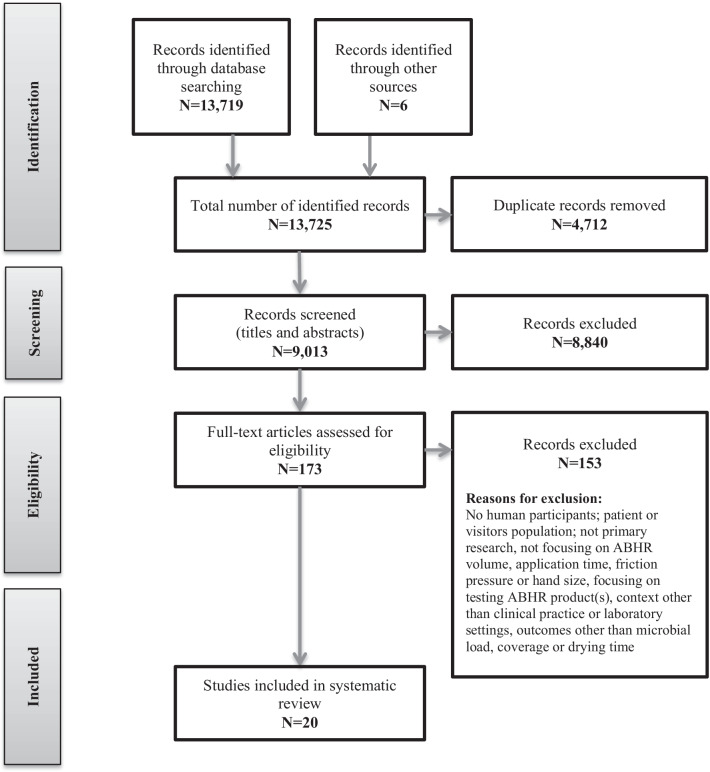
Medline, CINAHL, Web of Science and ScienceDirect databases were searched for healthcare or laboratory-based primary studies, published in English, (1980- February 2021), investigating the impact of ABHR volume, application time, rubbing friction or hand size on bacterial load reduction, hand coverage or drying time. Two reviewers independently performed data extraction and quality assessment. The results are presented narratively.
Twenty studies were included in the review. Categories included: ABHR volume, application time and rubbing friction. Sub-categories: bacterial load reduction, hand size, drying time or hand surface coverage. All used experimental or quasi-experimental designs. Findings showed as ABHR volume increased, bacterial load reduced, and drying times increased. Furthermore, one study showed that the application of sprayed ABHR without hand rubbing resulted in significantly lower bacterial load reduction than poured or sprayed ABHR with hand rubbing (- 0.70; 95%CI: - 1.13 to - 0.28). Evidence was heterogeneous in application time, volume, technique, and product. All studies were assessed as high risk of bias.
There is insufficient evidence to change WHO recommendation of a palmful of ABHR in a cupped hand applied for 20-30 s or manufacturer-recommended volume applied for about 20 s (Centers for Disease Control and Prevention). Future hand hygiene research should standardise volume, application time, and consider hand size.
酒精免洗手消毒剂(ABHR)的有效性受多种因素影响。为了研究这些因素,世界卫生组织(WHO)委托进行了一项系统评价。
评估 ABHR 用量、涂抹时间、揉搓摩擦力和手的大小对减少微生物负荷、手部表面覆盖率或干燥时间的影响。
在 Medline、CINAHL、Web of Science 和 ScienceDirect 数据库中检索了以英语发表的针对医护人员或实验室的基础研究,这些研究调查了 ABHR 用量、涂抹时间、揉搓摩擦力或手的大小对减少细菌负荷、手部覆盖或干燥时间的影响。两位评审员独立进行数据提取和质量评估。结果以叙述性方式呈现。
共纳入 20 项研究。类别包括 ABHR 用量、涂抹时间和揉搓摩擦力。子类别包括:细菌负荷减少、手的大小、干燥时间或手部表面覆盖率。所有研究均采用实验或准实验设计。结果表明,随着 ABHR 用量的增加,细菌负荷减少,干燥时间增加。此外,有一项研究表明,与手揉搓喷洒 ABHR 相比,手不揉搓喷洒 ABHR 导致的细菌负荷减少明显更低(-0.70;95%CI:-1.13 至-0.28)。在涂抹时间、用量、技术和产品方面,证据存在异质性。所有研究均被评估为高偏倚风险。
目前尚无足够证据改变 WHO 推荐的掌心一捧 ABHR 用量(在一只手的手心中),或改变推荐的涂抹时间(双手各涂抹 20-30 秒或涂抹制造商推荐的用量约 20 秒)(美国疾病控制与预防中心)。未来的手部卫生研究应标准化用量、涂抹时间,并考虑手的大小。