Urology Division, Department of Surgery, Brigham and Women's Hospital, Harvard Medical School, Boston, MA, USA.
Translational Cancer Genomics, Danish Cancer Society Research Center, Copenhagen, Denmark.
JNCI Cancer Spectr. 2021 Dec 27;6(1). doi: 10.1093/jncics/pkab097. eCollection 2022 Feb.
Altered DNA damage response (DDR) has emerged as an important mechanism for the development of aggressive prostate cancer among men of European ancestry but not other ancestry groups. Because common mechanisms for aggressive disease are expected, we explored a large panel of DDR genes and pathways to demonstrate that DDR alterations contribute to development of aggressive prostate cancer in both African American and European American men.
We performed a case-case study of 764 African American and European American men with lethal or indolent prostate cancer treated at 4 US hospitals. We calculated carrier frequencies of germline pathogenic or likely pathogenic sequence variants within 306 DDR genes, summarized by DDR pathway, and compared lethal cases against indolent cases using 2-sided Fisher's exact tests. Secondary analysis examined if carrier frequencies differed by ancestry.
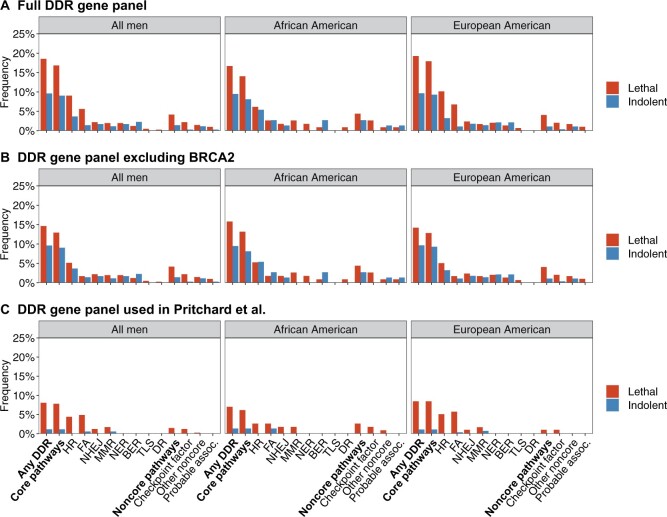
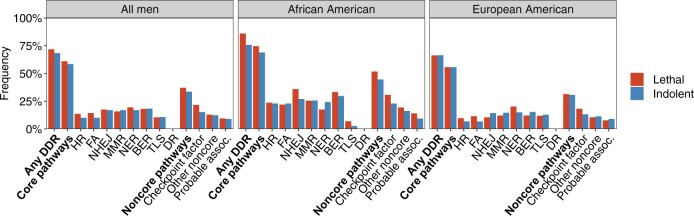
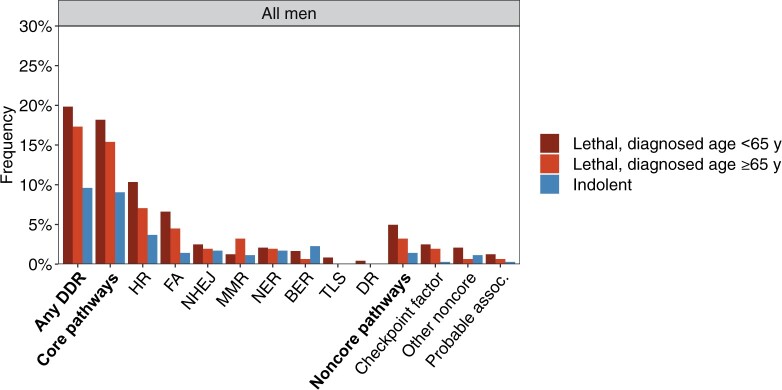
Lethal cases were more likely to carry a pathogenic sequence variant in a DDR gene compared with indolent cases (18.5% vs 9.6%, = 4.30 × 10), even after excluding (14.6% vs 9.6%, = .04). The carrier frequency was similar among lethal cases of African (16.7% including and 15.8% excluding ) and lethal cases of European (19.3% including and 14.2% excluding ) ancestry. Three DDR pathways were statistically significantly associated with lethal disease: homologous recombination ( = .003), Fanconi anemia ( = .002), and checkpoint factor ( = .02).
Our findings suggest that altered DDR is an important mechanism for aggressive prostate cancer not only in men of European but also of African ancestry. Therefore, interrogation of entire DDR pathways is needed to fully characterize and better define genetic risk of lethal disease.
改变的 DNA 损伤反应 (DDR) 已成为欧洲裔男性侵袭性前列腺癌发展的重要机制,但并非其他种族群体。由于预计会有共同的侵袭性疾病机制,我们探索了大量 DDR 基因和途径,以证明 DDR 改变有助于非裔美国人和欧洲裔美国男性侵袭性前列腺癌的发展。
我们对 4 家美国医院治疗的 764 名非裔美国人和欧洲裔美国男性致命性或惰性前列腺癌患者进行了病例对照研究。我们计算了 306 个 DDR 基因中种系致病性或可能致病性序列变异的携带者频率,按 DDR 途径进行总结,并使用双侧 Fisher 精确检验比较致命性病例与惰性病例。二次分析检查了携带者频率是否因种族而异。
与惰性病例相比,致命性病例更有可能携带 DDR 基因中的致病性序列变异(18.5%比 9.6%, = 4.30×10),即使排除了种系嵌合体(14.6%比 9.6%, = .04)。非洲裔致命性病例(包括 16.7%和排除后 15.8%)和欧洲裔致命性病例(包括 19.3%和排除后 14.2%)的携带者频率相似。三个 DDR 途径与致命性疾病具有统计学显著相关性:同源重组( = .003)、范可尼贫血( = .002)和检查点因子( = .02)。
我们的发现表明,改变的 DDR 不仅是欧洲裔男性侵袭性前列腺癌的重要机制,也是非洲裔男性侵袭性前列腺癌的重要机制。因此,需要全面研究整个 DDR 途径,以充分描述和更好地定义致命性疾病的遗传风险。