Hung Lillian, Wong Joey, Smith Chelsea, Berndt Annette, Gregorio Mario, Horne Neil, Jackson Lynn, Mann Jim, Wada Mineko, Young Erika
School of Nursing, University of British Columbia, Vancouver, BC, Canada.
Community Engagement Advisory Network, Vancouver, BC, Canada.
J Rehabil Assist Technol Eng. 2022 Jan 21;9:20556683211072385. doi: 10.1177/20556683211072385. eCollection 2022 Jan-Dec.
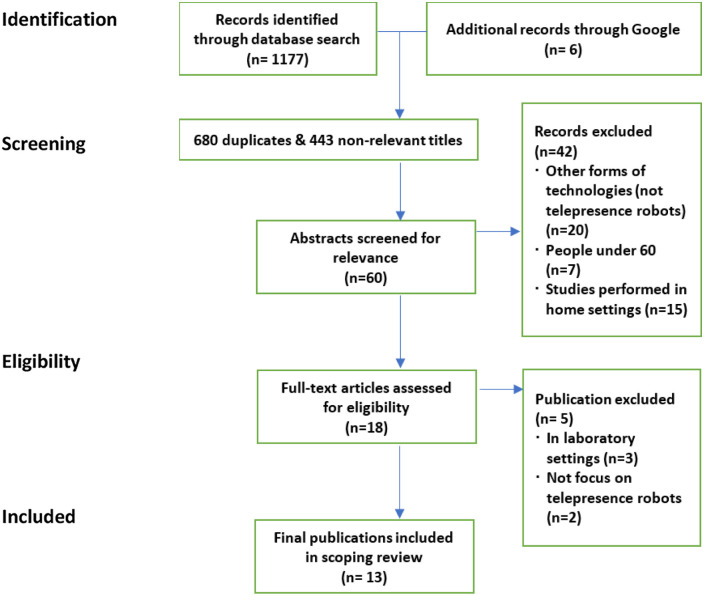
Social isolation has been a significant issue in aged care settings, particularly during the COVID-19 pandemic, and is associated with adverse outcomes, including loneliness, depression, and cognitive decline. While robotic assistance may help mitigate social isolation, it would be helpful to know how to adopt technology in aged care. This scoping review aims to explore facilitators and barriers to the implementation of telepresence robots in aged care settings. Following the Joanna Briggs Institute scoping review methodology and the PRISMA extension for scoping reviews reporting guidelines, we searched relevant peer-reviewed studies through eight databases: CINAHL, MEDLINE, Cochrane, PsychINFO (EBSCO), Web of Science, ProQuest Dissertations and Theses Global, IEEE Xplore, and ACM Digital Library. Google was used to search gray literature, including descriptive, evaluative, quantitative, and qualitative designs. Eligibility includes: studies with people aged 65 years and older who interacted with a telepresence robot in a care setting, and articles written in English. We conducted a thematic analysis to summarize the evidence based on the constructs in the Consolidated Framework of Implementation Research. Of 1183 articles retrieved, 13 were included in the final review. The analysis yielded three themes: relative advantages, perceived risks and problems, and contextual considerations. The key facilitators to telepresence robot adoption are as follows: a feeling of physical presence, ease of use, mobility, and training. The barriers to implementation are as follows: cost, privacy issues, internet connectivity, and workflow. Future research should investigate the role of leadership support in implementation and practical strategies to overcome barriers to technology adoption in aged care settings.
社交隔离一直是老年护理机构中的一个重要问题,尤其是在新冠疫情期间,并且与包括孤独、抑郁和认知衰退在内的不良后果相关。虽然机器人辅助可能有助于缓解社交隔离,但了解如何在老年护理中采用技术会很有帮助。本综述旨在探讨在老年护理机构中实施远程临场机器人的促进因素和障碍。遵循乔安娜·布里格斯研究所综述方法以及综述报告指南的PRISMA扩展版,我们通过八个数据库搜索了相关的同行评审研究:护理学与健康领域数据库(CINAHL)、医学期刊数据库(MEDLINE)、考科蓝图书馆(Cochrane)、心理学文摘数据库(PsychINFO,EBSCO)、科学引文索引数据库(Web of Science)、PQDT全球博硕士论文数据库(ProQuest Dissertations and Theses Global)、电气与电子工程师协会数据库(IEEE Xplore)和美国计算机协会数字图书馆(ACM Digital Library)。利用谷歌搜索灰色文献,包括描述性、评价性、定量和定性设计。纳入标准包括:研究对象为65岁及以上在护理机构中与远程临场机器人互动的人群,以及用英文撰写的文章。我们基于实施研究综合框架中的结构进行了主题分析以总结证据。在检索到的1183篇文章中,13篇被纳入最终综述。分析得出三个主题:相对优势、感知风险和问题以及情境因素。采用远程临场机器人的关键促进因素如下:有身临其境的感觉、易用性、移动性和培训。实施的障碍如下:成本、隐私问题、互联网连接和工作流程。未来的研究应调查领导支持在实施中的作用以及克服老年护理机构技术采用障碍的实际策略。