
长期对共生蝙蝠物种进行个体化监测揭示了冬眠物候学在物种和种群上的显著差异。
Long-term individualized monitoring of sympatric bat species reveals distinct species- and demographic differences in hibernation phenology.
机构信息
Zoological Institute and Museum, Applied Zoology and Nature Conservation, Greifswald University, Greifswald, Germany.
Department of Evolutionary Ecology, Leibniz Institute for Zoo and Wildlife Research, Berlin, Germany.
出版信息
BMC Ecol Evol. 2022 Jan 28;22(1):7. doi: 10.1186/s12862-022-01962-6.
BACKGROUND
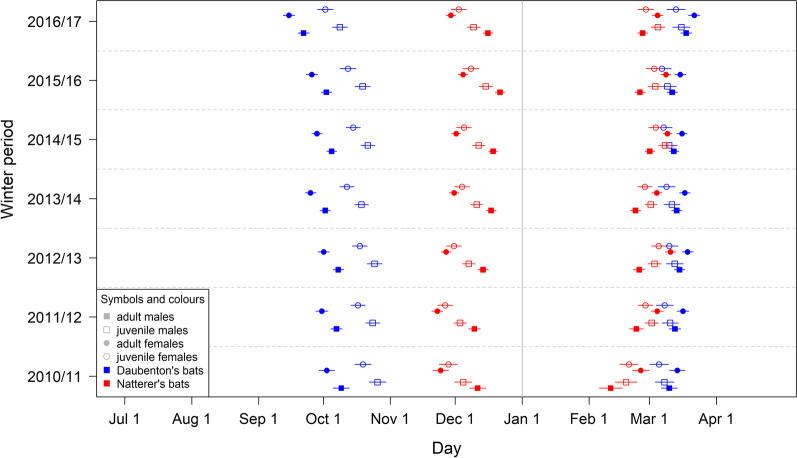
Hibernation allows species to conserve energy and thereby bridge unfavorable environmental conditions. At the same time, hibernation imposes substantial ecological and physiological costs. Understanding how hibernation timing differs within and between species can provide insights into the underlying drivers of this trade-off. However, this requires individualized long-term data that are often unavailable. Here, we used automatic monitoring techniques and a reproducible analysis pipeline to assess the individualized hibernation phenology of two sympatric bat species. Our study is based on data of more than 1100 RFID-tagged Daubenton's bats (Myotis daubentonii) and Natterer's bats (Myotis nattereri) collected over seven years at a hibernaculum in Germany. We used linear mixed models to analyze species-, sex- and age-specific differences in entrance, emergence and duration of the longest continuous period spent in the hibernaculum.
RESULTS
Overall, Daubenton's bats entered the hibernaculum earlier and emerged later than Natterer's bats, resulting in a nearly twice as long hibernation duration. In both species, adult females entered earlier and emerged from hibernation later than adult males. Hibernation duration was shorter for juveniles than adults with the exception of adult male Natterer's bats whose hibernation duration was shortest of all classes. Finally, hibernation timing differed among years, but yearly variations in entrance and emergence timing were not equally shifted in both species.
CONCLUSIONS
Our results suggest that even in sympatric species, and across sex and age classes, hibernation timing may be differentially affected by environmental conditions. This highlights the necessity of using individualized information when studying the impact of changing environments on hibernation phenology.
背景
冬眠使物种能够节约能量,从而渡过不利的环境条件。与此同时,冬眠也会带来巨大的生态和生理代价。了解物种内部和物种之间的冬眠时间差异,可以深入了解这种权衡背后的潜在驱动因素。然而,这需要个体长期数据,而这些数据通常是不可用的。在这里,我们使用自动监测技术和可重复的分析管道来评估两种同域蝙蝠物种的个体冬眠物候。我们的研究基于在德国一个冬眠地收集的超过 1100 只戴氏菊头蝠(Myotis daubentonii)和巴氏伏翼蝠(Myotis nattereri)的 RFID 标签数据,这些数据收集了七年。我们使用线性混合模型分析了种间、性别间和年龄间进入冬眠、出眠以及在冬眠地停留最长连续时间的差异。
结果
总体而言,戴氏菊头蝠比巴氏伏翼蝠更早进入冬眠,更晚出眠,导致冬眠时间几乎延长了一倍。在这两个物种中,成年雌性比成年雄性更早进入冬眠,出眠时间也更晚。除了成年雄性巴氏伏翼蝠外,幼蝠的冬眠时间比成年蝠短,而成年雄性巴氏伏翼蝠的冬眠时间是所有年龄组中最短的。最后,冬眠时间在不同年份有所不同,但两种蝙蝠的进入和出眠时间的年际变化并没有均等转移。
结论
我们的研究结果表明,即使在同域物种中,以及在性别和年龄组中,冬眠时间也可能受到环境条件的不同影响。这凸显了在研究不断变化的环境对冬眠物候学的影响时,使用个体信息的必要性。


 Zotero 插件