Department of Orthopaedic Sports Medicine, Technical University of Munich, Ismaninger Str. 22, 81675, Munich, Germany.
Arch Orthop Trauma Surg. 2023 Apr;143(4):1809-1816. doi: 10.1007/s00402-022-04344-1. Epub 2022 Jan 29.
The purpose of the present study was to compare the functional and radiographic outcomes following reverse total shoulder arthroplasty (RTSA) in a senior athletic and non-athletic population.
In this retrospective cohort study, patients who underwent RTSA between 06/2013 and 04/2018 at a single institution were included. Minimum follow-up was 2 years. A standardized questionnaire was utilized for assessment of patients' pre- and postoperative physical fitness and sportive activity. Patients who resumed at least one sport were assigned to the athletic group, while patients who ceased participating in sports were assigned to the non-athletic group. Postoperative clinical outcome measures included the Constant score (CS), American Shoulder and Elbow Surgeons (ASES) score, Simple Shoulder Test (SST), and visual analog scale (VAS) for pain. Active shoulder range of motion (ROM) and abduction strength were assessed. Radiographic evaluation was based on a standardized core set of parameters for radiographic monitoring of patients following shoulder arthroplasty.
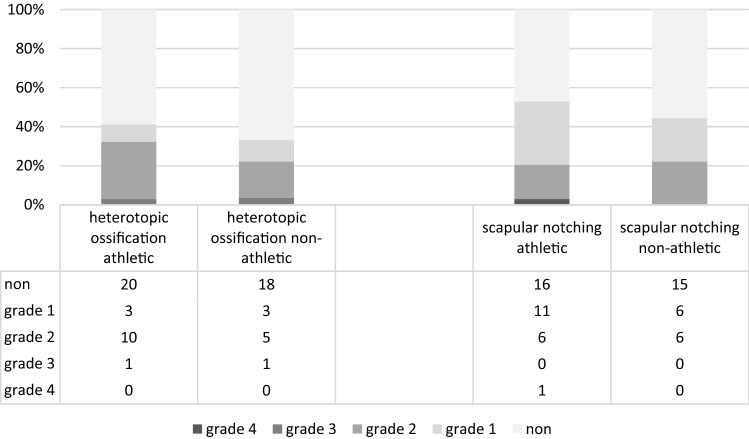
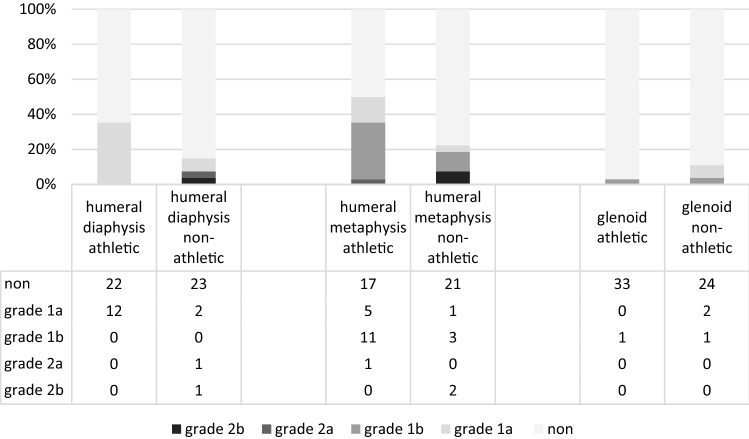
Sixty-one of 71 patients (85.9%; mean age: 72.1 ± 6.6 years) were available for clinical and radiographic follow-up at a mean of 47.1 ± 18.1 months. Thirty-four patients (55.7%) were assigned to the athletic group and 27 patients (44.3%) to the non-athletic group. The athletic group demonstrated significantly better results for CS (P = 0.002), ASES score (P = 0.001), SST (P = 0.001), VAS (P = 0.022), active external rotation (P = 0.045) and abduction strength (P = 0.016) compared to the non-athletic group. The overall rate of return to sport was 78.0% at an average of 5.3 ± 3.6 months postoperatively. Incomplete radiolucent lines (RLL) around the humeral component were found significantly more frequently in the athletic group compared to the non-athletic group (P = 0.019), whereas the occurrence of complete RLLs around the implant components was similar (P = 0.382). Scapular notching was observed in 18 patients (52.9%) of the athletic group and 12 patients (44.9%) of the non-athletic group (P = 0.51). The overall rate for revision surgery was 8.2%, while postoperative complications were encountered in 3.3% of cases.
At mid-term follow-up, the athletic population demonstrated significantly better clinical results following RTSA without a higher rate of implant loosening and scapular notching when compared to non-athletic patients. However, incomplete radiolucency around the humeral component was observed significantly more often in the athletic group.
III.
本研究的目的是比较老年运动员和非运动员行反式全肩关节置换术(RTSA)后的功能和影像学结果。
这是一项回顾性队列研究,纳入了 2013 年 6 月至 2018 年 4 月在一家机构接受 RTSA 的患者。最低随访时间为 2 年。使用标准化问卷评估患者术前和术后的身体状况和运动活动情况。恢复至少一项运动的患者被分配到运动组,而停止运动的患者被分配到非运动组。术后临床结果评估包括 Constant 评分(CS)、美国肩肘外科医师协会(ASES)评分、简易肩部测试(SST)和疼痛视觉模拟评分(VAS)。评估主动肩关节活动范围(ROM)和外展力量。影像学评估基于肩关节置换术后患者影像学监测的标准化核心参数集。
61 例 71 例患者(85.9%;平均年龄:72.1±6.6 岁)在平均 47.1±18.1 个月时接受了临床和影像学随访。34 例(55.7%)患者被分配到运动组,27 例(44.3%)患者被分配到非运动组。运动组的 CS(P=0.002)、ASES 评分(P=0.001)、SST(P=0.001)、VAS(P=0.022)、主动外旋(P=0.045)和外展力量(P=0.016)的结果明显优于非运动组。术后平均 5.3±3.6 个月时,总体重返运动的比例为 78.0%。与非运动组相比,运动组肱骨组件周围不完全透亮线(RLL)的发生率明显更高(P=0.019),而植入物组件周围完全 RLL 的发生率相似(P=0.382)。运动组 18 例(52.9%)和非运动组 12 例(44.9%)患者出现肩胛切迹(P=0.51)。总的翻修手术率为 8.2%,术后并发症发生率为 3.3%。
在中期随访中,与非运动员相比,运动组在接受 RTSA 后临床结果明显更好,且植入物松动和肩胛切迹的发生率没有增加。然而,运动组肱骨组件周围的不完全透光性明显更常见。
III 级。