de Haan Amber, Ahmadizar Fariba, van der Most Peter J, Thio Chris H L, Kamali Zoha, Ani Alireza, Ghanbari Mohsen, Chaker Layal, van Meurs Joyce, Ikram M Kamran, van Goor Harry, Bakker Stephan J L, van der Harst Pim, Snieder Harold, Kavousi Maryam, Pasch Andreas, Eijgelsheim Mark, de Borst Martin H
Division of Nephrology, Department of Internal Medicine, University of Groningen, University Medical Center Groningen, Groningen, Netherlands.
Department of Epidemiology, Erasmus Medical Center, University Medical Center Rotterdam, Rotterdam, Netherlands.
Front Cardiovasc Med. 2022 Jan 14;8:809717. doi: 10.3389/fcvm.2021.809717. eCollection 2021.
Serum calciprotein particle maturation time (T), a measure of vascular calcification propensity, is associated with cardiovascular morbidity and mortality. We aimed to identify genetic loci associated with serum T and study their association with cardiovascular disease and mortality.
We performed a genome-wide association study of serum T in 2,739 individuals of European descent participating in the Prevention of REnal and Vascular ENd-stage Disease (PREVEND) study, followed by a two-sample Mendelian randomization (MR) study to examine causal effects of T on cardiovascular outcomes. Finally, we examined associations between T loci and cardiovascular outcomes in 8,566 community-dwelling participants in the Rotterdam study.
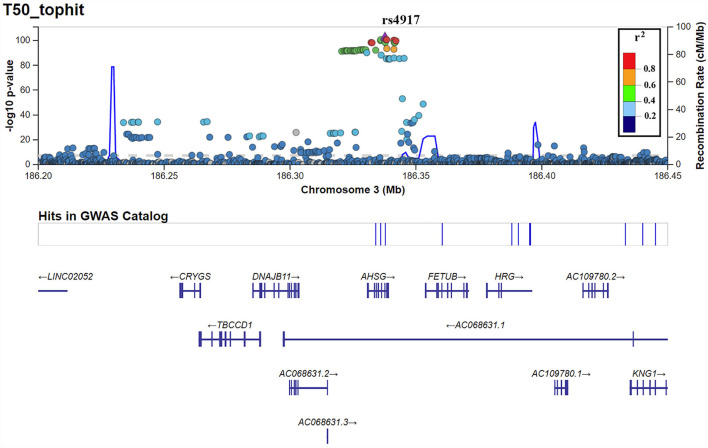
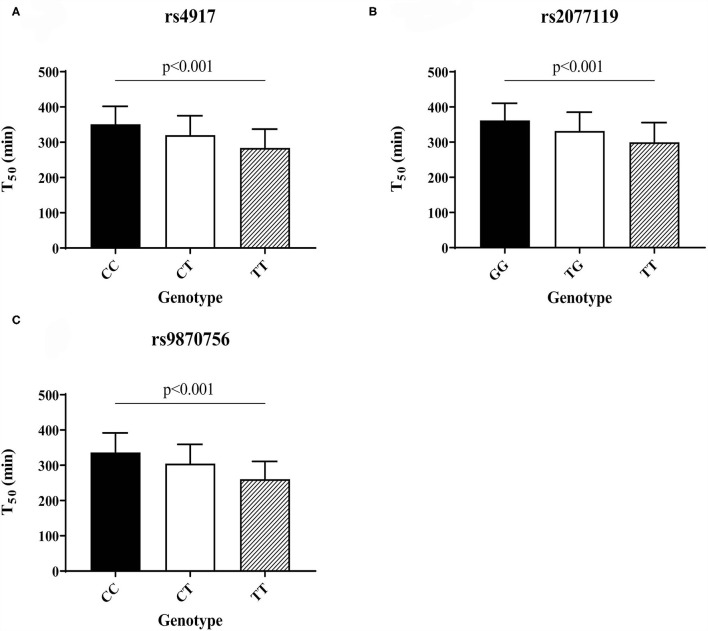
We identified three independent genome-wide significant single nucleotide polymorphism (SNPs) in the gene encoding fetuin-A: rs4917 ( = 1.72 × 10), rs2077119 ( = 3.34 × 10), and rs9870756 ( = 3.10 × 10), together explaining 18.3% of variation in serum T. MR did not demonstrate a causal effect of T on cardiovascular outcomes in the general population. Patient-level analyses revealed that the minor allele of rs9870756, which explained 9.1% of variation in T, was associated with a primary composite endpoint of all-cause mortality or cardiovascular disease [odds ratio (95% CI) 1.14 (1.01-1.28)] and all-cause mortality alone [1.14 (1.00-1.31)]. The other variants were not associated with clinical outcomes. In patients with type 2 diabetes or chronic kidney disease, the association between rs9870756 and the primary composite endpoint was stronger [OR 1.40 (1.06-1.84), relative excess risk due to interaction 0.54 (0.01-1.08)].
We identified three SNPs in the gene that explained 18.3% of variability in serum T levels. Only one SNP was associated with cardiovascular outcomes, particularly in individuals with type 2 diabetes or chronic kidney disease.
血清钙蛋白颗粒成熟时间(T)是血管钙化倾向的一种度量,与心血管疾病的发病率和死亡率相关。我们旨在确定与血清T相关的基因位点,并研究它们与心血管疾病和死亡率的关联。
我们对参与预防终末期肾病和血管疾病(PREVEND)研究的2739名欧洲血统个体的血清T进行了全基因组关联研究,随后进行了两样本孟德尔随机化(MR)研究,以检验T对心血管结局的因果效应。最后,我们在鹿特丹研究的8566名社区居住参与者中研究了T基因位点与心血管结局之间的关联。
我们在编码胎球蛋白-A的基因中鉴定出三个全基因组显著的独立单核苷酸多态性(SNP):rs4917(= 1.72 × 10)、rs2077119(= 3.34 × 10)和rs9870756(= 3.10 × 10),它们共同解释了血清T变异的18.3%。MR未显示T对一般人群心血管结局有因果效应。患者水平分析显示,rs9870756的次要等位基因解释了T变异的9.1%,与全因死亡率或心血管疾病的主要复合终点相关[比值比(95%可信区间)1.14(1.01 - 1.28)],且单独与全因死亡率相关[1.14(1.00 - 1.31)]。其他变异与临床结局无关。在2型糖尿病或慢性肾病患者中,rs9870756与主要复合终点之间的关联更强[比值比1.40(1.06 - 1.84),交互作用导致的相对超额风险0.54(0.01 - 1.08)]。
我们在该基因中鉴定出三个SNP,它们解释了血清T水平变异的18.3%。只有一个SNP与心血管结局相关,特别是在2型糖尿病或慢性肾病患者中。