Li Hai-Feng, Yu Tao, Zhu Xing-Fei, Wang Hua, Zhang Ying-Qi
Department of Orthopaedic Surgery, Tongji Hospital, School of Medicine, Tongji University, Shanghai 200065, China.
Department of Orthopaedic Surgery, Zhabei Central Hospital, Shanghai, Shanghai 200070, China.
World J Clin Cases. 2022 Jan 14;10(2):502-510. doi: 10.12998/wjcc.v10.i2.502.
Complex tibial plateau fractures can seriously affect quality of life and physical and mental health of patients. The anatomical relationship between the proximal tibial bone and soft tissue is complex, resulting in different types of tibial plateau fractures. Violent trauma can lead to displaced fracture, serious soft tissue injury, and potentially, dislocation of the knee joint. Therefore, tibial plateau fractures are extremely unstable.
To assess the use of locking compression plate (LCP) + T-type steel plate for postoperative weight bearing and functional recovery of complex tibial plateau fractures.
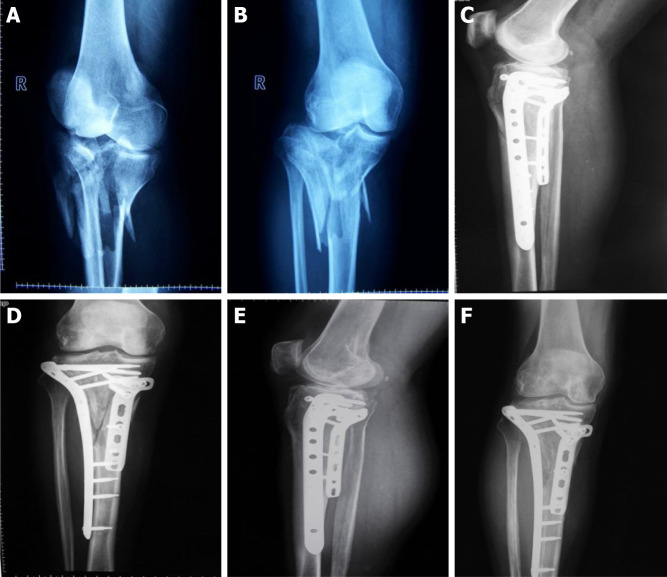
Ninety-seven patients with complex tibial plateau fractures who underwent surgery at our hospital were selected for retrospective study. Forty-nine patients had been treated with LCP + T-type steel plate limited internal fixation (study group), and 48 patients with bilateral ordinary steel plate support (control group). The operation process index, postoperative rehabilitation related index, Rasmussen score of the knee joint, tibial plateau varus angle (TPA), tibial plateau retroversion angle (PA), and surgical complications of the two groups were compared.
The operation time and intraoperative bone graft volume in the study group were lower than those in the control group ( < 0.05). There were no significant differences in surgical bleeding, anterior external incision length, postoperative drainage, hospital stay duration, and fracture healing time between the groups ( > 0.05). There was no significant difference in the TPA and PA angle between the groups immediately and 18 mo after surgery ( > 0.05). At 12 mo after surgery, the Rasmussen scale score was higher in the study group than in the control group ( < 0.05). There was no significant difference in the Rasmussen scale score at 18 mo after surgery, and the radiology score at 12 and 18 mo after surgery, between the two groups ( > 0.05). The postoperative complication rate in the study group (3.77%) was lower than that in the control group (15.09%; < 0.05).
LCP + T-type steel plate internal fixation has advantages in terms of minimizing trauma and enabling early postoperative functional exercise, promoting functional recovery and lower limb weight-bearing, and reducing postoperative complications.
复杂胫骨平台骨折可严重影响患者生活质量及身心健康。胫骨近端骨骼与软组织的解剖关系复杂,导致胫骨平台骨折类型多样。暴力外伤可导致骨折移位、严重软组织损伤,甚至膝关节脱位。因此,胫骨平台骨折极不稳定。
评估锁定加压钢板(LCP)+T型钢板用于复杂胫骨平台骨折术后负重及功能恢复的效果。
选取我院收治的97例复杂胫骨平台骨折手术患者进行回顾性研究。49例患者采用LCP+T型钢板有限内固定治疗(研究组),48例患者采用双侧普通钢板支撑治疗(对照组)。比较两组手术过程指标、术后康复相关指标、膝关节Rasmussen评分、胫骨平台内翻角(TPA)、胫骨平台后倾角(PA)及手术并发症。
研究组手术时间及术中植骨量低于对照组(P<0.05)。两组手术出血量、前外侧切口长度、术后引流量、住院时间及骨折愈合时间比较,差异无统计学意义(P>0.05)。术后即刻及术后18个月两组TPA及PA角比较,差异无统计学意义(P>0.05)。术后12个月,研究组Rasmussen评分高于对照组(P<0.05)。术后18个月两组Rasmussen评分及术后12、18个月影像学评分比较,差异无统计学意义(P>0.05)。研究组术后并发症发生率(3.77%)低于对照组(15.09%;P<0.05)。
LCP+T型钢板内固定在减少创伤、利于术后早期功能锻炼、促进功能恢复及下肢负重、降低术后并发症方面具有优势。