Columbia University Irving Medical Center, 1051 Riverside Drive, New York, NY, 10032, USA.
Columbia University, Mailman School of Public Health, 722 West 168th Street, Room 941, New York, NY, 10032, USA.
Trials. 2022 Jan 31;23(1):93. doi: 10.1186/s13063-021-05767-8.
Depression is a leading cause of disability worldwide. African American adults, compared to White adults, are half as likely to be screened for depression in primary care settings. Disparities in depression screening contribute to poor clinical outcomes, as African Americans with depression are more disabled and sicker longer compared to Whites. African American churches are trusted settings that provide access to supports for depression. Indeed, in the first study of its kind, the investigators found that 20% of adults in African American churches screened positive for depression using the Patient Health Questionnaire-9 (PHQ-9). However, no subjects with a positive screen (PHQ-9 ≥ 10) accepted a treatment referral when offered by research personnel. Community Health Workers, who are trusted paraprofessionals from the target community, may bridge the gap between depression screening and treatment. The investigators have trained and certified 112 Community Health Workers from 45 African American churches in New York City to deliver an evidence-based intervention called Screening, Brief Intervention, and Referral to Treatment (SBIRT). Thus, the aim of the current study is to test the impact of Community Health Worker-delivered depression screening in Black churches on engagement with clinical services.
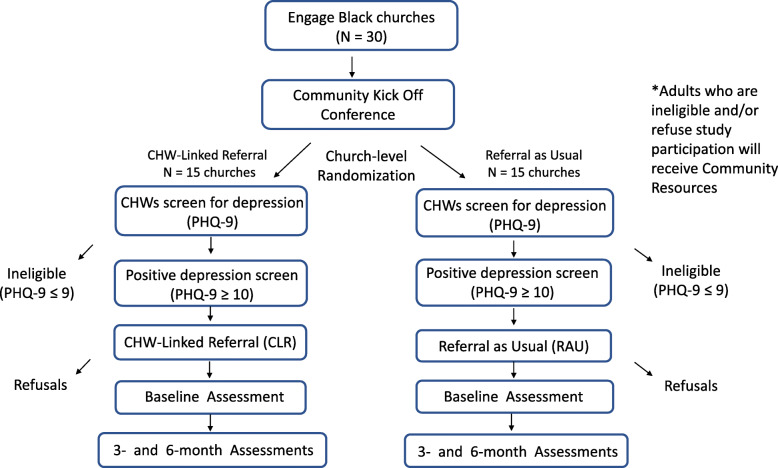
Using a hybrid type 1 effectiveness-implementation design, we propose a 2-arm, mixed-methods cluster randomized controlled trial. Church study sites will be randomized to either SBIRT (intervention arm) or referral as usual (usual care arm). This trial will be conducted with 600 church members across 30 churches (300 intervention; 300 usual care). Our primary outcome is treatment engagement, defined as attending a depression-related clinical visit. Secondary outcomes will be changes in Mental Health-Related Quality of Life and depressive symptoms at 3 and 6 months post-screening. Lastly, we will conduct a concurrent, mixed-methods (qualitative-quantitative) process evaluation to assess contextual facilitators and barriers of screening and referral.
This is the first randomized trial of a church-placed, community health worker-delivered intervention for depression in African American populations. This study may provide a novel and effective approach to increasing depression identification and treatment linkage in economically disadvantaged populations with high depression rates.
ClinicalTrials.gov NCT04524767 . Registered on 21 August 2020.
抑郁症是全球导致残疾的主要原因。与白人成年人相比,非裔美国成年人在初级保健环境中接受抑郁症筛查的可能性仅为其一半。抑郁症筛查方面的差异导致临床结局较差,因为与白人相比,患有抑郁症的非裔美国人残疾时间更长,病情更严重。非裔美国教堂是提供抑郁症支持的可信赖场所。事实上,在同类研究中,研究人员发现,使用患者健康问卷-9(PHQ-9)进行筛查,20%的非裔美国教堂的成年人筛查呈阳性。然而,当研究人员提供治疗转介时,没有一个阳性筛查(PHQ-9≥10)的患者接受了转介。社区卫生工作者是非裔美国社区中可信赖的准专业人员,他们可能会在抑郁症筛查和治疗之间架起桥梁。研究人员已经培训并认证了来自纽约市 45 个非裔美国教堂的 112 名社区卫生工作者,以提供一种名为“筛查、简短干预和转介治疗(SBIRT)”的基于证据的干预措施。因此,目前的研究旨在检验在黑人教堂中由社区卫生工作者进行的抑郁症筛查对参与临床服务的影响。
研究采用混合 1 型有效性-实施设计,提出了一项 2 臂、混合方法的聚类随机对照试验。教堂研究地点将随机分为 SBIRT(干预组)或常规转介(常规护理组)。这项试验将在 30 个教堂的 600 名教会成员中进行(干预组 300 名,常规护理组 300 名)。我们的主要结局是治疗参与度,定义为参加与抑郁症相关的临床就诊。次要结局将是在筛查后 3 个月和 6 个月时心理健康相关生活质量和抑郁症状的变化。最后,我们将进行一项同期、混合方法(定性-定量)的过程评估,以评估筛查和转介的情境促进因素和障碍。
这是一项针对非裔美国人的、在教堂进行、由社区卫生工作者提供的干预抑郁症的随机试验。这项研究可能为在经济弱势群体中增加抑郁症识别和治疗联系提供一种新颖有效的方法,这些人群的抑郁症发病率很高。
ClinicalTrials.gov NCT04524767。于 2020 年 8 月 21 日注册。