Department of Medical Laboratory, School of Medicine, Hunan Normal University, Changsha, 410013, China; Immunodiagnostic Reagents Engineering Research Center of Hunan Province, Hunan Normal University, Changsha, 410013, China.
Department of Medical Laboratory, School of Medicine, Hunan Normal University, Changsha, 410013, China; Department of Clinical Laboratory, the First People's Hospital of Chenzhou, Chenzhou, 423000, China.
J Virol Methods. 2022 Apr;302:114486. doi: 10.1016/j.jviromet.2022.114486. Epub 2022 Jan 30.
Recently, the Coronavirus Disease 2019 (COVID-19) caused by SARS-CoV-2 infection has spread rapidly around the world, becoming a new global pandemic disease. Nucleic acid detection is the primary method for clinical diagnosis of SARS-CoV-2 infection, with the addition of antibody and antigen detection. Nucleocapsid protein (NP) is a kind of conservative structural protein with abundant expression during SARS-CoV-2 infection, which makes it an ideal target for immunoassay.
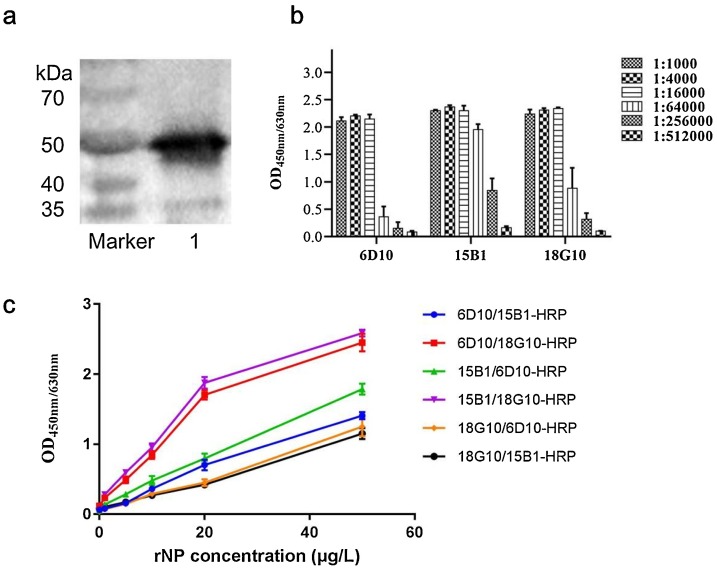
The coding sequence for SARS-CoV-2-NP was obtained by chemical synthesis, and then inserted into pET28a(+). The soluble recombinant NP (rNP) with an estimated molecular weight of 49.4 kDa was expressed in E. coli cells after IPTG induction. Six-week-old BALB/c mice were immunized with rNP, and then their spleen cells were fused with SP2/0 cells, to develop hybridoma cell lines that stably secreted monoclonal antibodies (mAbs) against NP. The mAbs were preliminarily evaluated by enzyme-linked immunosorbent assay (ELISA), and then used to develop a magnetic particle-based chemiluminescence enzyme immunoassay (CLEIA) for measurement of SARS-CoV-2-NP.
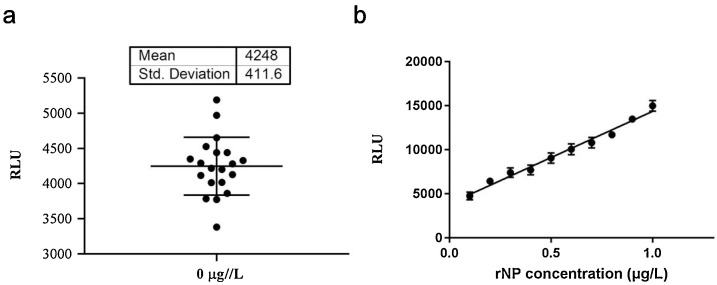
mAb 15B1 and mAb 18G10 were selected as capture and detection antibody respectively to develop CLEIA, due to the highest sensitivity for rNP detection. The proposed CLEIA presented a good linearity for rNP detection at a working range from 0.1 to 160 μg/L, with a precision coefficient of variance below 10 %.
The newly developed mAbs and CLEIA can serve as potential diagnostic tools for clinical measurement of SARS-CoV-2-NP.
由 SARS-CoV-2 感染引起的 2019 年冠状病毒病(COVID-19)最近在全球迅速传播,成为一种新的全球大流行疾病。核酸检测是临床诊断 SARS-CoV-2 感染的主要方法,此外还包括抗体和抗原检测。核衣壳蛋白(NP)是一种保守的结构蛋白,在 SARS-CoV-2 感染期间大量表达,使其成为免疫测定的理想靶标。
通过化学合成获得 SARS-CoV-2-NP 的编码序列,然后将其插入 pET28a(+)。在 IPTG 诱导下,在大肠杆菌细胞中表达了估计分子量为 49.4 kDa 的可溶性重组 NP(rNP)。用 rNP 免疫 6 周龄 BALB/c 小鼠,然后用其脾细胞与 SP2/0 细胞融合,开发稳定分泌针对 NP 的单克隆抗体(mAb)的杂交瘤细胞系。通过酶联免疫吸附测定(ELISA)对 mAb 进行初步评估,然后用于开发基于磁性粒子的化学发光酶免疫测定(CLEIA)来测量 SARS-CoV-2-NP。
mAb 15B1 和 mAb 18G10 分别被选为捕获和检测抗体,用于开发 CLEIA,因为它们对 rNP 的检测具有最高的灵敏度。所提出的 CLEIA 在 0.1 至 160 μg/L 的工作范围内对 rNP 的检测具有良好的线性,精密度变异系数低于 10%。
新开发的 mAb 和 CLEIA 可作为临床测量 SARS-CoV-2-NP 的潜在诊断工具。