National Heart and Lung Institute, Imperial College London, London, UK.
University of Nicosia Medical School, Nicosia, Cyprus.
Clin Exp Allergy. 2022 May;52(5):646-657. doi: 10.1111/cea.14103. Epub 2022 Feb 10.
Understanding risk factors for peanut allergy (PA) is essential to develop effective preventive measures.
The objective was to ascertain associates and predictors of PA, and the relationship between PA and asthma severity.
In a population-based birth cohort, we investigated the association between objectively confirmed PA with early-life environmental exposures, filaggrin (FLG)-loss-of-function mutations and other atopic disease. We then examined the association of PA with longitudinal trajectories of sensitization, wheeze and allergic comorbidities, which were previously derived using machine learning. Finally, we ascertained the relationship between PA and asthma severity.
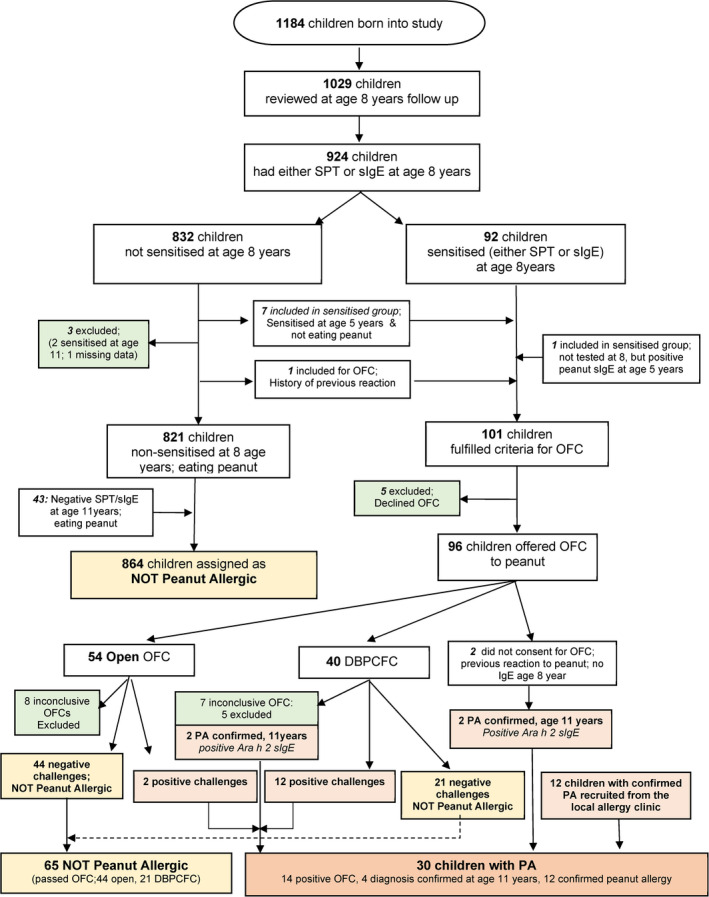
PA was confirmed in 30/959 participants with evaluable data. In the multivariate analysis, eczema in infancy (OR = 4.4, 95% CI 1.5-13.2, p = 0.007), egg sensitization at age 3 years (OR = 9.7, 95% CI 3.3-29.9, p < 0.001) and early-life cat ownership (OR = 3.0, 95% CI 1.1-8.4, p = 0.04) were independent associates of PA. In the stratified analysis among 700 participants with genetic information, in children with early-life eczema there was no difference in FLG mutations between children with and without PA (3/18 [16.7%] vs. 42/220 [19.1%], p = 1.00). In contrast, among children without eczema, those with PA were almost eight times more likely to have FLG mutations (2/6 [33.3%] vs. 27/456 [5.9%], p = 0.049). We observed associations between PA and multiple allergic sensitization profiles derived using machine learning, with ~60-fold increase in risk among individuals assigned to multiple early sensitization. PA was significantly associated with persistent wheeze (but not other wheeze phenotypes), and with trajectories of atopic disease characterized by co-morbid persistent eczema and wheeze (but not with transient phenotypes). Children with PA were more likely to have asthma, but among asthmatics we found no evidence of an association between PA and asthma severity.
Peanut allergy is associated with multiple IgE sensitization and early-onset persistent eczema and wheeze. FLG loss-of-function mutations were associated with peanut allergy in children without eczema.
了解花生过敏 (PA) 的风险因素对于制定有效的预防措施至关重要。
本研究旨在确定 PA 的相关因素和预测因素,以及 PA 与哮喘严重程度之间的关系。
在一项基于人群的出生队列研究中,我们调查了 PA 与生命早期环境暴露、丝聚蛋白(FLG)功能丧失突变和其他特应性疾病之间的关系。然后,我们使用机器学习方法检测了 PA 与纵向致敏轨迹、喘息和过敏合并症之间的关联,这些关联以前已经通过机器学习得出。最后,我们确定了 PA 与哮喘严重程度之间的关系。
在有可评估数据的 959 名参与者中,确认了 30 名 PA 患者。在多变量分析中,婴儿期湿疹(OR=4.4,95%CI 1.5-13.2,p=0.007)、3 岁时鸡蛋致敏(OR=9.7,95%CI 3.3-29.9,p<0.001)和生命早期养猫(OR=3.0,95%CI 1.1-8.4,p=0.04)是 PA 的独立相关因素。在 700 名具有遗传信息的参与者中进行的分层分析中,在有生命早期湿疹的儿童中,PA 患儿与无 PA 患儿的 FLG 突变无差异(18 例中有 3 例 [16.7%],220 例中有 42 例 [19.1%],p=1.00)。相比之下,在没有湿疹的儿童中,PA 患儿发生 FLG 突变的可能性几乎高出八倍(6 例中有 2 例 [33.3%],456 例中有 27 例 [5.9%],p=0.049)。我们观察到 PA 与使用机器学习得出的多种过敏致敏谱之间存在关联,在被分配到多种早期致敏的个体中,风险增加约 60 倍。PA 与持续性喘息显著相关(但与其他喘息表型无关),与伴有持续性湿疹和喘息的特应性疾病轨迹相关(但与一过性表型无关)。PA 患儿更容易患哮喘,但在哮喘患儿中,我们没有发现 PA 与哮喘严重程度之间存在关联的证据。
花生过敏与多种 IgE 致敏和早发性持续性湿疹和喘息有关。FLG 功能丧失突变与无湿疹儿童的花生过敏有关。